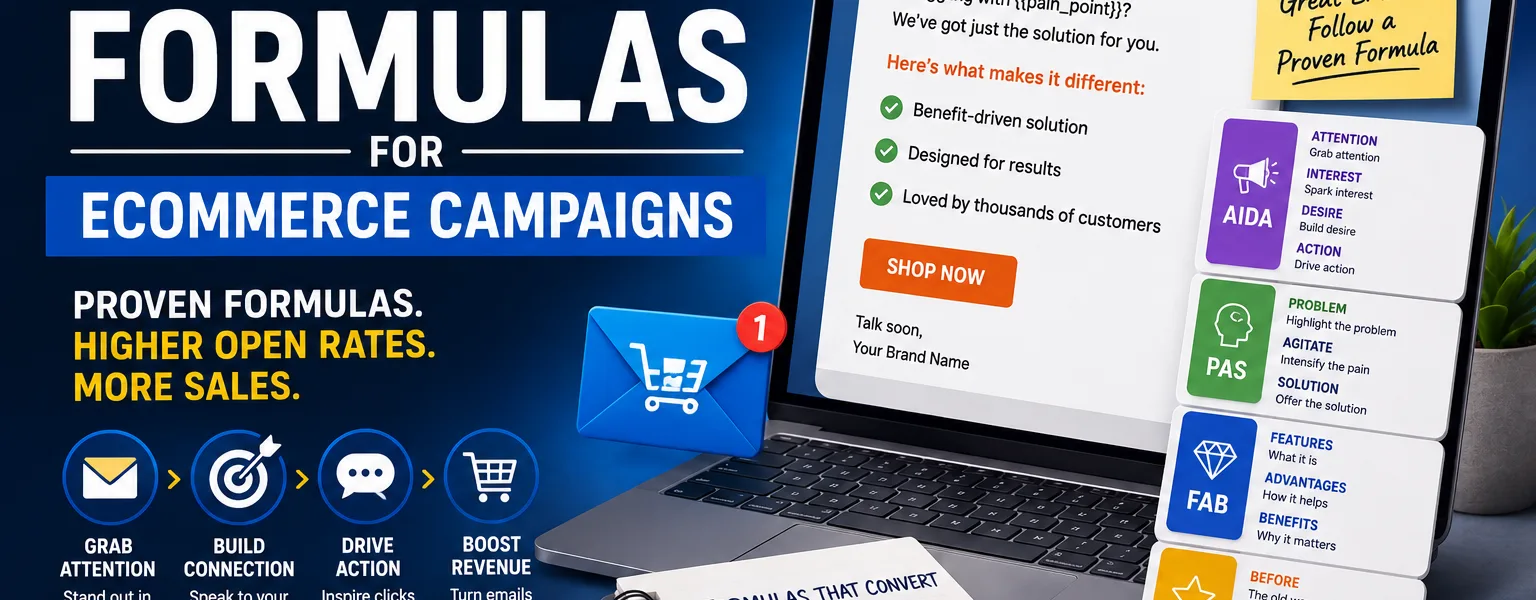
The Best Email Copy Formulas for E-commerce Campaigns
Introduction
Most e-commerce emails get deleted in under three seconds.
Not because the offer was bad. Not because the product was wrong. But because the copy was forgettable—bland sentences strung together with no structure, no pull, and no reason for the reader to care.
Here is the hard truth: great email copy does not happen by accident. The brands generating explosive revenue from their email lists are not just naturally gifted writers. They are using proven email copy formulas for e-commerce—battle-tested frameworks that trigger the right emotions, in the right order, at exactly the right moment.
And the best part? You do not need to be a professional copywriter to use them.
In this guide, you will discover the most powerful e-commerce email copywriting formulas used by 7-figure brands—with real examples, copy snippets, and plug-and-play templates you can steal and implement today.
Stop writing emails from scratch. Start building them from frameworks that convert.
Why Email Copy Formulas Work (And Why You Need Them)
Before we dive into the formulas, let us settle one thing.
Formulas are not crutches. They are not shortcuts for lazy writers. They are the product of decades of research into direct-response copywriting — frameworks built by studying what makes human beings click, buy, and act.
**Every high-converting email you have ever received was built on a formula.** The copywriter just made it look effortless.
Here is what formulas do for your e-commerce email marketing:
– They give your copy a clear emotional arc—a beginning, middle, and end that leads the reader toward one specific action
– They eliminate writer’s block—instead of staring at a blank page, you fill in a proven structure
– They are repeatable—once you master a formula, you can apply it across your welcome series, abandoned cart, flash sales, product launches, and more
– They are testable—you can A/B test two formulas against each other and let data decide which converts better for your specific audience
The e-commerce brands dominating their niches have not discovered some secret nobody else knows. They have simply committed to using the right formula for the right email—consistently.
Now, let us get into the formulas that will transform your campaigns.
Formula 1 — PAS (Problem, Agitate, Solution)
**The most versatile email copy formula in e-commerce.**
PAS is the foundation of direct response copywriting. It works because it meets your reader exactly where they are — inside their problem — before offering the escape route.
How PAS Works
**Problem:** Open by naming the specific pain your reader is experiencing. Be precise. Generic problems produce generic responses.
**Agitate:** Pour fuel on the pain. Make the problem feel more urgent, more costly, more impossible to ignore. This is where most e-commerce brands go too soft—they name the problem and immediately jump to the solution. Do not. Let the agitation breathe.
**Solution:** Present your product as the inevitable answer to the problem you just made feel unbearable.
PAS in Action — Skincare Brand Example
**Subject line:** *”Why your skin is still breaking out (and the real fix)”*
> You wash your face twice a day. You drink water. You follow every skincare tip the internet throws at you.
>
> And your skin is still breaking out.
>
> Here is what nobody is telling you: the products you are using are designed for general skin types — not yours. Every ingredient that promises to clear your skin is likely triggering the very reaction you are trying to fix.
>
> That stops today.
>
> [Product Name] is formulated for reactive skin — the skin that every generic brand gets wrong. Three weeks. Real results. Or your money back.
>
> [TRY [PRODUCT NAME] RISK-FREE →]
When to Use PAS
PAS is your go-to formula for:
– Welcome email day 3 (education + problem awareness)
– Abandoned cart recovery (the problem: they almost fixed their pain, but left)
– Flash sale announcements (the problem: paying full price when they do not have to)
– Winback campaigns (the problem: their life without your product)
—
Formula 2 — AIDA (Attention, Interest, Desire, Action)
**The classic e-commerce email marketing formula—and still one of the most powerful.**
AIDA has been the backbone of advertising copy since the 1890s. It works because it mirrors the exact psychological journey a buyer takes from being a stranger to becoming a customer.
How AIDA Works
**Attention:** Your subject line and opening line. You have one job here — stop the scroll. Make ignoring this email impossible.
**Interest:** Build curiosity and relevance. Why should your reader care about what you are about to say? Connect the offer to something they already want.
**Desire:** Make them want it. Use benefits (not features), social proof, transformation language, and sensory detail. Make the reader picture their life after the purchase.
**Action:** One clear, compelling CTA. No confusion. No multiple buttons. One direction.
AIDA in Action — Coffee Subscription Brand Example
**Subject line:** *”The morning ritual 4,000 people swear by”*
> **[A]** — There is a reason 4,000 people refuse to start their morning without this.
>
> **[I]** — Most coffee drinkers settle. They grab whatever is on the supermarket shelf, brew a pot that tastes like disappointment, and wonder why mornings feel so hard.
>
> You are not most people.
>
> **[D]** — [Product Name] is single-origin, small-batch roasted within 48 hours of your order. No sitting in a warehouse for months. No stale beans dressed up in premium packaging. Just the cleanest, richest cup you have ever poured — delivered to your door before you run out.
>
> Our subscribers call it “the upgrade that makes every other morning feel like a Monday.”
>
> **[A]** — [UPGRADE YOUR MORNING — FIRST BAG 20% OFF →]
When to Use AIDA
AIDA works brilliantly for:
– Product launch emails (build attention + desire before the buy button appears)
– Bestseller spotlight emails in your welcome sequence
– Promotional emails for new arrivals
– Re-engagement campaigns where you need to rebuild interest fast
—
Formula 3 — BAB (Before, After, Bridge)
**The transformation formula. The most emotionally powerful structure in e-commerce email copywriting.**
BAB works by painting two vivid pictures—the reader’s painful current reality and the irresistible future they could have—then positioning your product as the bridge between them.
How BAB Works
**Before:** Describe your reader’s current situation with unflinching honesty. Make them feel seen and understood. The more specific you are, the more powerful this lands.
**After:** Paint the transformation. What does life look, feel, and sound like after your product solves the problem? Use sensory language. Make the after feel real and achievable.
**Bridge:** Your product is the bridge. Introduce it naturally as the only logical path from before to after.
BAB in Action — Fitness Equipment Brand Example
**Subject line:** *”What if Monday morning felt completely different?”*
> **[Before]**
> Right now, your gym bag is collecting dust in the corner of your bedroom.
> Your workout plan lasted eleven days before life got in the way.
> And every time you walk past that bag, you feel that familiar sting — the gap between who you are and who you planned to be.
>
> **[After]**
> Imagine rolling out of bed at 6 AM — not dreading it, but actually looking forward to it. Twenty-two minutes. Your living room. No commute, no waiting for machines, no excuses. Just consistent progress that finally sticks — and a body that reflects it.
>
> **[Bridge]**
> That is exactly what [Product Name] was designed to create.
> A complete home workout system built for the schedule you actually have — not the one you wish you had.
>
> [BUILD THE HABIT THAT STICKS — SHOP NOW →]
When to Use BAB
BAB is the perfect formula for:
– Product launch emails (the transformation story)
– Browse abandonment (they were already imagining the after—remind them)
– Post-purchase onboarding (reinforce the transformation they just invested in)
– Social proof emails featuring real customer results
—
Formula 4 — The 4 Ps (Promise, Picture, Proof, Push)
**The sales-first formula. Use this when you need to convert—fast.**
The 4 Ps is a direct, conversion-focused formula designed for e-commerce emails where the goal is a purchase, not a relationship. It is particularly explosive for flash sales, limited-edition drops, and back-in-stock alerts.
How the 4 Ps Work
**Promise:** Open with a bold, specific promise. What will your reader have, feel, or experience if they act right now?
**Picture:** Make the promise vivid. Use descriptive language to paint the reader into the desired outcome.
**Proof:** Back the promise with evidence. Testimonials, reviews, numbers, before/afters, press mentions — anything that transforms your promise from a claim into a fact.
**Push:** A direct, time-sensitive call to action. The push is not polite. It is firm, clear, and urgent.
4 Ps in Action — Beauty Brand Example
**Subject line:** *”Flawless skin in 30 days — proven by 2,000 customers”*
> **[Promise]**
> Thirty days from today, your skin can look visibly clearer, smoother, and more radiant than it does right now. That is not marketing copy. That is our guarantee.
>
> **[Picture]**
> Picture waking up, looking in the mirror, and not reaching for the concealer. Running your fingers across skin that feels as good as it looks. Finally, wear your confidence as your best accessory.
>
> **[Proof]**
> Over 2,000 customers have documented their 30-day results. Here is what three of them said:
> ✅ “My skin cleared in week two. I cried.” — Sarah M.
> ✅ “The only product that has ever actually worked for me.” — Jasmine R.
> ✅ “I cancelled my dermatologist appointment. I did not need it anymore.” — Priya K.
>
> **[Push]**
> This is not available in stores. And at the current price, it will not last long.
>
> [GET YOUR 30-DAY TRANSFORMATION — LIMITED STOCK →]
When to Use the 4 Ps
The 4 Ps convert powerfully in:
– Flash sale emails (promise the deal, picture the savings, prove it with popularity, push with the deadline)
– Back-in-stock alerts (the product is back — promise, picture, prove it sold out before, push to act fast)
– VIP customer emails (exclusive early access drops)
– Review-driven product spotlight emails
—
Formula 5 — FAB (Features, Advantages, Benefits)
**The product email formula. Use this when your product needs explaining.**
FAB is the antidote to feature-dumping. Most e-commerce brands list their product specifications and call it copy. FAB teaches you to translate every feature into the advantage it creates—and then the benefit that advantage delivers.
How FAB Works
**Features:** What the product is or has — the technical reality.
**Advantages:** What the feature does — why it matters in practical terms.
**Benefits:** What the advantage means for the buyer’s life — the emotional and practical outcome they actually care about.
FAB Comparison — Wireless Earbuds
| Feature | Advantage | Benefit |
|—|—|—|
| 40-hour battery life | Charge once, use all week | Never scramble for a charger mid-run again |
| Active noise cancelling | Blocks out ambient sound | Finally focus in a noisy office or loud commute |
| IPX7 waterproof rating | Survives sweat and rain | Take your music everywhere — no exceptions |
| Instant pairing | Connects in under 2 seconds | Music starts when you are ready — not after fumbling with settings |
**The rule with FAB:** Never stop at the feature. Always push through to the benefit. Your customer does not buy the feature — they buy the transformation the benefit delivers.
When to Use FAB
FAB is essential for:
– Product launch emails where you need to explain a new or complex product
– Upgrade emails (showing why the new version is worth the switch)
– Comparison emails (your product vs a competitor or older solution)
– New arrival spotlights in post-purchase sequences
—
## Formula 6 — The Open Loop
**The curiosity formula. The most irresistible email opener in e-commerce.**
An open loop is a psychological technique that starts a story or poses a question but deliberately withholds the resolution. The human brain physically cannot tolerate unresolved loops. We are wired to seek closure, which means once you open a loop, your reader is compelled to keep reading until you close it.
How to Use Open Loops in E-commerce Email
Open your email with a statement, story, or question that creates an irresistible information gap:
> *”Three months ago, we almost discontinued this product. Today it has a 900-person waitlist. Here is what happened.”*
> *”A customer emailed us last week with a result that stopped our entire team in their tracks.”*
> *”Most skincare brands would never tell you this about their own ingredients. We are going to.”*
The open loop works because your reader’s brain immediately generates the question, “What happened? What did they say? What are you going to tell me?”* — and they keep reading to find out.
**Close the loop with your product story or a customer result, or reveal your subject line promise.** Never leave a loop open without delivering the payoff — that is the fastest way to lose trust.
When to Use Open Loops
Open loops are game-changing as
– Subject lines (the email IS the resolution)
– Email openers (the rest of the email resolves the loop)
– Product teasers in pre-launch sequences
– The P.S. line in any email (open a new loop that drives a click)
—
How to Choose the Right Formula for Every Email
Here is your quick-reference guide to matching the right formula to every email in your sequence:
| Email Type | Best Formula | Why |
|—|—|—|
| Welcome Email 1 | AIDA | Grabs attention, builds desire from day one |
| Welcome Email 3 | PAS | Problem-aware stage — meets them in their pain |
| Abandoned Cart | PAS or BAB | Agitate the pain of not having it |
| Flash Sale | 4 Ps | Direct, proof-heavy, urgency-driven |
| Product Launch | BAB or AIDA | Transformation story builds desire before the buy |
| Post-Purchase | FAB | Reinforce their decision with benefits |
| Winback | PAS or BAB | Remind them of the before they returned to |
| Back-in-Stock | 4 Ps | Urgency + proof (it sold out before) |
| Browse Abandonment | Open Loop + BAB | Start with curiosity, close with transformation |
| VIP / Loyalty | AIDA | Make exclusivity feel earned and irresistible |
—
Frequently Asked Questions
**What is the best email copy formula for e-commerce?**
There is no single best formula—the right formula depends on the goal of the email. PAS works brilliantly for problem-aware audiences, like abandoned cart and winback emails. AIDA is ideal for product launches and bestseller spotlights. The 4 Ps are your most powerful formula when you need an immediate purchase. Master all of them, and you will have a formula for every situation.
**How do I use email copywriting formulas without sounding formulaic?**
The key is to inject your brand voice into every element of the formula. The structure is the skeleton—your voice, your product, and your customer’s specific language are the flesh. Use real customer reviews and testimonials to fuel your agitation and desire sections. When the words feel authentically human, no reader can detect the formula underneath.
**Can I mix email copy formulas in one email?**
Absolutely—and the best e-commerce email copywriters do it constantly. A common powerful combination is opening with an open loop to create curiosity, using PAS for the body, and closing with the push from the 4 Ps for the CTA. The formula is a guide, not a rigid script.
**How long should an e-commerce email be when using these formulas?**
Match the length to the temperature of your audience. Cold or new subscribers need shorter emails—150 to 250 words—to earn attention before demanding it. Warm subscribers who trust your brand can handle 300 to 500 words. Last-chance and urgency emails should always be short — under 200 words. The formula does not dictate length. The goal does.
**Do email copy formulas work for every e-commerce niche?**
Yes — because all formulas are built on human psychology, not industry specifics. The same loss aversion that drives a fashion brand’s abandoned cart conversion drives a pet supplement brand’s winback email. The emotions are universal. Your job is to apply the formula to the specific language, desires, and fears of your niche audience.
—
Conclusion
The e-commerce brands winning the inbox war are not the ones with the biggest budgets or the most creative teams.
They are the ones who understand that every email needs a structure — a proven emotional arc that takes the reader from where they are to where your product needs them to be.
PAS for the pain-aware audience. AIDA for the product launch. BAB for the transformation story. The 4 Ps for fast sale. FAB for the feature-heavy product. Open loops for the irresistible opener.
Master these six formulas, and you will never write a flat, forgettable e-commerce email again.
And if you want these formulas applied to your specific store — with copy built for your audience, your products, and your revenue goals — that is exactly what I do at **blogwithjawed.com**. Let us turn your email list into your most powerful sales channel.