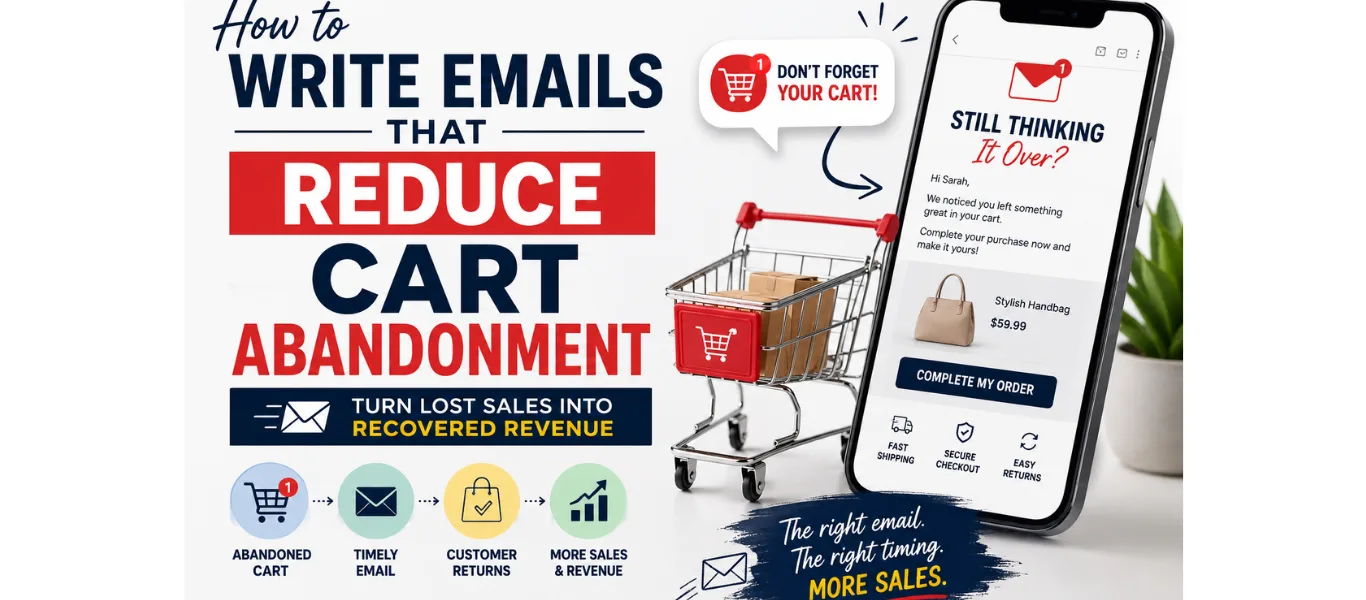
How to Write Emails That Reduce Cart Abandonment
Introduction
75.38% of shoppers abandon their cart before buying.
Let that sink in for a second. Three out of every four people who add your products to their cart—people who were close enough to purchase—walk away without spending a single dollar.
That is not just a frustrating statistic. That is your revenue, evaporating quietly, every single day.
And here is what makes it worse: most e-commerce brands respond to cart abandonment with one flat, forgettable email that says, “You left something behind!”—and then wonder why recovery rates are embarrassingly low.
The truth? Cart abandonment emails are the single highest-converting automation in e-commerce. Done right, they achieve 41.18% open rates and convert at 50% when opened — recovering up to 30% of your lost revenue on autopilot.
But only if you write them correctly.
In this guide, you will discover the proven, step-by-step system to write cart abandonment emails that pull shoppers back, crush hesitation, and turn abandoned carts into completed orders—with real copy templates you can steal and implement today.
Why 75% of Your Shoppers Abandon Their Carts — And Why It Is Not What You Think
Before you write a single word of cart recovery copy, you need to understand *why* your shoppers left.
Because here is the game-changing insight most brands miss: **not all cart abandoners are the same.** And sending the same generic email to every single one of them is why your recovery rates stay stuck.
According to Baymard Institute research, the top reasons shoppers abandon carts are:
– **39%** — Unexpected extra costs (shipping, taxes, fees)
– **24%** — Forced account creation before checkout
– **22%** — Slow or complicated checkout process
– **18%** — Not trusting the site with their payment details
– **17%** — Website errors or crashes during checkout
– **43%** — Simply browsing, not ready to buy yet
Notice something? Three of those top six reasons are friction problems — not interest problems. Your shopper *wanted* to buy. Something got in the way.
**Your cart abandonment email copy needs to address the specific friction—not just remind them they left something behind.**
This is the critical distinction between a cart recovery email that converts and one that gets ignored. When you write to the real reason someone left, your email feels personal, relevant, and irresistible. When you write generically, it feels like spam.
The Proven 3-Email Cart Abandonment Sequence That Recovers Lost Sales
One email is not a strategy. It is a starting point.
Omnisend data proves this conclusively: **a three-message cart abandonment series generates 24.94 orders compared to just 14.76 from a single email.** That is 69% more revenue from the same traffic — just by sending the right emails in the right sequence.
Here is the exact 3-email cart abandonment sequence that works:
Email 1 — The Gentle Reminder (Send Within 30–60 Minutes)
**Goal:** Recapture attention without pressure. Most abandoners at this stage simply forgot or got distracted.
Sending your first email within one hour of abandonment boosts conversions by 20%. Your shopper is still warm. Their purchase intent is still high. This is not the moment to push hard — it is the moment to simply show up.
**What to include:**
– Product image — show them exactly what they left
– Product name and price — no hunting required
– One clear CTA button — “Return to Your Cart.”
– Zero pressure, zero urgency—this is a friendly nudge
**Steal-worthy subject lines for Email 1:**
– *”Did you forget something, [First Name]?”*
– *”Your cart is waiting—we saved it for you.”*
– *”[Product Name] is still in your cart 👀”*
– *”Need more time? Your cart is still here (for now).”*
**Plug-and-play copy template:**
**Subject:** Your cart is waiting — we saved it for you
**Preview text:** One click and you are right back where you left off.
—
Hey [First Name],
Looks like you left something behind.
Your [Product Name] is still sitting in your cart — and we wanted to make sure you did not miss it.
No pressure at all. We just saved it for you so you can pick up exactly where you left off.
**[RETURN TO MY CART →]**
Talk soon,
[Your Name] at [Brand Name]
P.S. Got a question before you order? Just reply to this email—we are real humans, and we actually respond.
—
**Why this converts:** The P.S. line is a secret weapon. Inviting questions removes the barrier of uncertainty and instantly builds trust. Shoppers who were hesitating due to product questions now have a direct line — and that feels irresistible.
—
Email 2 — The Trust Builder (Send 24 Hours Later)
**Goal:** Address the real objection. Rebuild confidence. This email does the heavy lifting.
By now, your shopper did not buy from Email 1. Something is holding them back. Email 2 identifies and destroys that objection — using social proof, your guarantee, and a genuine human voice.
**Apply the PAS formula here:**
**Problem:** They hesitated for a reason.
**Agitate:** Every day without your product is another day with the problem it solves.
**Solution:** Here is why other customers made the leap — and why you should too.
**Steal-worthy subject lines for Email 2:**
– *”Still thinking it over? Here is what our customers say:”*
– *”We get it — here is why 2,000 customers said yes.”*
– *”Your biggest question about [Product] — answered”*
– *”This is the part that usually makes people decide.”*
**Plug-and-play copy template:**
—
**Subject:** Still thinking it over? Here is what finally made them decide.
**Preview text:** Real words from real customers who almost did not buy either.
—
[First Name],
You are not alone.
Most of our customers spent time thinking before they ordered. And they all had the same question you probably have right now:
*”Is this actually going to work for me?”*
Here is what three of them said after they took the leap:
✅ *”I was skeptical at first — but the results after two weeks completely changed my mind.”*
— Sarah M., Verified Buyer
✅ *”Best purchase I have made this year. Wish I had not waited so long.”*
— James K., Verified Buyer
✅ *”I almost talked myself out of it. So glad I didn’t.”*
— Priya L., Verified Buyer
Still not sure? Here is our promise: if [Product Name] does not deliver, we will make it right. [Your guarantee — free returns / full refund / exchange].
No risk. No hassle. No reason to wait.
**[COMPLETE MY ORDER — RISK FREE →]**
[Your Name]
—
**Why this converts:** Personalization increases CTR by 41%. This email makes the shopper feel seen — not sold to. The testimonials do the selling. Your guarantee removes the final barrier.
—
Email 3—The Urgency Close (Send 48–72 Hours After Abandonment)
**Goal:** Create genuine, ethical urgency. Make waiting feel costly.
This is your last touch. Keep it short — under 200 words. The brevity signals urgency better than any countdown timer. Apply the 4 Ps formula: **Promise, Picture, Proof, Push.**
**Steal-worthy subject lines for Email 3:**
– *”Last chance—your cart expires tonight.”*
– *”⏰ Only [X] left in stock—just so you know.”*
– *”[First Name], this is the last email about your cart.”*
– *”Your [Product Name] is almost gone.”*
– *”We cannot hold this much longer.”*
**Plug-and-play copy template:**
—
**Subject:** [First Name], your cart expires tonight
**Preview text:** After tonight, we cannot guarantee stock.
—
[First Name] — keeping this short.
Your [Product Name] is still in your cart, but we cannot hold stock indefinitely.
**[Promise]** At [Brand Name], we cap every order cycle to guarantee quality. When stock is gone — it is gone.
**[Picture]** Imagine finally having [core product benefit] without [core product problem]. That is what is waiting for you right now.
**[Proof]** Over [X] customers made this decision this month alone. Here is what they said: *”[One punchy testimonial]”*
**[Push]** Your cart clears at midnight. After that, we start fresh.
**[CLAIM MY [PRODUCT NAME] NOW →]**
This is the last email I will send about this. Promise.
[Your Name]
—
The 7 Urgency Triggers That Make Cart Abandonment Emails Irresistible
Urgency is not a countdown timer slapped at the bottom of an email. **Urgency is an emotion—and your copy needs to engineer it.**
These are the seven most powerful urgency triggers to weave into your cart abandonment email sequence:
1. Stock Scarcity With Real Numbers
*”Only 3 left in your size”* hits differently than *”limited stock available.”* Specific numbers are believable. Vague scarcity is ignored. **Always use real numbers — never fabricate stock levels.** Fake scarcity destroys trust permanently.
2. Time-Based Deadlines With Specific Times
*”Your cart expires at midnight tonight”* is a hard deadline the brain respects. *””Expires soon”* is procrastination permission. Always include the specific time and timezone.
3. Price Anchoring — The Return Price Reminder
*”After tonight, this returns to $89″* activates loss aversion instantly. Your shopper is not just gaining a product—they are about to lose $22 if they do not act. Frame every deadline as a loss, not a gain.
4. Social Proof With Real-Time Signals
*”47 people are looking at this right now”* or *”200 customers bought this this week”* creates FOMO at a primal level. The herd instinct kicks in, and your shopper does not want to be the person who missed out.
5. The Personal Objection Crusher
Address the single most likely reason they left—by name. *”If it is the shipping cost that stopped you — here is your free shipping code.”* This level of specificity feels like a conversation, not a broadcast.
6. The Exclusive Subscriber Offer
*”This discount is for subscribers only — it is not on the website.”* VIP language makes your shopper feel chosen. Chosen people act.
7. Consequence-Framing
Most emails tell customers what they gain. **The most converting cart abandonment emails tell customers what they lose.** *”Every day without [Product] is another day with [Problem].”* Consequence-framing activates loss aversion — the most powerful buying trigger in human psychology.
Cart Abandonment Email Subject Lines That Skyrocket Open Rates
According to TargetBay research, 69.87% of abandoned cart subject lines are non-conversion focused — they lack urgency and specific offers. Here is how you obliterate that average:
**The 5 top-performing subject line formats:**
**1. The Direct Reminder (simple, warm)**
– *”You left something behind, [First Name]”*
– *”Your cart is still waiting”*
– *”[Product Name] is reserved for you”*
**2. The Curiosity Hook (open loop)**
– *”We noticed something — thought you should know”*
– *”Your cart just sent us a message”*
– *”Something is different about your order today”*
**3. The Social Proof Lead**
– *”Here is what 3,000 customers said before they ordered”*
– *”The review that changes everything”*
– *”They almost did not buy either”*
**4. The Urgency + Scarcity**
– *”Only 2 left — just so you know, [First Name]”*
– *”Cart expires at midnight — no exceptions”*
– *”Stock update on your saved items”*
**5. The Objection Crusher**
– *”Worried about the price? Read this”*
– *”Free shipping — for the next 24 hours”*
– *”Your biggest question answered inside”*
The BAB Formula Applied — A Complete Cart Abandonment Email
Here is the Before, After, Bridge formula applied to a full cart recovery email—showing exactly how transformation copy outperforms reminder copy:
**Subject:** *”What changes when you stop settling”*
**[Before — the pain they are living right now]**
> Right now you are dealing with [specific problem your product solves].
> You have tried other solutions. Some helped a little. None fixed it.
> And so the problem stays — quietly draining your energy, your time, your confidence.
**[After — the life they want]**
> Picture waking up tomorrow and [core transformation your product delivers].
> Not someday. Tomorrow — if you complete the order you started today.
**[Bridge — your product is the only logical path between the two]**
> [Product Name] was built specifically for this moment — for the person who is tired of almost fixing the problem.
>
> It is still in your cart. It is still the same price. And it is still waiting for you.
**[FINISH MY ORDER AND START TOMORROW →]**
5 Cart Abandonment Email Mistakes That Are Killing Your Recovery Rate
Even with the right sequence, these mistakes silently sabotage your results:
Mistake 1 — Sending to Your Full List**
Only send cart abandonment emails to engaged subscribers. Blasting your entire list destroys deliverability and spikes spam complaints. Use Klaviyo segmentation to target recent, engaged subscribers only.
Mistake 2 — One Email and Done**
One email yields 14.76 recovered orders on average. Three emails yield 24.94. You are leaving 69% of your potential recovery revenue untouched by stopping at one.
Mistake 3 — Generic Subject Lines**
You left something in your cart”* is the most forgettable subject line in ecommerce. It says nothing specific, creates no urgency, and triggers no emotion. Use the subject line formats above instead.
Mistake 4 — No Product Image**
Your shopper needs to see what they left behind the moment they open the email. A clear, beautiful product image triggers the desire they felt when they first added it to their cart. Without it, the email is just words.
Mistake 5 — Multiple CTAs**
One email. One goal. One button. *”Browse our collection”*, *”See more products”*, and *”Complete your order”* in the same email dilutes focus and tanks click rates. Every cart abandonment email gets one CTA and one CTA only.
Frequently Asked Questions
How many cart abandonment emails should I send?**
Three is the proven sweet spot. Send the first within 30–60 minutes, the second at 24 hours, and the third at 48–72 hours. Omnisend data shows a three-email sequence generates 69% more orders than a single email. Sending more than three starts to feel aggressive and drives unsubscribes.
When is the best time to send a cart abandonment email?**
Your first email should go out within 30–60 minutes of abandonment — this is when purchase intent is highest. Sending within one hour boosts conversions by 20%. For subsequent emails, match your send time to when your audience is most active — typically mid-morning or early evening in their timezone.
Should I offer a discount in my cart abandonment emails?**
Not in Email 1. Start with a reminder and social proof. Reserve the discount for Email 3 if the shopper has not converted. Leading with a discount immediately trains your audience to abandon carts on purpose to wait for the offer — which crushes your margins over time.
What is a good cart abandonment email recovery rate?**
Most ecommerce brands recover 10–30% of abandoned carts depending on strategy and execution. Cart recovery emails achieve 41.18% open rates on average — significantly higher than standard marketing emails. If your open rate is below 30%, focus on subject line testing first.
How do I set up cart abandonment emails in Klaviyo?**
In Klaviyo, create a Flow triggered by the “Started Checkout” event. Set the filter to exclude anyone who has placed an order since the trigger. Add three emails at 1 hour, 24 hours, and 72 hours respectively. Use dynamic blocks to pull in the abandoned product name, image, and price automatically. Enable smart sending to avoid over-emailing active subscribers.
Conclusion
Cart abandonment is not a failure. It is an opportunity — the closest signal in ecommerce that a shopper is ready to buy.
Three out of four shoppers leave without purchasing. But with the right 3-email sequence, the right urgency triggers, and copy built on proven formulas — PAS, BAB, the 4 Ps — you can recover up to 30% of that lost revenue automatically.
Send Email 1 within an hour. Make it warm and frictionless. Use Email 2 to crush the real objection with social proof. Close with Email 3 — short, urgent, consequence-framed, and impossible to ignore.
Your next recovered sale is already sitting in your Klaviyo flow. It just needs the right words behind it.
And if you want those words written by someone who does this for ecommerce brands every day — that is exactly what I do at **blogwithjawed.com**. Let us turn your abandoned carts into your most reliable revenue stream.