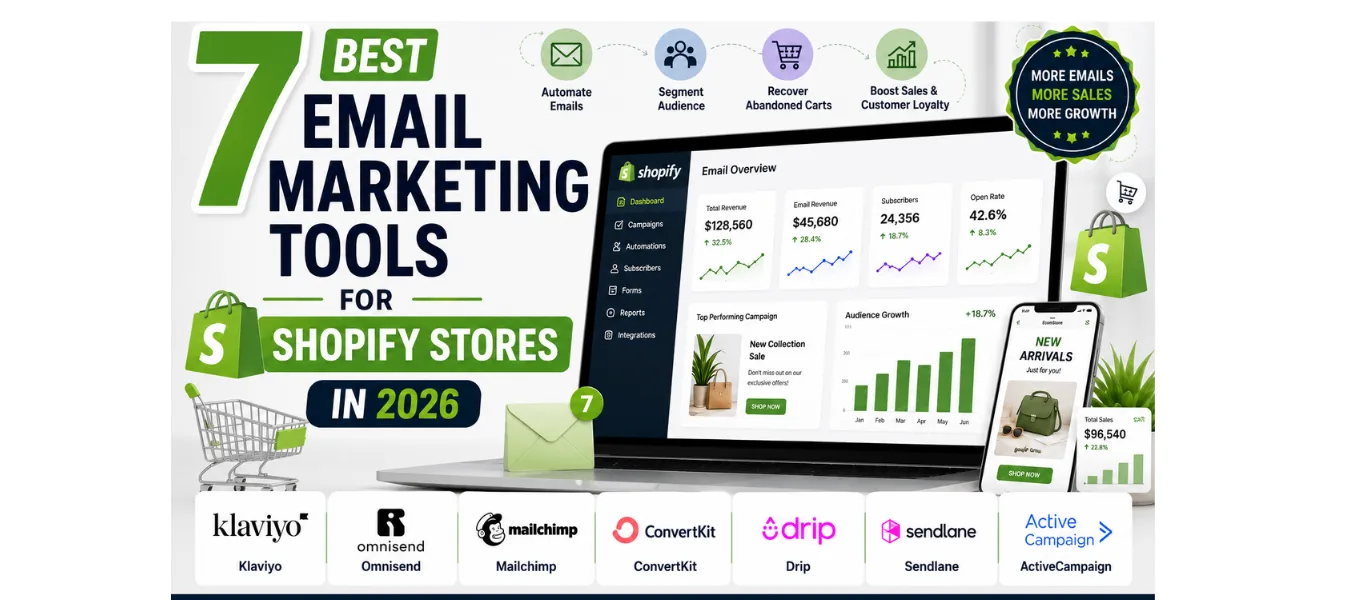
7 Best Email Marketing Tools for Ecommerce in 2026
Warning: choosing the wrong email marketing tool for your e-commerce store in 2026 costs you far more than the monthly subscription fee. It costs you in missed abandoned cart recovery, broken automation flows, and revenue your competitors are capturing while you’re not.
Here’s what most comparison posts won’t tell you: the best email marketing tools for e-commerce aren’t the ones with the longest feature list. They’re the ones built specifically for how e-commerce stores actually grow—through automated sequences, behavioral segmentation, and revenue tracking that shows you exactly what each email is worth.
I’ve worked with e-commerce brands across every major e-commerce email marketing platform available in 2026. This is the honest review—no affiliate commissions influencing a single word, no vague feature lists masquerading as advice. Just a clear, revenue-focused verdict for every store size and budget.
Quick verdict: Klaviyo wins for e-commerce stores doing serious volume. Omnisend wins for budget-conscious stores wanting e-commerce-first features without Klaviyo’s price. Mailchimp wins for absolute beginners. Full breakdown below, including the tools most comparison posts don’t cover.
What to Look for in an Ecommerce Email Marketing Tool
Before we compare platforms, here are the six criteria that actually matter when choosing email marketing tools for e-commerce stores in 2026:
- E-commerce-native integration: Does the tool pull real-time behavioral data from your store—purchase history, browsing activity, cart events—or just basic contact info?
- Automation depth: Can it trigger flows based on specific customer actions? Browse abandonment, cart abandonment, post-purchase sequences, and win-back campaigns are the automations that drive ecommerce revenue.
- Segmentation capability: Can you segment by customer lifetime value, predicted next purchase date, number of orders, and specific products bought? E-commerce segmentation drives personalization at scale.
- Revenue attribution: Does it show you how much revenue each individual email generates? Without this, you’re optimizing blind.
- SMS integration: In 2026, the strongest e-commerce email automation software platforms combine email and SMS in one workflow—reducing tool complexity and increasing customer touchpoints.
- Price-to-ROI ratio: The cheapest email marketing tool for e-commerce is the one that generates the most revenue per pound or dollar spent—not the one with the lowest monthly fee.
With those criteria clear, here’s how the top-rated email tools for e-commerce brands in 2026 stack up.
Best Email Marketing Tools for Ecommerce — Quick Comparison
Here’s a side-by-side overview of the 7 best email marketing tools for e-commerce in 2026:
| Platform | Ecommerce Focus | Free Plan | 10K Contacts | Best For |
|---|---|---|---|---|
| Klaviyo | Native/Deep | 250 contacts | ~$200/mo | Growing stores |
| Mailchimp | Basic sync | 250 contacts | ~$135/mo | Beginners |
| Omnisend | Strong | 250 contacts | ~$115/mo | Best value |
| ActiveCampaign | Good + CRM | None | ~$186/mo | CRM + email |
| Drip | Ecommerce-first | None | ~$154/mo | DTC brands |
| Sendlane | Advanced | None | ~$200/mo | High volume |
| ConvertKit | Growing | 300 contacts | ~$119/mo | Content brands |
All prices are approximate 2026 monthly rates. Verify current pricing on each platform’s website before committing.
1. Klaviyo — Best Overall Email Marketing Tool for Ecommerce
Rating: 9.5/10 | Best for: Ecommerce stores generating $2,000+/month in revenue
Klaviyo is the best email marketing tool for e-commerce stores that are serious about revenue. It was built from day one for online stores — not adapted from a general marketing tool — and that architectural difference shows in every feature.
No other platform on this list matches Klaviyo’s depth of Shopify, WooCommerce, and BigCommerce integration. The moment you connect your store, Klaviyo pulls in real-time purchase history, browsing behavior, cart activity, product catalog data, and customer lifetime value—and makes all of it available as triggers for your automation flows and segmentation rules.
Klaviyo Key Features for Ecommerce
- Browse abandonment flows: Triggered the moment a visitor views a product and leaves without adding to cart—one of the highest-converting automations in e-commerce, unavailable on most general-purpose tools
- Predictive analytics: AI-powered predictions for customer churn probability, predicted next order date, and predicted lifetime value—enabling proactive win-back and upsell campaigns before customers lapse
- Revenue-per-email tracking: See exactly how much money every email and every flow generates—the most important metric for optimising your e-commerce email automation software
- Advanced segmentation: Create segments based on RFM scoring, predicted CLV, specific product purchase history, email engagement, and dozens of other e-commerce-specific data points
- SMS + email in one platform: Build cross-channel flows that send an email, wait for an open, then follow up with SMS if there’s no click—seamlessly within a single workflow editor.
Klaviyo Pricing
- Free plan: 250 contacts, 500 emails/month — full feature access including flows and segmentation
- 1,500 contacts: ~$45/month
- 5,000 contacts: ~$100/month
- 10,000 contacts: ~$200/month
Klaviyo charges per active profile. The cost grows with your list — but so does the revenue when you’re using the platform’s automation capabilities properly.
Klaviyo Pros and Cons
- ✅ Deepest e-commerce integration of any platform—real-time behavioural data
- ✅ Browse abandonment and predictive replenishment flows unavailable elsewhere
- ✅ Revenue attribution per email—essential for serious optimisation
- ✅ Best-in-class e-commerce segmentation and personalisation
- ❌ Higher price point—Omnisend delivers 80% of the capability at 60% of the cost
- ❌ Steeper learning curve — expect 4–6 hours before you’re fully comfortable
See also: Our full head-to-head comparison of Klaviyo vs. Mailchimp for e-commerce in 2026, which covers pricing at every tier, integration depth, and a clear verdict for every store stage.
2. Mailchimp — Best Free Email Marketing Tool for Ecommerce Beginners
Rating: 7.0/10 | Best for: New e-commerce stores with under 500 contacts and a tight budget
Mailchimp is the most recognized name in email marketing tools globally—and for beginners, it earns that recognition. Its interface is clean, its documentation is excellent, and you can send your first e-commerce email campaign in under an hour without reading a single tutorial.
As a free email marketing tool for e-commerce, Mailchimp’s free plan is generous enough to get started—250 contacts and 500 sends per month at no cost. But the honest assessment is that Mailchimp is where you begin your e-commerce email journey, not where you scale it.
Where Mailchimp Falls Short for Ecommerce
Mailchimp’s fundamental limitation for e-commerce is its architecture—it was built as a general-purpose email tool and adapted for e-commerce, rather than built for it. The practical consequences:
- No browse abandonment automation: Mailchimp cannot trigger emails based on product page visits—a significant revenue gap for any growing e-commerce store
- Limited behavioural segmentation: Segmentation based on specific purchase patterns, product categories, or predictive data is unavailable at the depth that e-commerce stores need
- Hidden pricing issue: Mailchimp charges for duplicate contacts across multiple lists—the same subscriber on three lists counts and bills as three contacts. Every other platform on this list counts each contact once
- Abandoned cart requires paid plan: Cart abandonment automation is only available on the Standard plan ($20+/month), not the free or Essentials tier
Mailchimp Pricing
- Free: 250 contacts, 500 sends/month
- Essentials: From $13/month for 500 contacts
- Standard: From $20/month — required for cart abandonment
- 10,000 contacts: ~$135/month on Standard
Migration note: When you’re ready to move from Mailchimp to a more powerful e-commerce email platform, Klaviyo and Omnisend both offer free migration support.
3. Omnisend — Best Value Email Marketing Tool for Ecommerce
Rating: 8.8/10 | Best for: Ecommerce stores wanting Klaviyo-level features at significantly lower cost
Omnisend is the most underrated email marketing tool for e-commerce stores in 2026—and it’s the strongest Klaviyo alternative for stores watching their platform spend. It delivers abandoned cart automation, browse abandonment flows, welcome series, SMS, push notifications, and deep e-commerce segmentation at pricing 30–40% lower than Klaviyo at comparable list sizes.
As email marketing tools with SMS for e-commerce go, Omnisend is the most complete combined solution available below Klaviyo’s price point. Its email + SMS + push notification combination in a single workflow editor is genuinely best-in-class for stores in the $1,500–$10,000/month revenue range.
Omnisend Standout Features
- Full e-commerce automation suite: Abandoned cart, browse abandonment, welcome series, post-purchase, win-back, and cross-sell flows — all built specifically for e-commerce without the Klaviyo premium
- SMS + email + push in one workflow: Build true omnichannel automation sequences combining all three channels in a single flow—rare at this price point
- Product picker in email editor: Pull products directly from your store into emails with one click—pricing, images, and descriptions auto-populated
- Audience sync with ad platforms: Sync your Omnisend segments directly to Facebook and Google Ads for retargeting—closing the loop between email and paid advertising
Omnisend Pricing
- Free: 250 contacts, 500 emails/month
- Standard: From $16/month for 500 contacts
- Pro: From $59/month — includes unlimited web push notifications
- 10,000 contacts: ~$115/month — 40% cheaper than Klaviyo at this tier
For stores looking for the most affordable e-commerce email marketing tool without sacrificing e-commerce-critical automation features, Omnisend is the clear winner in 2026.
4. ActiveCampaign — Best for CRM + Email Marketing Combined
Rating: 8.2/10 | Best for: Ecommerce stores that need CRM capabilities alongside email automation
ActiveCampaign is the strongest email marketing tool for e-commerce stores that also need a built-in CRM. If you run a Shopify store selling high-ticket products, manage B2B e-commerce relationships, or have a sales team that needs visibility into customer email engagement, ActiveCampaign delivers capabilities none of the other platforms on this list can match.
ActiveCampaign Key Strengths
- Most sophisticated automation builder: The most powerful visual automation editor available — capable of conditional logic, branching paths, and multi-channel sequences that would require significant developer work to replicate elsewhere
- Built-in CRM with deal tracking: Manage customer relationships, track deal stages, and assign follow-up tasks directly within the same platform as your email campaigns
- Predictive sending: Machine learning identifies the optimal send time for each individual subscriber based on their historical engagement patterns
- Ecommerce integration: Solid Shopify and WooCommerce integration with purchase syncing, abandoned cart triggers, and product recommendation blocks
ActiveCampaign Pricing
- No free plan: 14-day free trial only
- Starter: From $15/month
- Plus (includes CRM): From $49/month
- 10,000 contacts: ~$186/month on Plus
ActiveCampaign is not the best e-commerce email automation software if pure e-commerce automation is your primary need—Klaviyo and Omnisend both serve that better. But for stores where CRM is as important as email marketing, it’s the strongest combined solution available in 2026.
5. Drip—Best Email Marketing Tool for DTC Ecommerce Brands
Rating: 7.9/10 | Best for: Direct-to-consumer e-commerce brands focused on deep personalisation
Drip positions itself as the e-commerce email platform for DTC brands that want Klaviyo-level e-commerce data depth with a cleaner, more intuitive interface. It was acquired specifically to serve e-commerce brands, and every feature reflects that focus—from its product recommendation engine to its revenue dashboard.
Drip Key Features
- E-commerce-native architecture: Every feature built around the e-commerce customer journey—from first-time visitor to loyal repeat buyer
- Clean visual workflow builder: More intuitive than Klaviyo’s flow editor—complex multi-step automations are easier to build and maintain
- Dynamic content personalisation: Content blocks that adapt automatically based on customer purchase history, browsing behaviour, and predictive spend data
- Revenue dashboard: Clear attribution of email revenue across campaigns and flows — comparable to Klaviyo’s reporting at a slightly lower price point
Drip Pricing
- No free plan: 14-day free trial available
- Starts at: $39/month for up to 2,500 contacts
- 10,000 contacts: ~$154/month
Drip’s lack of a free plan makes it harder to recommend as the best free email marketing tool for an e-commerce startup. For established DTC e-commerce brands wanting a Klaviyo alternative with a superior interface, it’s a serious contender.
6. Sendlane — Best for High-Volume Ecommerce Email Marketing
Rating: 7.6/10 | Best for: High-volume e-commerce stores sending millions of emails monthly
Sendlane is purpose-built for e-commerce brands operating at serious scale. Its unified customer data platform combines email, SMS, and reviews data into the most comprehensive single customer view of any e-commerce email automation software on this list—making it particularly powerful for stores with large, active subscriber bases where deliverability at volume is the primary concern.
Sendlane Strengths
- Industry-leading deliverability: Best inbox placement rates for high-volume sends — critical when you’re sending hundreds of thousands of emails daily
- Unified customer data: Email, SMS, reviews, and purchase data in a single customer profile—one of the most complete views available
- Real-time revenue dashboard: Revenue attribution updates as emails are sent, opened, and converted—live monitoring of campaign performance
- Deep segmentation: Behavioural, transactional, and predictive segmentation on par with Klaviyo—with stronger deliverability infrastructure at scale
Sendlane Pricing
- No free plan: Demo available on request
- Starts at: Custom pricing based on volume
- 10,000 contacts: ~$200/month
Sendlane’s pricing and complexity aren’t justified for small- to mid-size e-commerce stores. It earns its place on this list for large-scale operations where deliverability and unified data at volume are the primary requirements.
7. ConvertKit — Best for Content-Led Ecommerce Brands
Rating: 7.4/10 | Best for: Ecommerce brands that lead with content, courses, or community
ConvertKit sits at an interesting intersection in 2026—it’s historically been the tool of choice for content creators, but its growing e-commerce features make it increasingly relevant for brands that sell products alongside content, courses, or memberships. If your e-commerce brand has a strong content strategy, newsletter, or community component, ConvertKit’s subscriber-first architecture may suit you better than a pure e-commerce tool.
ConvertKit Key Features
- Subscriber-first architecture: Built around individual subscriber relationships rather than list-based sending—powerful for content-driven brands with high subscriber engagement
- Commerce features: Built-in digital product sales, tip jars, and paid newsletter subscriptions — unique among the tools on this list
- Visual automation builder: Clean, tag-based automation system that’s intuitive for content-driven email sequences
- Ecommerce integrations: Integrates with Shopify, WooCommerce, and major e-commerce platforms—though less deeply than Klaviyo or Omnisend
ConvertKit Pricing
- Free: 300 contacts — one of the more generous free plans
- Creator: From $25/month for 1,000 contacts
- 10,000 contacts: ~$119/month
ConvertKit is not the best choice for pure-play product e-commerce stores where automation depth and e-commerce data integration are paramount. It shines for content-led brands where subscriber relationship quality matters more than e-commerce-specific automation sophistication.
Which Email Marketing Tool Is Right for Your Ecommerce Store?
Here’s the decision framework I use with every e-commerce client choosing or switching their email marketing platform
Choose Klaviyo if:
- Your e-commerce store generates $2,000+ per month consistently
- You want the most powerful e-commerce email automation tools available
- Revenue-per-email tracking is essential to your decision-making
- You’re on Shopify or WooCommerce and want the deepest possible integration
- You’re willing to invest time learning the platform for long-term payoff
Choose Omnisend if:
- You want Klaviyo-level e-commerce features at 30-40% lower cost
- Email, SMS, and push notifications in one platform is a priority
- You’re on a mid-size store budget between $1,500 and $10,000/month revenue
- You want e-commerce email automation software without Klaviyo’s learning curve
Choose Mailchimp if:
- You’re just starting out with under 500 contacts
- You need the best free email marketing tool for e-commerce to get started
- You want to get your first campaign live today without complexity
- You understand this is a starting point, not a long-term solution
Choose ActiveCampaign if:
- Your store requires CRM capabilities alongside email marketing
- You have complex, multi-step customer journeys with conditional logic
- You sell high-ticket products with longer consideration cycles
Choose Drip if:
- You run a DTC e-commerce brand and want a cleaner interface than Klaviyo
- Deep personalisation and a sophisticated automation builder are priorities
- You’re looking for a Klaviyo alternative for e-commerce with similar capabilities
Choose Shopify Email if:
- You’re an absolute beginner, sending fewer than 10,000 emails per month
- You want zero setup and the most affordable email marketing tool for e-commerce
- You understand this is a temporary starting point before upgrading
Also read: Best Email Marketing Software for Shopify Stores in 2026 — a detailed breakdown of the top platforms specifically for Shopify store owners, at
Frequently Asked Questions
What is the best email marketing tool for e-commerce in 2026?
Klaviyo is the best overall email marketing tool for e-commerce in 2026 for stores generating consistent revenue. Its native e-commerce integrations, advanced automation flows including browse abandonment, and revenue-per-email attribution make it the strongest revenue-generating platform available. For budget-conscious stores, Omnisend delivers comparable e-commerce features at a significantly lower cost.
What is the best free email marketing tool for e-commerce?
Klaviyo, Mailchimp, Omnisend, and ConvertKit all offer free plans. Klaviyo’s free plan is the most feature-rich — unlocking all automation and segmentation capabilities for up to 250 contacts and 500 sends per month. ConvertKit offers 300 free contacts. Shopify Email provides 10,000 free email sends per month for Shopify store owners, making it the most generous free option by volume.
What is the best Klaviyo alternative for e-commerce?
Omnisend is the strongest Klaviyo alternative for small stores and mid-size e-commerce brands in 2026. It delivers abandoned cart automation, browse abandonment flows, SMS + email combination, and solid e-commerce integration at pricing 30–40% lower than Klaviyo at equivalent contact tiers. Drip is a strong alternative for DTC brands prioritizing interface simplicity and deep personalization.
Do I need a paid email marketing tool for my e-commerce store?
Not immediately. Start with a free plan from Klaviyo, Omnisend, or Mailchimp to build your list and learn the fundamentals. Upgrade to a paid e-commerce email automation software plan when your store is generating $1,000–$2,000 per month consistently and you’re ready to invest in automation flows that recover abandoned carts, welcome new subscribers, and win back lapsed customers automatically.
Which email marketing tools for e-commerce have the best SMS features?
Omnisend offers the most complete email marketing tools with SMS for e-commerce at the best price point—combining email, SMS, and push notifications in a single workflow editor. Klaviyo’s SMS features are more powerful and deeply integrated with e-commerce data, but at a higher cost. Both platforms allow you to build cross-channel flows that seamlessly coordinate email and SMS based on customer behavior.
Can I switch email marketing tools without losing my subscriber list?
Yes—all major e-commerce email marketing platforms support subscriber list import and export. Klaviyo and Omnisend both offer migration assistance for stores switching from Mailchimp or other platforms. The main consideration is recreating your automation flows in the new platform, which takes 4–8 hours depending on complexity. Most stores find the migration effort pays back within the first month of improved automation performance.
Final Verdict — The Best Email Marketing Tools for Ecommerce in 2026
The email marketing tools for the e-commerce landscape in 2026 have never been stronger—and the gap between a platform built for e-commerce and a general-purpose email tool has never been wider.
For growing stores: Klaviyo remains the gold standard. Its revenue attribution, e-commerce automation depth, and Shopify integration justify the premium cost at almost every scale.
For value-focused stores: Omnisend is the most compelling option in the market—genuine e-commerce automation capability at a price point that makes serious email marketing accessible to mid-size stores.
For beginners: start with Mailchimp or Klaviyo’s free plan. Learn the fundamentals. Build your list. Upgrade when your store revenue justifies the investment.
Whatever e-commerce email platform you choose, remember: the tool is only as powerful as the copy running inside it. High-converting email sequences—welcome series, abandoned cart flows, and win-back campaigns—require copy that connects with your audience emotionally and drives action.
If you need help writing the email copy that makes your chosen platform perform at its absolute best, visit blogwithjawed.com—I write high-converting email sequences for e-commerce brands that want to turn their email list into their most reliable revenue channel.
Related reading:
Klaviyo vs Mailchimp for Ecommerce in 2026
Best Email Marketing Software for Shopify Stores
Published on blogwithjawed.com | Written by Jawed Iqbal, Email Copywriter for Ecommerce Brands