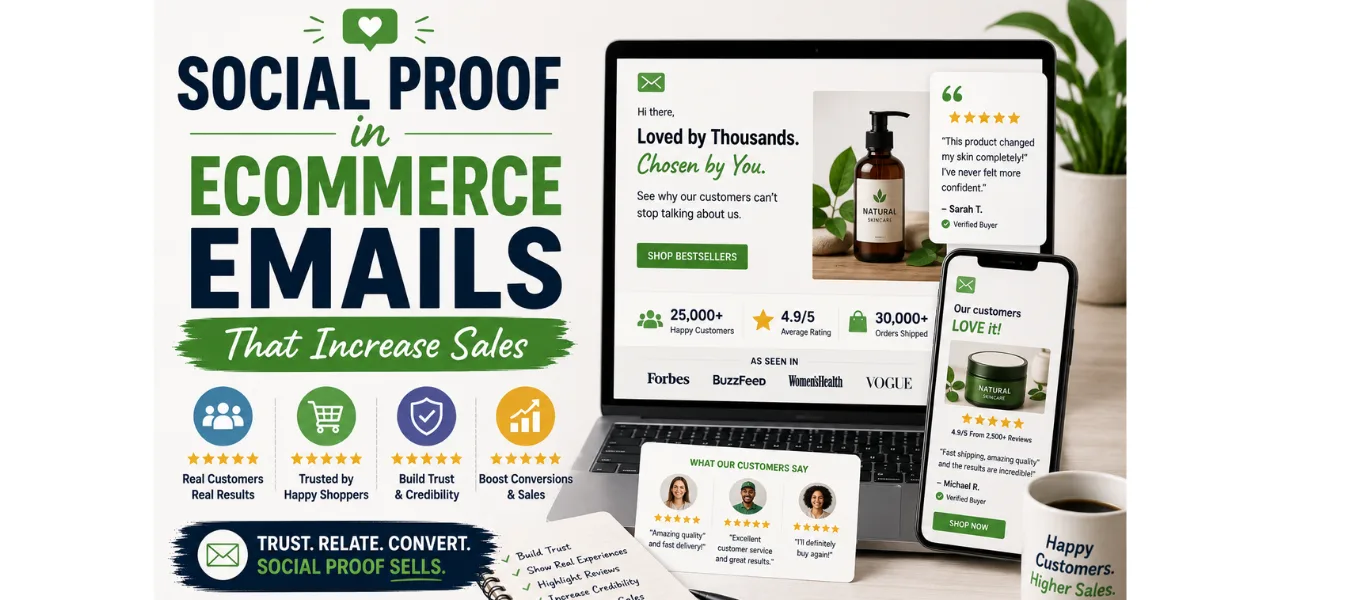
Using Social Proof in Ecommerce Emails to Increase Sales
Reviews increase conversions by up to 270%.
Not your headline copy. Not your discount offer. Not even your product photography.
The words of your customers — real people who bought, used, and loved your product — are the single most powerful conversion tool in your entire email arsenal.
And yet most e-commerce brands are sitting on hundreds of glowing reviews, star ratings, and customer photos—and burying them in a hidden tab on their website where nobody ever reads them.
Here is the brutal reality: **92% of consumers hesitate to buy when no customer reviews are available.** Your subscribers are opening your emails with doubt already baked in. They want to buy. They just need proof that other people have already made this decision—and been glad they did.
That proof is social proof. And when you learn how to use it strategically inside your e-commerce emails, it becomes your most effortless sales tool.
In this guide you will discover exactly how to deploy social proof in e-commerce emails at every stage of your sequence—with real copy examples, plug-and-play templates, and the psychological framework behind why it works.
Why Social Proof Works Harder Than Any Sales Copy You Will Ever Write
Before we get into the tactics, let us talk about why social proof is so explosively effective—because understanding the psychology makes you dramatically better at deploying it.
Your brain is wired for social validation. It is an ancient survival mechanism: when you are uncertain about a decision, you look at what other people are doing and use their behavior as a guide. Psychologists call this “informational social influence”—and it operates at a level below conscious thought.
When a subscriber opens your email and sees that 2,847 people have rated your product 4.8 stars, they feel it before they analyze it. That number triggers a subconscious signal: *other people have taken this risk and been satisfied.* The uncertainty dissolves. The path to purchase feels safer.
**This is why 88% of consumers trust user reviews as much as personal recommendations from friends.** Your best customer talking about your product in a review has more persuasive power than anything you write in first-person brand voice.
And here is the game-changing insight that most brands completely miss: social proof does not only belong on your product pages. **It belongs in every single email you send** — because doubt exists at every stage of the customer journey, and social proof is the fastest way to dissolve it.
The 6 Types of Social Proof and Exactly Which Emails They Belong In
Not all social proof is equal—and different types convert at different stages of the buyer journey. Here is your complete guide to matching the right social proof to the right email:
Type 1 — Customer Reviews and Star Ratings
**Best in:** Abandoned cart emails, bestseller spotlight emails, post-purchase upsell emails
Customer reviews are the backbone of e-commerce social proof email copywriting. They work because they are specific, credible, and relatable — especially when the reviewer sounds like your subscriber.
**The golden rule of testimonials in email: specifics beat generalities every single time.**
*”Great product!”* converts almost nothing.
*”I wore this on a 14-hour flight, and my feet didn’t hurt once—I’m buying three more pairs”* converts because it names a specific situation, a specific result, and an emotional outcome.
**How to select reviews for your emails:**
– Choose reviews that mention a specific result, timeframe, or transformation
– Prioritise reviews that address common objections (price, quality, sizing, returns)
– Match the review to the email’s goal — an abandoned cart email needs a review that removes the hesitation that caused the abandonment
**Plug-and-play abandoned cart email with customer reviews:**
—
**Subject:** Still thinking? Here is what 847 customers decided
**Preview text:** Real words from real people who almost didn’t buy either.
—
[First Name],
You are not alone in thinking it over.
Most of our best customers spent time deciding before they ordered. Here is what a few of them said afterwards:
⭐⭐⭐⭐⭐ *”I was skeptical because I’ve been burned by similar products before. This completely changed my mind. Results in week two.”*
— Sarah M., Verified Buyer
⭐⭐⭐⭐⭐ *”Best purchase I’ve made this year. Wish I hadn’t waited as long as I did.”*
— James K., Verified Buyer
⭐⭐⭐⭐⭐ *”I almost talked myself out of it. So glad I didn’t.”*
— Priya L., Verified Buyer
Your [Product Name] is still in your cart.
**[COMPLETE MY ORDER →]**
[Your Name]
—
Type 2 — Testimonials and Case Studies
**Best in:** Welcome sequence email 3, product launch emails, winback campaigns
While reviews are reactive — customers writing after purchase — testimonials are curated. They are your best customers saying their best thing about your brand in their best words.
**Testimonials in ecommerce emails perform best when they follow the transformation structure:** before → during → after. A testimonial that shows where a customer was, what changed, and where they are now is a case study in miniature — and it is irresistible.
**What to ask customers to get transformation testimonials:**
– *”What problem were you trying to solve when you first found us?”*
– *”What made you hesitate before buying?”*
– *”What specific result did you experience after using it?”*
Those three answers become the most compelling testimonial copy your brand will ever have.
Type 3 — User-Generated Content (UGC) in Email Campaigns
**Best in:** Post-purchase emails, loyalty emails, social proof bomb emails in welcome sequence
**User-generated content email campaigns are one of the most underutilised revenue drivers in ecommerce.** A customer photo of your product in real life — a real person wearing your jacket, using your skincare product, cooking with your equipment — converts at a completely different level than polished studio photography.
Here is why: studio photography shows what a product looks like. UGC shows what a product looks like *in someone’s actual life.* That context is what makes it convert.
According to research, displaying user-generated photos can increase conversion rates by up to 29%. And video UGC? Video testimonials increase conversion rates by 80% compared to text-only alternatives.
**How to collect UGC for your email campaigns:**
– Add a post-purchase email asking customers to share a photo in exchange for a discount on their next order
– Monitor your brand hashtag on Instagram and TikTok—reach out to creators who tag you
– Run a monthly UGC contest — best photo wins store credit
**UGC email subject lines that skyrocket open rates:**
– *”[Customer Name] is obsessed—see her results.”*
– *”Real photos from real customers (no filters)”*
– *”This is what [Product] actually looks like in your life.”*
– *”2,400 customers posted this. Here’s our favorite.”*
—
Type 4 — Social Numbers and Popularity Signals
**Best in:** Flash sale emails, product launch emails, back-in-stock alerts
Numbers are powerful social proof because they are undeniable. *”Join 12,000 happy customers”* bypasses the critical brain and speaks directly to the social validation instinct.
**Use social numbers to:**
– Establish scale: *”Over 8,000 five-star reviews”*
– Create FOMO: *”342 people are looking at this right now”*
– Signal popularity: *”Our #1 bestseller — 3,000 orders this month”*
– Build urgency: *”Only 14 left at this price — 23 people have this in their cart”*
**The critical rule:** every number you use must be real. Fabricated social proof destroys trust permanently when discovered — and it will be discovered.
—
Type 5 — Expert and Authority Endorsements
**Best in:** Product launch emails, premium product emails, brand story emails
If your product has been featured in press, recommended by experts, or endorsed by credible figures in your niche — this is social proof gold. Use it.
*”As featured in Vogue, Forbes, and Cosmopolitan”* does not need any supporting copy. The authority of those names does all the work.
**Authority social proof works even at small scale:**
– A mention from a respected niche blogger
– A recommendation from a doctor or specialist (for health products)
– A feature in a local publication
– An industry award or certification
—
Type 6 — Real-Time Activity Notifications
**Best in:** Flash sale emails, back-in-stock alerts, urgency close emails
*”27 people bought this in the last hour”* is social proof and urgency combined — one of the most explosive conversion combinations in email marketing.
Use real-time or recent activity data to create authentic social momentum:
– *”47 orders placed since we sent this email”*
– *”This sold out in 3 hours the last time we ran this sale”*
– *”Already 200 units sold — [X] remaining”*
—
Applying the PAS Formula to Social Proof Email Copy
Here is the PAS framework applied to a complete social proof-led email — the most powerful formula for customer reviews in email marketing:
**[Problem]**
> [First Name], if you have been on the fence about [Product Name] — this email is for you.
>
> Most people who hesitate before buying have one quiet worry they never say out loud:
>
> *”What if it doesn’t actually work for me?”*
**[Agitate]**
> That doubt is completely normal — and it costs people real results every day.
>
> Because while they wait, the problem they were trying to solve keeps draining their time, their money, and their confidence.
>
> Meanwhile, thousands of customers who had exactly the same doubt — made the decision. And here is what happened.
**[Solution]**
> ⭐⭐⭐⭐⭐ *”[Specific transformation testimonial with before and after result]”*
> — [Customer Name], Verified Buyer
>
> ⭐⭐⭐⭐⭐ *”[Second testimonial addressing a specific objection]”*
> — [Customer Name], Verified Buyer
>
> We back every order with [your guarantee]. No risk. No question.
>
> **[SEE WHY 3,000+ CUSTOMERS GAVE US 5 STARS →]**
—
How to Build a Social Proof Email System That Runs on Autopilot
A one-off social proof email is powerful. A social proof system built into every email in your sequence is transformational.
Here is the effortless framework for deploying social proof consistently across your entire email automation:
Step 1 — Audit your existing social proof**
Pull all your reviews from your Shopify product pages, Google reviews, Trustpilot, and social media mentions. Tag each one by: type (review, transformation, or objection-crusher), product, and customer profile.
Step 2 — Map social proof to email type**
| Email Type | Best Social Proof Type |
|—|—|
| Welcome Email 3 | 2–3 transformation testimonials |
| Abandoned Cart | Objection-crushing review + star rating |
| Flash Sale | Social numbers + recent activity data |
| Post-Purchase | UGC request + peer review prompt |
| Winback | Before/after transformation case study |
| Product Launch | Authority endorsement + early adopter reviews |
| Back-in-Stock | Waitlist size + past sell-out data |
Step 3 — Create a monthly review harvest email**
Send one automated post-purchase email at day 14–21 asking for a review. Incentivise with a small discount on next purchase. This keeps your social proof library fresh and growing without manual effort.
Step 4 — Update your social proof quarterly**
Review your top five automated emails every quarter. Swap in more recent, more specific testimonials. Social proof with recent dates performs better than older reviews — it signals that your brand is consistently delivering.
—
The Subject Line Formulas That Make Social Proof Emails Irresistible
The most powerful social proof in the world does not convert if nobody opens the email. Here are the subject line formats that work best for social proof emails:
**Review-led subject lines:**
– *”Here is what our customers actually say (unfiltered)”*
– *”2,847 reviews. Here are our 5 favourites.”*
– *”She called it life-changing. Here’s why.”*
**Social numbers:**
– *”Join 12,000 people who made this decision”*
– *”Our bestseller — 3,000 orders this month alone”*
– *”47 people bought this while you read this email”*
**Transformation-led:**
– *”Before and after: what [Product] actually does”*
– *”[Customer Name] went from [before] to [after] in [timeframe]”*
– *”The result that changed how we talk about [product category]”*
**Curiosity + social proof combined:**
– *”Don’t take our word for it — they said it better”*
– *”1,200 customers can’t be wrong… can they?”*
– *”What happened when 500 people tried this for 30 days”*
—
Frequently Asked Questions
**How do I use social proof in ecommerce emails if I do not have many reviews yet?**
Start with what you have — even two or three genuine, specific testimonials are more powerful than none. Focus your review collection on your top-selling product first. Send a post-purchase email at day 14 asking for feedback, and incentivise with a small discount on their next order. Within 30 days you will have enough to populate your key automated emails. Remember: quality of social proof beats quantity — one specific, transformation-focused testimonial outperforms twenty vague five-star ratings.
Where should I place customer reviews in email marketing — at the top or bottom of the email?**
It depends on the email’s goal. In abandoned cart emails, lead with the testimonial in the first third of the email — your subscriber abandoned because of doubt, and you need to dissolve that doubt before making any ask. In product launch emails, build desire first and then use testimonials from beta users or early adopters as the proof that seals the decision. In standalone social proof emails, the testimonial is the entire email — do not bury the lead.
What types of social proof work best in testimonials for ecommerce email campaigns?**
The most converting testimonials are transformation-focused — they show where a customer was before your product, what changed, and the specific result they experienced after. *”My skin cleared in two weeks”* destroys *”love this product!”* because it names a real outcome in a realistic timeframe. Prioritise testimonials that address common objections, mention a specific product use case, or compare your product favourably to something the customer tried before.
How many testimonials should I include in a single ecommerce email?**
Two to three is the sweet spot. One testimonial feels cherry-picked. Four or more creates cognitive overload and dilutes the impact of each individual review. Choose your two or three strongest, most specific testimonials and let them do the work. For social proof bomb emails — emails dedicated entirely to reviews — you can extend to four or five if each one addresses a different customer profile or use case.
Does social proof in emails work for new product launches with no reviews?**
Absolutely — you just need to source social proof differently. Use waitlist size (*”3,400 people signed up for early access”*), beta tester results (*”here’s what our 50 beta users said”*), founder story testimonials from your industry network, or press mentions. Any credible third-party validation that proves other people have evaluated and endorsed your product works as launch social proof. Plan your review collection strategy before launch so you can update your email automation with real customer reviews within the first 30 days.
—
Conclusion
Social proof is not a nice-to-have element you sprinkle into your emails occasionally. It is the trust multiplier that transforms doubt into confidence and hesitation into completed orders — at every stage of your customer journey.
Imagine every email in your sequence working harder — your welcome series building instant credibility, your abandoned cart emails dissolving doubt before it kills the sale, your product launches backed by real customer voices that speak louder than any copy you write yourself.
Reviews increase conversions by 270%. Pages with testimonials convert 34% better. Consistent social proof increases revenue by 62% per customer. The data is not ambiguous — your customers’ words sell better than yours.
Start with one email. Identify your most converting automation. Replace one generic paragraph with your two strongest testimonials. Watch what happens to your click rate.
And if you want your entire email sequence rebuilt around social proof email copywriting that converts — that is exactly what I do at **blogwithjawed.com**. Let us turn your customer voices into your most powerful sales team.