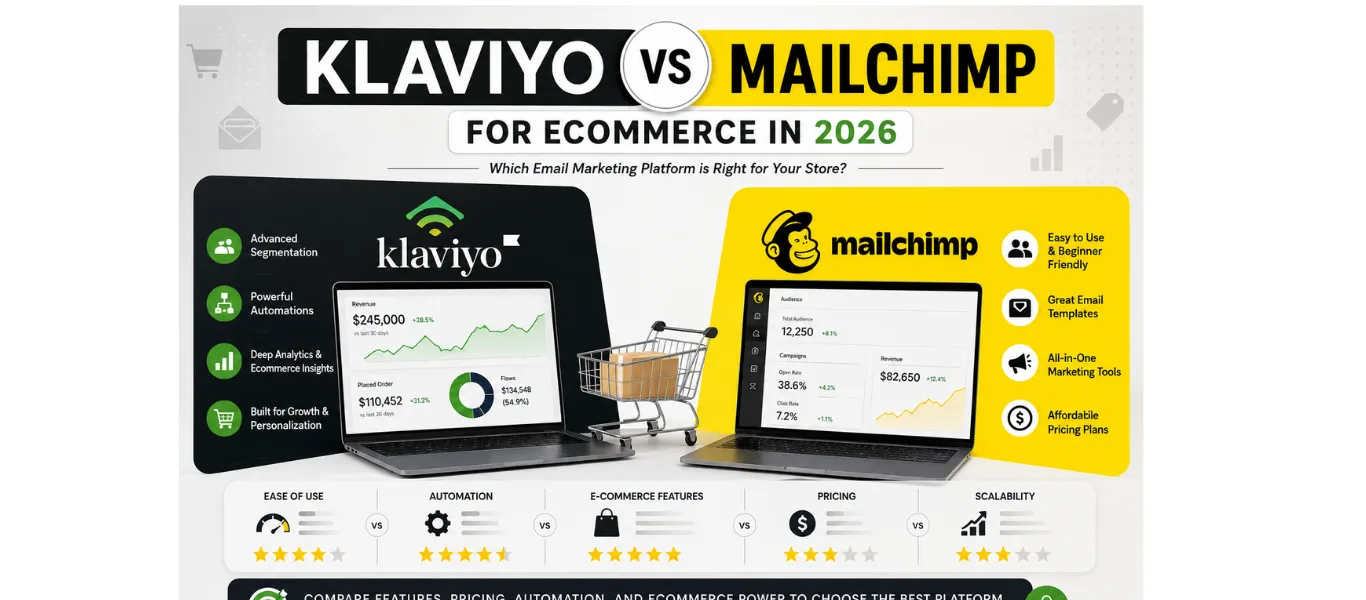
Klaviyo vs. Mailchimp for Ecommerce in 2026: Which One Should Small Shopify Stores Choose?
You’ve decided to get serious about email marketing for your e-commerce store. Smart move. But now you’re stuck staring at two names that keep coming up: Klaviyo and Mailchimp. Both promise to grow your revenue. Both have thousands of reviews. And both look almost identical on the surface.
Here’s the truth: they’re built for completely different types of businesses.
This guide gives you a no-fluff, honest comparison of Klaviyo vs. Mailchimp specifically for ecommerce store owners—not agencies, not B2B companies, and not newsletter writers. If you’re running a Shopify store (or thinking about it), this is exactly what you need to make the right decision in 2026.
| Quick Verdict
Klaviyo wins for e-commerce. Mailchimp wins for beginners on a tight budget. If you’re doing more than $2,000/month in store revenue, Klaviyo will likely pay for itself. If you’re just starting out with under 500 contacts, Mailchimp’s free plan is a reasonable place to begin. |
What’s the Core Difference Between Klaviyo and Mailchimp?
The simplest way to understand these two platforms:
Klaviyo was built specifically for e-commerce. Every feature — segmentation, automation flows, analytics — revolves around selling products online.
Mailchimp was built as a general email marketing tool. It works for everyone from solopreneurs to nonprofits to ecommerce stores. That flexibility is its strength and its weakness.
Think of it this way: Klaviyo is a specialist. Mailchimp is a generalist. For ecommerce, specialists usually win.
Klaviyo vs Mailchimp: Side-by-Side Comparison
Here’s a quick overview before we go deep:
| Feature | Klaviyo | Mailchimp |
| Built for | E-commerce stores | All business types |
| Free Plan | 250 contacts, 500 sends/month | 250 contacts, 500 sends/month |
| Paid Plan (1,500 contacts) | ~$45/month | ~$20/month |
| Paid Plan (10,000 contacts) | ~$200/month | ~$135/month |
| Shopify Integration | Native, deep, real-time | Basic integration |
| Abandoned Cart Emails | Built-in, advanced | Available on Standard+ |
| Segmentation Depth | Advanced (behaviour-based) | Moderate |
| Ease of Use | Moderate learning curve | Beginner-friendly |
| SMS Marketing | Yes (built-in) | Yes (add-on) |
| Revenue Tracking | Detailed, per-email | Basic |
| Customer Support | Email + chat (paid tiers) | Email + chat (paid tiers) |
| Best For | Growing Shopify stores | Beginners, small budgets |
Pricing: Which Is More Affordable for Small Ecommerce Stores?
Both platforms offer a free plan with 250 contacts and 500 email sends per month. That’s where the similarity ends.
Klaviyo Pricing
- Free: 250 contacts, 500 emails/month — full feature access
- 1,500 contacts: ~$45/month
- 5,000 contacts: ~$100/month
- 10,000 contacts: ~$200/month
Klaviyo charges per active profile — meaning everyone in your database, even inactive subscribers. This caused controversy in 2025 when Klaviyo restructured its billing, and it’s something to watch as your list grows.
Mailchimp Pricing
- Free: 250 contacts, 500 sends/month — limited features
- Essentials: From $13/month for 500 contacts
- Standard: From $20/month — needed for automation
- 10,000 contacts: ~$135/month on Standard
Mailchimp looks cheaper — and it often is. But there’s a hidden cost: Mailchimp charges for duplicate contacts across multiple lists. If the same subscriber appears on three lists, you pay for them three times. Klaviyo counts each contact once regardless of how many lists they’re on.
| Pricing Verdict
Mailchimp is cheaper at every contact tier. But for e-commerce stores doing serious volume, Klaviyo’s ROI often justifies the premium—its automation can recover far more in sales than the extra monthly cost. |
Automation: Where the Real Difference Shows Up
This is where Klaviyo absolutely dominates Mailchimp for e-commerce—and it’s the most important factor for your revenue.
Klaviyo Automation
Klaviyo’s flows are built around e-commerce behavior. Out of the box, you get:
- Abandoned cart sequences (1-email to multi-step with SMS)
- Browse abandonment flows (triggered by what visitors view)
- Welcome series with product recommendations
- Post-purchase follow-up and upsell sequences
- Win-back campaigns for lapsed customers
- Price drop and back-in-stock alerts
Every flow is triggered by real-time data from your store. Klaviyo knows what your customers viewed, added to cart, purchased, and how much they’ve spent over their lifetime.
Mailchimp Automation
Mailchimp has automation—but it requires the Standard plan or higher, and the e-commerce triggers are less granular. You can set up:
- Abandoned cart emails (Standard plan+)
- Welcome series
- Post-purchase follow-ups
- Re-engagement campaigns
What Mailchimp lacks is browse abandonment automation and deep behavioral segmentation based on purchase history. These are the flows that drive the most revenue for e-commerce stores—and they’re simply not available at the same level.
| Automation Verdict
Klaviyo wins decisively. Browse abandonment and behavior-based flows are where e-commerce revenue compounds. Mailchimp can’t match Klaviyo here, especially for Shopify stores with real order volume. |
Segmentation: Targeting the Right Customer at the Right Time
Segmentation is how you stop sending the same email to everyone and start sending the right message to the right person. This directly impacts open rates, click rates, and revenue.
Klaviyo Segmentation
Klaviyo’s segmentation is built around your store data. You can create segments based on:
- Products viewed but not purchased
- Total spend over the customer lifetime
- Number of orders placed
- Days since last purchase
- Predicted next order date (AI-powered)
- Email engagement (opens, clicks, ignores)
This level of granularity lets you send highly targeted campaigns—for example, emailing only customers who’ve bought from you twice and spent over $100, with a VIP loyalty offer.
Mailchimp Segmentation
Mailchimp’s segmentation has improved significantly but still treats purchase data as one input among many rather than the central organizing principle. You can segment by purchase history and predicted spend tiers, but the depth and real-time accuracy lag behind Klaviyo.
| Segmentation Verdict
Klaviyo wins. Its segmentation is the engine behind higher revenue per email. For stores with real customer data, Klaviyo turns that data into money. Mailchimp covers the basics but not the advanced use cases. |
Shopify Integration: Which Platform Works Better?
Most e-commerce store owners reading this are on Shopify. Here’s how both platforms integrate:
Klaviyo + Shopify
This is a native, deep integration. Klaviyo pulls in real-time data, including
- Full product catalogue
- Purchase history per customer
- Browsing behaviour (pages and products viewed)
- Cart activity (items added, abandoned)
- Customer lifetime value
Setup is straightforward from the Shopify App Store, and flows activate automatically once connected. Your store essentially becomes Klaviyo’s data source, powering every segment and automation.
Mailchimp + Shopify
Mailchimp’s Shopify integration was temporarily removed from the Shopify App Store due to a business dispute and has since returned, but it’s worth knowing the history. The integration works for basic email data syncing and purchase-based segmentation, but doesn’t pull the same depth of real-time behavioral data that Klaviyo captures automatically.
| Shopify Integration Verdict
Klaviyo is the stronger Shopify partner by a significant margin. If Shopify is your platform, Klaviyo is the natural choice. |
Ease of Use: Which Platform Is Easier to Learn?
Let’s be honest here.
Mailchimp is easier. The interface is clean, intuitive, and beginner-friendly. You can send your first campaign in under an hour without reading any documentation. For someone new to email marketing, this matters.
Klaviyo has a steeper learning curve. The dashboard is dense. Flows, segments, profiles, and metrics all live in the same sidebar and can feel overwhelming at first. Expect to spend 3–4 hours just getting comfortable, and another 8+ hours setting up your first 5 flows properly.
That said, once you get past the learning curve, Klaviyo’s interface is extremely logical. Everything is built around how e-commerce actually works, which makes complex tasks easier once you understand the system.
| Ease of Use Verdict
Mailchimp wins for beginners. Klaviyo wins for anyone willing to invest a weekend learning it—the payoff in automation power is worth the time. |
Email Deliverability: Will Your Emails Actually Reach the Inbox?
Both platforms perform well on deliverability. Independent 2026 testing shows:
- Klaviyo: ~97% inbox delivery rate
- Mailchimp: ~96% inbox delivery rate
The 1% gap is mostly immaterial for small stores. What matters more is your list quality, permission practices, and email frequency. Both platforms support DKIM, SPF, and DMARC authentication—essential for inbox placement in 2026.
Klaviyo has one edge here: its Smart Sending feature automatically suppresses recipients who’ve received too many emails in a short window, protecting your sender reputation automatically.
| Deliverability Verdict
It’s effectively a tie. Focus on list hygiene and proper authentication on either platform rather than worrying about the 1% difference. |
Who Should Choose Klaviyo?
Klaviyo is the right choice if:
- You’re on Shopify (or WooCommerce) and doing more than $2,000/month in revenue
- You want advanced automation flows like browse abandonment and predictive replenishment
- You have more than 1,000 subscribers and are ready to segment seriously
- You want to track email revenue down to the individual send
- You’re willing to spend time learning the platform for long-term payoff
- You want SMS and email in one platform without expensive add-ons
Who Should Choose Mailchimp?
Mailchimp is the right choice if
- You’re just starting out and have fewer than 500 contacts
- Your budget is tight and the price difference matters right now
- You send simple newsletters without complex automation needs
- You’re not on Shopify and don’t need deep e-commerce integrations
- You want to get your first campaign live quickly without a learning curve
The Real Question: Which One Makes You More Money?
This is the only metric that truly matters for an e-commerce store.
Klaviyo-powered brands typically attribute 20–35% of total revenue to email marketing. The industry average for general-purpose ESPs like Mailchimp sits at 15–20%. That gap represents real money.
Consider this: a Shopify store with 10,000 contacts pays roughly $65/month more for Klaviyo than Mailchimp. If Klaviyo’s browse abandonment flow alone recovers even a small percentage of lost sales from visitors who didn’t buy, that $65 premium pays for itself many times over.
Cheaper software that generates less revenue is ultimately more expensive. The decision isn’t about the monthly invoice — it’s about the return on that invoice.
| Bottom Line
For e-commerce stores serious about growth, Klaviyo is the better investment. For stores just starting out, Mailchimp gets you moving without friction or cost. The best strategy: start on Mailchimp’s free plan, learn the basics of email marketing, then migrate to Klaviyo when your store is generating consistent revenue. |
Frequently Asked Questions
Is Klaviyo better than Mailchimp for Shopify?
Yes, for most Shopify stores. Klaviyo’s native Shopify integration pulls real-time data, including browsing behavior, purchase history, and lifetime value. This powers automation flows that Mailchimp simply cannot replicate at the same depth.
Can I switch from Mailchimp to Klaviyo later?
Absolutely. Many e-commerce brands start on Mailchimp and migrate to Klaviyo when they’re ready for more advanced features. Klaviyo makes migration straightforward and even offers free migration support for larger accounts.
Is Klaviyo worth the extra cost for small stores?
It depends on your revenue. If you’re doing under $1,000/month in store revenue, start with Mailchimp’s free plan. Once you’re generating consistent sales, the automation revenue Klaviyo unlocks — particularly from abandoned cart and browse abandonment flows — makes it worth every penny.
Does Mailchimp work with Shopify?
Yes, Mailchimp integrates with Shopify. The integration covers basic contact syncing, purchase data, and some automation triggers. However, it lacks the real-time behavioral data depth that Klaviyo’s native Shopify integration provides.
Which has better email templates—Klaviyo or Mailchimp?
Mailchimp has a slight edge on template design quality and ease of use. Klaviyo’s templates are functional and e-commerce-focused (product blocks, dynamic content), but Mailchimp’s drag-and-drop editor is more beginner-friendly and visually polished.
Ready to Level Up Your Ecommerce Email Marketing?
Whichever platform you choose, the most important step is starting. Email marketing consistently delivers the highest ROI of any marketing channel — $36 to $79 for every $1 spent, depending on your platform and strategy.
If you want help writing the email copy that actually converts your subscribers into buyers—welcome sequences, abandoned cart emails, product launch campaigns—that’s exactly what I do at blogwithjawed.com.
Explore more email marketing guides: Head to blogwithjawed.com for practical tips, copy frameworks, and e-commerce email strategies that drive real results.
Visit the links below to know more about email copywriting for e-commerce.
Re-Engagement Emails That Win Back Customers
Social Proof in Ecommerce Emails That Increase Sales
Welcome Email Sequence Examples That Convert
Published on blogwithjawed.com | Written by Jawed Iqbal, Email Copywriter for Ecommerce Brands