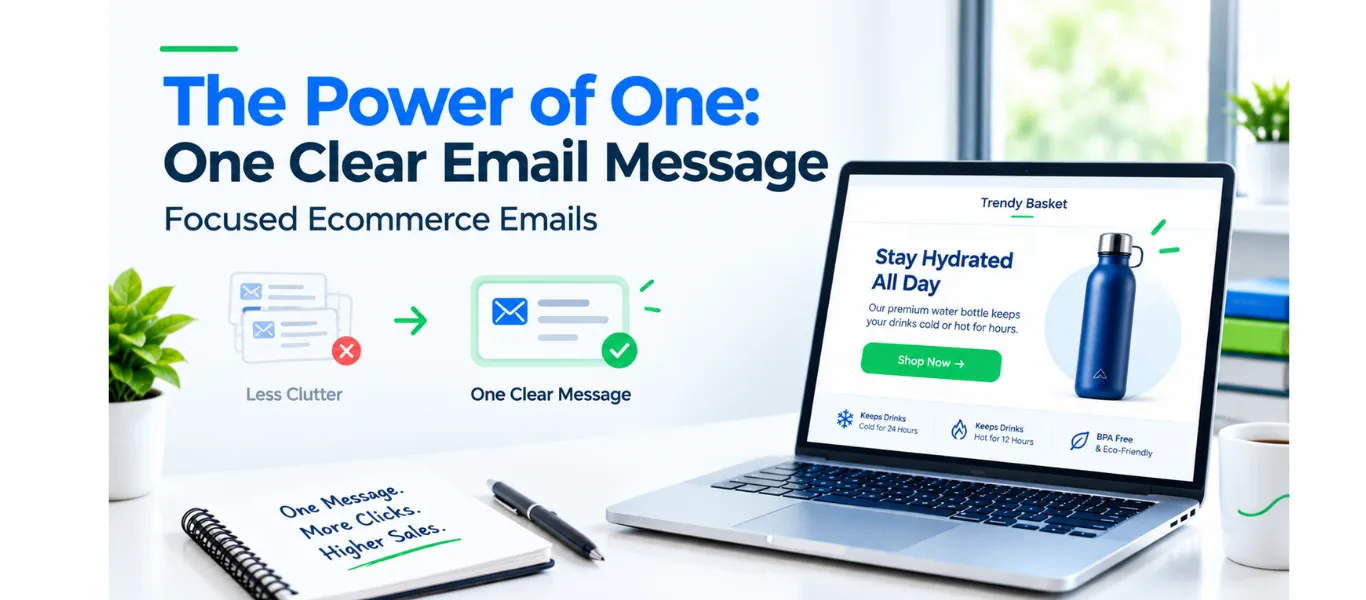
An ecommerce email can contain excellent products, a strong offer, and polished design—and still feel confusing if it asks readers to think about too many things at once. A welcome offer, new arrivals, founder story, loyalty points, and a sale announcement may all matter, but putting them into one email can weaken the main message.
The power of one is a simple copywriting principle: give each email one primary goal, one central message, and one clear next step. This does not mean every email must be tiny or have only one link. It means each part should support the same purpose so subscribers can quickly understand why the email matters and what to do next.
What Does “The Power of One” Mean in Email Copywriting?
For ecommerce email copywriting, the power of one means choosing a single priority before drafting. That priority shapes the subject line, preview text, headline, body copy, visuals, and primary call to action (CTA).
- One goal: the business outcome this email is designed to support.
- One main message: the key idea the reader should remember.
- One primary CTA: the main action you want the reader to take.
You can still include supporting links, product details, or a secondary CTA when useful. The test is whether these elements reinforce the main message or compete with it.
Shopify’s current guide to writing effective email calls to action recommends clear, action-oriented wording and a cohesive thought. A focused message makes that guidance easier to apply.
Why Too Many Messages Can Weaken an Email
Subscribers often scan marketing emails rather than read every word. If an email presents several unrelated offers and destinations, readers have to decide which part matters. Some may postpone the decision or leave without clicking.
Common signs of an unfocused email include:
- The subject line promotes a sale, but the headline announces a new collection.
- The opening paragraph talks about the brand story before revealing the offer.
- Several buttons compete equally for attention.
- The email introduces unrelated product categories without explaining the connection.
- The CTA asks readers to do something different from what the copy promised.
The solution is not to remove useful information automatically. It is to give the information a clear hierarchy: one main idea first, relevant support second, and the primary action clearly visible.
The One-Email Focus Framework
Step 1: Choose one campaign goal
Complete this sentence before writing: “This email should help the reader ______.” Examples include discover a new collection, use a welcome offer, return to an item they viewed, replenish a product, or learn how a recently purchased item works.
If you find yourself adding several unrelated goals, consider splitting the content into separate campaigns or an email sequence.
Step 2: Identify the audience and moment
A first-time subscriber may need a quick introduction and a clear reason to explore the store. A recent customer may need setup advice or complementary products. Someone who browsed a particular item may benefit from relevant product details rather than a general store-wide promotion.
Use the information you legitimately have about the subscriber and their relationship with the store. Avoid making assumptions that your data cannot support.
Step 3: Write the main message in one sentence
Write a plain-language summary of the email’s central point. For example: “Our lightweight bottle makes it easier to carry water during your daily commute.” Treat this sentence as a filter: if a paragraph does not support it, remove it or save it for another email.
Step 4: Make every element support the same idea
- Subject line: set an accurate expectation.
- Preview text: add useful context rather than repeat the subject.
- Headline: state the main value clearly.
- Body copy: explain the benefit and add relevant proof.
- Primary CTA: describe the next step.
- Visuals: help readers understand the product or offer.
Consistency matters. Do not promise one thing in the subject line and make readers search for it in the body.
Step 5: Choose one primary CTA
Use a short, action-led CTA that matches the email’s goal. Examples include “Shop the New Collection,” “Use Your Welcome Offer,” “View Your Cart,” or “Read the Care Guide.” Avoid generic wording when a more specific label helps readers know what happens after clicking.
If a secondary link is genuinely useful, keep it visually subordinate and aligned with the same message. A welcome email may include a primary “Shop Bestsellers” button and a quieter link to learn about shipping. A sale email should not give equal prominence to unrelated actions that distract from the promotion.
Before-and-After Ecommerce Email Examples
These examples are illustrative drafts, not performance claims or real customer campaigns. Adapt the copy to verified product details, your offer, and your audience.
Example 1: New product launch
Unfocused version: “Meet our new bottle! Check out our hoodies, explore our candles, read our story, and sign up for updates.”
Focused version:
Subject: Meet your new everyday water bottle
Preview: Explore the design details made for daily use.
Headline: A bottle ready for your routine
From your commute to your desk, discover a bottle designed to travel with you. Review the size, materials, and care details to see whether it suits your day.
CTA: Explore the Bottle
Why it works: the subject, body, and CTA all support one product-discovery goal.
Example 2: Welcome offer
Unfocused version: A long introduction, several unrelated collections, multiple discount codes, social links, and a loyalty-program pitch all compete in the same email.
Focused version:
Subject: Welcome—here’s how to get started
Preview: Explore customer favourites and find your fit.
Headline: Start with the essentials
Thanks for joining us. Browse a few popular picks to get familiar with the store. If your welcome offer has terms or an expiry, state them clearly before the customer checks out.
CTA: Explore Bestsellers
Why it works: the message helps new subscribers take one simple first step. Include a discount only if the offer is real and its terms are clear.
Example 3: Promotional campaign
Unfocused version: The email promotes a limited-time offer, announces new arrivals, asks for reviews, and directs readers to several unrelated categories.
Focused version:
Subject: Your selected favourites are on offer
Preview: Check eligible products and offer details.
Headline: Find your next everyday favourite
Explore the products included in this promotion. Review the eligible items, discount conditions, and end date before you place your order.
CTA: Shop Eligible Items
Why it works: the copy keeps attention on the promotion without inventing urgency or hiding conditions.
How to Keep Focus Across an Email Sequence
One clear message does not mean repeating the same email. An email sequence can cover several ideas across different messages, with each message doing one job.
- Welcome email: introduce the brand and guide the subscriber to a useful first step.
- Follow-up: explain a product benefit or answer a common question.
- Social-proof email: share genuine, permissioned customer feedback where available.
- Offer email: explain a real promotion and its conditions.
For the overall sequence, decide how each message advances the subscriber journey. Our ecommerce welcome email sequence guide explains how welcome messages can work together. You can also apply the same focus principle to benefit-driven email copywriting by choosing the one customer benefit most relevant to each campaign.
What to Remove—and What to Keep
Editing for focus does not mean making every email as short as possible. Keep any detail that helps the reader understand the offer, evaluate the product, trust the claim, or complete the intended action.
Consider removing:
- Unrelated announcements that can be sent separately.
- Repeated explanations that add no new information.
- Multiple equally prominent buttons with different purposes.
- Generic brand claims that do not support the main message.
- Decorative images that distract from the product or action.
Keep necessary offer terms, shipping or return information, accessibility needs, and other details required for an informed decision. Clarity should never come at the expense of transparency.
How to Test Whether a More Focused Email Works
Start with a specific hypothesis, such as “A subject line that highlights one product benefit will generate more qualified clicks than a subject line listing three features.” Where your email platform and audience size allow it, test one meaningful change at a time and keep the other conditions as comparable as possible.
- Click-through rate: indicates whether readers clicked from the email.
- Conversion rate or revenue per recipient: helps assess downstream business outcomes.
- Unsubscribe and complaint rates: can reveal whether the message or frequency is frustrating recipients.
Do not treat a small or inconclusive test as proof. Consider sample size, audience mix, offer strength, send timing, and the landing page experience. A focused email is a useful starting principle, not a guarantee of higher sales.
Pre-Send Checklist: One Email, One Clear Message
- Can I describe the email’s goal in one sentence?
- Does the subject line accurately reflect the message?
- Is the main benefit or offer easy to understand at a glance?
- Does every major section support the same goal?
- Is the primary CTA clear, relevant, and easy to find?
- Are product claims, prices, discounts, and deadlines accurate?
- Do links work and lead to the expected pages?
- Is the email easy to scan on a mobile screen?
Final Takeaway
The power of one helps ecommerce brands make their emails easier to understand and act on. Choose one goal, state one central message, support it with relevant details, and give readers one clear primary next step. When another idea deserves attention, give it its own email rather than forcing every message into one send.
For more practical techniques, read our guides to voice-of-customer copywriting and turning product features into customer benefits.
Further reading: Shopify’s guide to email CTAs.