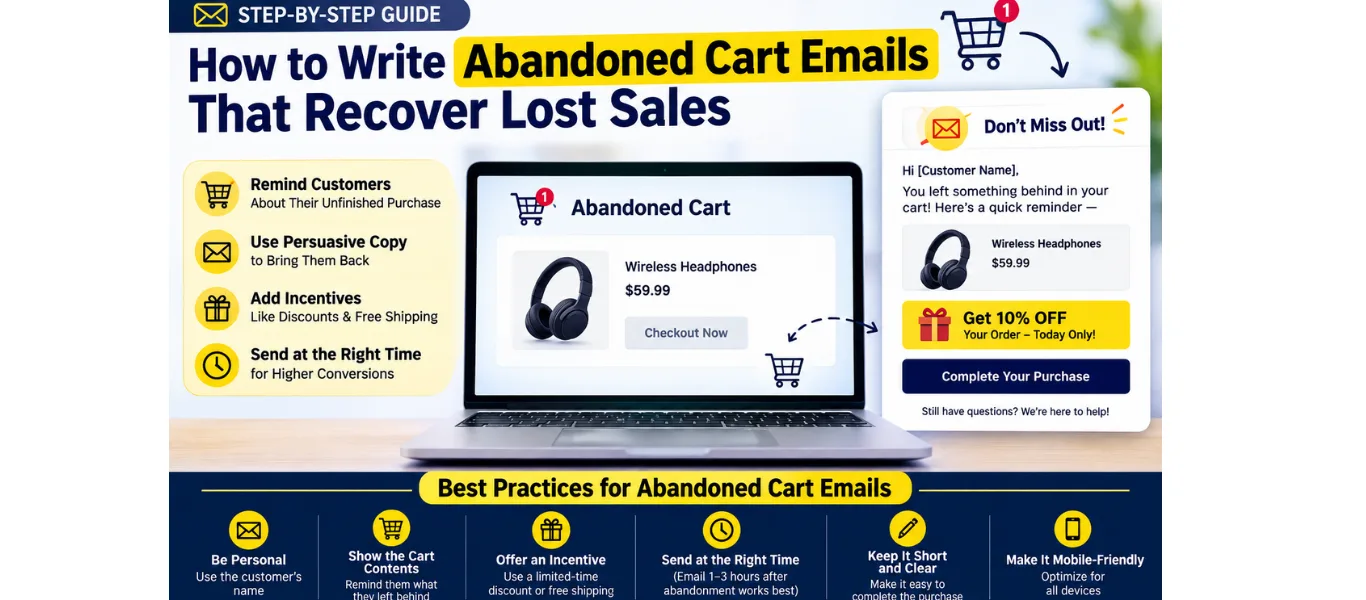
How to Write Abandoned Cart Emails That Recover Lost Sales — 2026 Guide
Shocking fact: 70% of online shoppers abandon their cart before completing a purchase. For every 10 people who add your product to their cart, 7 leave without buying. This is not a product or pricing issue. It is a follow-up problem—and one of the most profitable to solve in e-commerce.
The solution is a properly written abandoned cart email sequence. Not a single automated reminder. A deliberate 3-email sequence with the right copy at the right time—built to bring distracted, hesitant, and price-sensitive shoppers back to checkout.
This complete guide covers everything: how to write abandoned cart emails that actually recover lost sales, the exact 3-email sequence structure with send times, real subject line formulas, whether to offer a discount, and step-by-step setup in both Klaviyo and Mailchimp.
What you will have after this guide: A complete 3-email abandoned cart sequence with subject lines, copy angles, timing, and CTA strategy — ready to set up in your email platform today. The average 3-email cart recovery sequence recovers 5–8% of abandoned carts automatically, every day, without any ongoing effort.
Why Cart Abandonment Is the Biggest Revenue Leak in Ecommerce
Before learning how to write abandoned cart emails, it helps to understand exactly how much revenue cart abandonment is costing your store — because once you see the number, you will treat this automation as your highest priority.
Here is the cart abandonment reality for a typical Shopify store:
- Average cart abandonment rate: 70% of all shoppers who reach the cart page leave without buying
- Global revenue lost annually: $36 billion worth of e-commerce revenue is lost to cart abandonment every year across the industry
- Recovery potential: A 3-email abandoned cart recovery sequence can recover 5–8% of those lost sales—which, for a store doing $20,000/month, means $700–$1,120 in recovered revenue every single month, on autopilot
- Why shoppers abandon: Research consistently shows the top reasons are: got distracted (38%), not ready to buy yet (23%), comparing prices (18%), unexpected shipping costs (12%), and payment friction (9%). Most of these are addressable through email copy
The most important insight: cart abandoners are your warmest leads. They found your store, liked your product enough to add it to the cart, and left before completing the purchase. They do not need to be convinced your product is good. They need one clear, well-written nudge to come back.
KEY STAT: Abandoned cart emails have an average open rate of 40–50%—nearly double the open rate of standard promotional campaigns. The purchase intent is already there. Your copy just needs to activate it.
What Is an Abandoned Cart Email and How Does It Work?
An abandoned cart email is an automated message sent to a subscriber who added items to their cart but did not complete the purchase. Unlike broadcast campaigns that you send manually, cart recovery emails fire automatically—triggered by the abandonment behavior in real time.
Here is how the technical trigger works across the major e-commerce email platforms:
- Klaviyo: Tracks cart activity in real time through the Shopify integration. When a subscriber adds to cart and leaves without purchasing, Klaviyo fires the abandoned cart flow automatically—syncing the exact products in the cart, prices, and images into the email
- Mailchimp: Available on Standard and Premium plans. Connects to Shopify via the Mailchimp for Shopify app and sends an automated cart reminder with product details pulled dynamically
- Omnisend: Includes abandoned cart automation on all plans, including free. Strong product block personalisation that shows cart contents with images automatically
- Shopify Email: Basic abandoned checkout emails available natively through Shopify admin — simpler than third-party platforms but sufficient for stores just starting with cart recovery
The key distinction between abandoned cart emails and browse abandonment emails is that cart abandonment means the shopper added to cart.
“Browse abandonment” means they viewed a product page but did not add to cart. Cart abandonment emails have significantly higher open rates and conversion rates because the purchase intent is much stronger.
The 3-Email Abandoned Cart Sequence — Structure and Timing
The single biggest mistake e-commerce stores make with cart abandonment emails is sending only one. A single reminder captures the easiest recoveries — shoppers who simply got distracted. A 3-email abandoned cart email sequence captures three distinct types of abandoners: the distracted, the hesitant, and the price-sensitive.
| Send Time | Angle | Open Rate | Recovery Rate | |
| Email 1 — Reminder | 1 hour after abandon | Gentle reminder—no pressure | 40–50% | 2–4% |
| Email 2 — Follow-up | 24 hours after abandon | Benefit-led persuasion | 30–38% | 1–3% |
| Email 3 — Last chance | 72 hours after abandon | Urgency + optional discount | 25–32% | 1–2% |
| Full sequence combined | — | All three angles covered | — | 5–8% |
Each email in your cart recovery sequence targets a different psychological state—which is why the angle, tone, and offer strategy need to change across the three emails. Here is exactly how to write each one.
How to Write Email 1 — The Gentle Reminder (1 Hour After Abandonment)
Your first abandoned cart email should arrive within 1 hour of abandonment — while your store is still fresh in the shopper’s mind and the purchase intent is at its peak.
The Psychology of Email 1
The majority of cart abandoners at the 1-hour mark left because they got distracted—a phone call, a meeting, a family interruption. They are not price-objecting or brand-doubting. They simply forgot. Your email 1 tone should reflect this: warm, casual, and pressure-free. Think of it as a helpful reminder from a friend, not a sales pitch from a store.
Email 1 — Copy Framework
- Subject line: Personal, curiosity-driven, no discount mention. Examples: ‘Hey [Name], you left something behind…’ | ‘Your cart is waiting for you 🛒’ | ‘[Name], did you mean to leave this?’
- Opening line: Acknowledge what they left—with the product name and image if your platform supports dynamic product blocks
- Body copy: 1–2 short sentences reminding them why they wanted it. Lead with the feeling or outcome the product delivers—not the features
- CTA: Single button. ‘Complete My Order’ or ‘Return to My ‘Cart’—first-person phrasing converts 90% better than ‘Shop Now.’
- No discount: Do not offer a discount in Email 1. Most abandoners at this stage would have bought anyway—you save margin by not incentivising them unnecessarily
📧 EMAIL 1 EXAMPLE—1 Hour Subject: [Name], you left something behind… Preview: Your cart is still waiting — here is what you had saved. Hey [Name], you were so close. You left [PRODUCT NAME] in your cart — and we saved it for you. Thousands of [customers/people like you] love this because [core benefit in one sentence]. Whenever you are ready, it is right here waiting. → CTA: Complete My Order →
PRO TIP: Dynamic product blocks—showing the exact product image, name, and price from the abandoned cart—increase Email 1 click-through rates by an average of 36%. Klaviyo and Omnisend both support this natively.
How to Write Email 2 — The Persuasive Follow-Up (24 Hours After)
Shoppers who did not respond to Email 1 have a different psychological profile. They may be comparing options, uncertain about the purchase, or genuinely hesitant about the product. Your Email 2 abandoned cart copy needs to do more work—leading with the core benefit, addressing the most common objection, and building confidence through social proof.
The Psychology of Email 2
At the 24-hour mark, the shopper has seen your first reminder and did not act. This is no longer forgetfulness. This is hesitation. Your Email 2 should answer the question every hesitant buyer is asking: ‘Will this actually work for me?’
Email 2 — Copy Framework
- Subject line: Benefit-led or social proof angle. Examples: ‘Still thinking about it? Here is what 2,000 customers said…’ | ‘This is why people love [PRODUCT].’ | ‘[Name], here is what you get.’
- Opening: Acknowledge that they are still considering—validate the thought process without pressure
- Body copy: Lead with the strongest benefit. Include 1–2 specific customer reviews or testimonials that answer the most common objection. Use real customer names if possible
- Objection handling: Address the top 1–2 reasons people hesitate: shipping time, return policy, product quality concerns
- CTA: ‘Yes, I Want This’ or ‘Claim My [Product Name]—ownership language drives clicks
- Still no discount: Hold your discount for Email 3. Email 2 should convert through persuasion and confidence, not price reduction
📧 EMAIL 2 EXAMPLE — 24 Hours Subject: Still thinking about [PRODUCT]? Here is what customers say… Preview: 2,847 people bought this last month—here is what they told us. Hey [Name], we noticed you are still thinking about [PRODUCT]. That is completely understandable — we want you to feel great about this purchase. Here is what customers like you said: [REVIEW 1 with name] | [REVIEW 2 with name]. Free returns within 30 days. Ships in 2–3 business days. Questions? Reply to this email—we answer within 2 hours. → CTA: Yes, I Want This →
Related: For more persuasion techniques for e-commerce emails, read our guide on Email Copywriting Psychology That Drives Sales at blogwithjawed.com/email-copywriting-psychology-drives-sales
How to Write Email 3 — The Last Chance Close (72 Hours After)
Email 3 is your final attempt to recover the sale. At the 72-hour mark, you have exhausted gentle reminders and benefit-led persuasion. It is time to create genuine urgency and — if appropriate for your margins — offer an incentive to close the purchase.
The Psychology of Email 3
Shoppers who have received two emails and still have not purchased are either genuinely price-sensitive or have found an alternative. Your last-chance cart recovery email needs to introduce urgency—through stock availability, cart expiry, or a time-limited discount—and make the decision to buy feel easy and risk-free.
Email 3 — Copy Framework
- Subject line: Urgency led with a deadline. Examples: ‘⏰ Your cart expires tonight—here is 10% off.’ | ‘Last chance—[PRODUCT] is selling fast.’ | ‘[Name], this offer expires in 3 hours.’
- Opening: State the deadline or scarcity clearly in the first line—do not bury it
- Body copy: Short and direct. Restate the core benefit in one sentence. Introduce the discount or urgency driver. Make the CTA impossible to miss
- Discount decision: If you are offering a discount, keep it consistent — 10–15% is the sweet spot for most e-commerce stores. Anything lower feels insufficient; anything higher trains customers to abandon intentionally to get deals
- Urgency: Only use genuine urgency—real stock limits, real expiry times. False urgency destroys trust permanently when discovered
- CTA: ‘Claim My 10% Off’ or ‘Complete My Order—Save 10%’—lead with the benefit they get, not the action you want
📧 EMAIL 3 EXAMPLE — 72 Hours Subject: ⏰ [Name], your cart expires tonight—here is 10% off Preview: Last chance to save — this offer ends at midnight. Hey [Name], this is the last time we will reach out about your [PRODUCT]. We would love to see you get the [core benefit]. So here is our final offer: use code SAVE10 at checkout for 10% off your order. This code expires at midnight tonight. After that, your cart will clear and the offer disappears. If you have any questions before buying, reply to this email — we are here. → CTA: Claim My 10% Off →
Related: For a deep dive on urgency and scarcity tactics that convert without damaging trust, read our guide on How to Use Scarcity and Urgency in Ecommerce Emails at blogwithjawed.com/scarcity-urgency-ecommerce-emails
Abandoned Cart Email Subject Lines That Get Opened
Your abandoned cart email subject lines determine whether your recovery sequence gets read or ignored. Here are the highest-converting subject line formulas by type:
| Subject Line Type | Avg Open Rate | Example |
| Personalised with first name | 52% | Sarah, your cart is waiting for you 🛒 |
| Discount reveal | 51% | Here is 10% off what you left behind |
| Urgency with deadline | 49% | Your cart expires in 24 hours ⏰ |
| Question format | 47% | Did you forget something, [Name]? |
| Direct with emoji | 46% | 🛒 You left something behind… |
| Curiosity gap | 44% | We saved something for you… |
| Product name specific | 43% | Still thinking about [PRODUCT NAME]? |
Subject Line Rules for Cart Recovery Emails
- Keep it under 50 characters: Subject lines over 50 characters get cut off on mobile — where 60%+ of ecommerce emails are opened
- Use first-name personalisation: Subject lines with the subscriber’s first name open 26% higher on average across all email types
- Never reveal the discount in Email 1 subject line: Save the incentive reveal for Email 3 — using it too early conditions shoppers to abandon intentionally
- A/B test every subject line: Send two versions to 20% of your abandoners each and deploy the winner to the remaining 60%—Klaviyo does this automatically
Related: Our complete guide to Email Subject Line Secrets That Increase Open Rates at blogwithjawed.com/email-subject-line-secrets-increase-open-rates covers every proven subject line formula with examples for every email type.
Should You Offer a Discount in Your Abandoned Cart Emails?
This is the most debated question in abandoned cart email copywriting—and the honest answer is it depends on which email in the sequence and it depends on why your customer abandoned.
The Case Against Discounting in Email 1 and Email 2
Research from Klaviyo’s internal data consistently shows that 38% of cart abandoners left because they got distracted — not because of price. Offering a discount to these shoppers is unnecessary and directly reduces your margin. You were going to close the sale at full price. The discount is pure cost.
More importantly: if you consistently offer discounts in your first cart recovery email, you train a segment of your audience to abandon intentionally. Savvy shoppers learn that leaving the cart triggers a discount—and use it as a price-negotiation tactic.
The Case For Discounting in Email 3
Shoppers who have received two cart recovery emails and still have not purchased are demonstrating genuine price resistance. At the 72-hour mark, a 10–15% discount offer is justified — you are recovering a sale that would otherwise be permanently lost, and the margin trade-off is worth the recovered revenue.
| Discount Strategy | Reason | |
| Email 1 — 1 hour | No discount | 38% abandoned due to distraction — discount unnecessary |
| Email 2 — 24 hours | No discount | Convert through persuasion and social proof first |
| Email 3 — 72 hours | 10–15% optional | Price-sensitive shoppers need final incentive to close |
WARNING: Never use fake urgency in your cart recovery emails. ‘Only 2 left in stock’ when you have 200 units, or ‘Offer expires in 1 hour’ when it does not — destroys trust permanently when discovered. Only use urgency and scarcity that is 100% genuine.
How to Set Up Abandoned Cart Emails in Klaviyo
Klaviyo is the most powerful platform for Shopify abandoned cart email automation — its real-time cart data sync, dynamic product blocks, and multi-step flow builder make it the industry standard for ecommerce cart recovery.
- Log into your Klaviyo account and go to Flows in the left navigation
- Click Create Flow and select Abandoned Cart from the pre-built flow library
- The trigger is set automatically — Klaviyo fires when a contact starts checkout and does not complete it within the trigger delay you set
- Set your Email 1 delay to 1 hour — click the time delay block and set 1 hour
- Customise Email 1 — use Klaviyo’s drag-and-drop editor and add a dynamic product block showing cart contents automatically
- Add a time delay block of 23 hours (total: 24 hours from abandonment) then add Email 2
- Add a time delay block of 48 hours (total: 72 hours from abandonment) then add Email 3
- Add a conditional split before Email 3 — if purchased, exit the flow. If not purchased, send Email 3 with discount code
- Turn the flow to Live and test with your own email address to verify the product blocks and timing
Platform guide: For a full comparison of Klaviyo vs Mailchimp for ecommerce automations, read our guide at blogwithjawed.com/klaviyo-vs-mailchimp-ecommerce
How to Set Up Abandoned Cart Emails in Mailchimp
Mailchimp’s abandoned cart email feature is available on Standard and Premium plans. It is simpler than Klaviyo but sufficient for stores just starting with cart recovery.
- Connect your Shopify store to Mailchimp via the Mailchimp for Shopify app in the Shopify App Store
- Go to Automations in your Mailchimp dashboard and click Create
- Select E-commerce under the automation categories
- Choose Abandoned Cart and click Begin
- Set your send delay — Mailchimp’s default is 1 hour for the first email, which is correct
- Customise the email template — add your brand colours, product block, and copy following the frameworks in this guide
- To add a second and third email, click Add Email in the automation sequence builder
- Set Email 2 delay to 24 hours and Email 3 delay to 72 hours from the original abandonment
- Activate the automation — it will begin firing for new cart abandoners immediately
Abandoned Cart Email Copywriting Best Practices
Beyond the 3-email structure, here are eight abandoned cart email copywriting best practices that consistently improve recovery rates:
- Show the exact product with an image: Dynamic product blocks showing the specific item the shopper added — with the actual image, name, and price — are the single highest-converting element in any cart recovery email
- Keep copy short in Email 1: Your first cart recovery email should be 50–80 words maximum. Get to the point fast — a wall of text kills the casual reminder tone
- Write in first person as a brand voice: ‘We noticed you left something behind’ outperforms robotic ‘Our system detected cart abandonment’ every time. Write like a human, not an automation
- Include trust signals in Email 2: Free returns, secure checkout badges, customer review count — anything that reduces the perceived risk of purchasing
- Make the CTA a button, not a text link: Button CTAs consistently outperform text links in cart recovery emails — they are easier to tap on mobile and more visually prominent
- Add a FAQ section to Email 2: Three common questions and answers — shipping time, return policy, product care — address the objections holding hesitant shoppers back
- Suppress purchasers immediately: If someone completes their purchase after Email 1, they should immediately exit the flow and not receive Emails 2 and 3. Klaviyo handles this automatically with conditional splits
- Track revenue per email: Monitor which email in your sequence drives the most recovered revenue. Most stores find Email 1 recovers the most volume, while Email 3 recovers the highest value per conversion
Benchmark check: For open rate, CTR, and revenue per email benchmarks for abandoned cart sequences, read our Ecommerce Email Marketing Benchmarks guide at blogwithjawed.com/ecommerce-email-marketing-benchmarks
Frequently Asked Questions
How many abandoned cart emails should I send?
Three emails is the proven sweet spot for abandoned cart email sequences in ecommerce. One email captures only the easiest recoveries — distracted shoppers who just needed a reminder. Two emails add benefit-led persuasion for hesitant buyers. Three emails introduce urgency and an optional incentive for price-sensitive shoppers. More than three emails sees diminishing returns and increasing unsubscribe rates.
When should I send abandoned cart emails?
The optimal abandoned cart email timing is: Email 1 within 1 hour of abandonment, Email 2 at 24 hours, and Email 3 at 72 hours. The 1-hour first email is critical — recovery rates drop significantly when the first email is delayed beyond 2 hours. Shoppers cool quickly and competing options fill the gap.
Should I offer a discount in my abandoned cart email?
Not in Email 1 or Email 2. A discount in Email 1 is unnecessary for the majority of abandoners who left due to distraction — you are giving away margin you did not need to. Save the discount for Email 3 (72 hours), where it targets only the price-sensitive shoppers who have genuinely resisted two previous reminders. Keep the discount at 10–15% — enough to motivate action without training customers to abandon intentionally.
What is a good abandoned cart email open rate?
A good abandoned cart email open rate for Email 1 is 40–50%. Email 2 should achieve 30–38% and Email 3 should hit 25–32%. If your Email 1 open rate is below 30%, the issue is likely your subject line — test personalisation with first name, curiosity gaps, and product-specific subject lines. For full benchmark data see blogwithjawed.com/ecommerce-email-marketing-benchmarks
What is the best abandoned cart email subject line?
The highest-converting abandoned cart email subject lines in 2026 combine personalisation with either curiosity or urgency. Top performers include: ‘[Name], your cart is waiting for you 🛒’ (52% open rate), ‘Did you forget something, [Name]?’ (47%), and ‘⏰ Your cart expires tonight — here is 10% off’ (49% for Email 3). Always A/B test two subject line variants before deploying to your full abandoner list.
How do I set up abandoned cart emails in Klaviyo?
To set up Klaviyo abandoned cart emails: go to Flows → Create Flow → select Abandoned Cart from the template library. Set Email 1 delay to 1 hour, Email 2 to 24 hours, and Email 3 to 72 hours. Add a conditional split before Email 3 to exit any subscriber who purchases after Email 1 or 2. Add dynamic product blocks to all three emails so cart contents display automatically. Turn the flow to Live and test with your own email address before going live.
Start Recovering Lost Sales Today
Your abandoned cart email sequence is the single highest-ROI automation you can build for your e-commerce store. Set it up once—it recovers revenue every day, every week, and every month without any ongoing effort from you.
To summarize the complete abandoned cart recovery framework from this guide:
- Email 1 at 1 hour: Warm, casual reminder—no pressure, no discount, show the product
- Email 2 at 24 hours: Benefit-led persuasion — social proof, objection handling, confidence building
- Email 3 at 72 hours: Urgency and optional 10–15% discount — final close for price-sensitive shoppers
- Subject lines: Personalized first name + curiosity or urgency — test two variants on every email
- Discount strategy: Hold until Email 3 — protect margins and prevent intentional abandonment behaviour
- Platform setup: Klaviyo for maximum Shopify integration depth—Mailchimp or Omnisend as capable alternatives
Related reading:
Ecommerce Welcome Email Sequence
Scarcity and Urgency in Ecommerce Emails
Published on blogwithjawed.com | Written by Jawed Iqbal | Email Copywriter for Ecommerce Brands