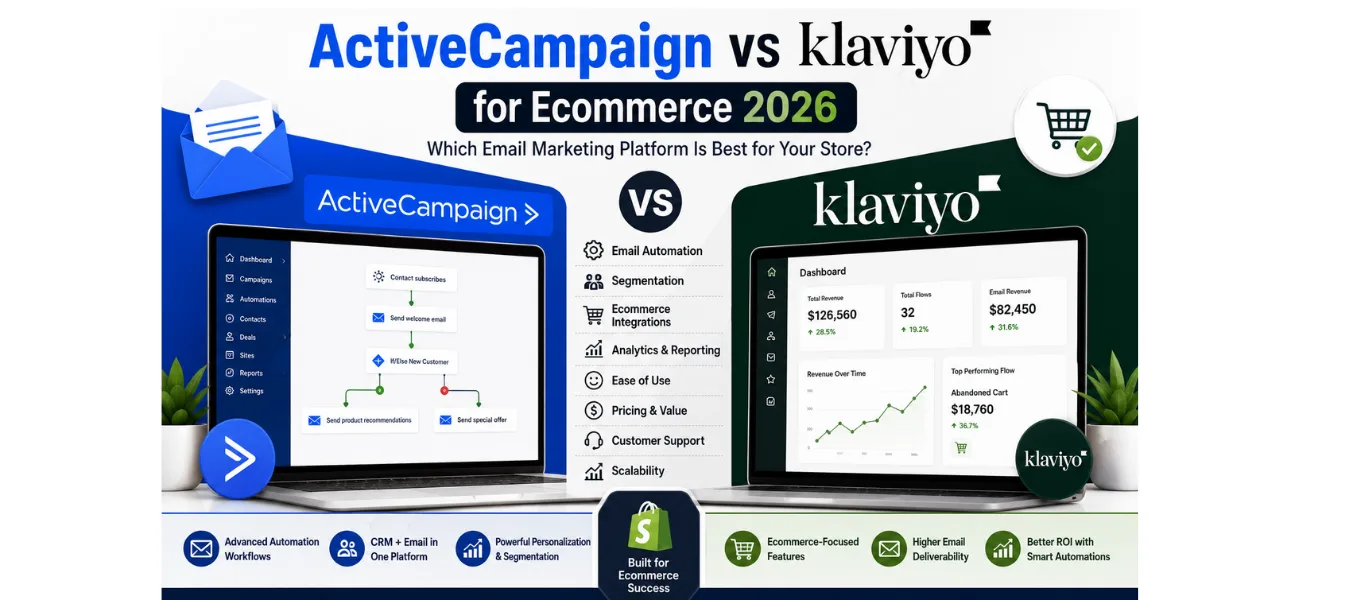
ActiveCampaign vs Klaviyo for Ecommerce 2026 — Honest Comparison
Critical question: You’re choosing between ActiveCampaign and Klaviyo for your e-commerce store—and every comparison you’ve read gives you a different answer. Some say Klaviyo dominates. Others say ActiveCampaign’s automation builder is unbeatable. Neither is wrong, but neither is giving you the full picture.
The honest truth about ActiveCampaign vs Klaviyo is that these are two genuinely excellent platforms that solve different problems for different e-commerce businesses. Choosing between them isn’t about which one is objectively better. It’s about which one is better for the specific way your store operates and grows.
I’ve worked with e-commerce brands on both platforms. In this guide, I’ll give you the most honest Klaviyo vs ActiveCampaign comparison available in 2026—covering Shopify integration, automation capability, CRM features, segmentation depth, pricing, and a clear verdict for every store type. No affiliate commissions influencing a single word.
Quick verdict: Klaviyo wins for pure product e-commerce stores on Shopify and WooCommerce where email revenue attribution and e-commerce-native automation are the priority. ActiveCampaign wins when CRM capability, sophisticated multi-step automation, and sales pipeline management matter as much as email marketing. Full breakdown below.
ActiveCampaign vs Klaviyo — Quick Overview
What Is Klaviyo?
Klaviyo is an e-commerce email marketing platform built from the ground up for online stores. Every feature—its Shopify integration, automation flows, segmentation engine, and revenue attribution dashboard—is designed specifically for e-commerce brands that sell products to consumers. It’s the dominant platform for DTC and Shopify brands in 2026, with over 130,000 paying customers.
What Is ActiveCampaign?
ActiveCampaign is a marketing automation and CRM platform that serves both B2B and B2C businesses. Unlike Klaviyo, it wasn’t built exclusively for e-commerce—it was built for businesses that need sophisticated automation sequences combined with customer relationship management. Its e-commerce capabilities have grown significantly, but its CRM and automation builder remain its strongest differentiators.
ActiveCampaign vs. Klaviyo—Head-to-Head Comparison Table
Here’s the complete ActiveCampaign vs Klaviyo comparison across every dimension that matters for e-commerce stores:
| Feature | Klaviyo | ActiveCampaign |
| Built for | Pure e-commerce—DTC brands | B2B + B2C — CRM-first |
| Shopify integration | Native — deepest available | Good, solid sync |
| Ecommerce automation | Best-in-class flows | Strong—less e-commerce-specific |
| CRM capability | Basic only | Full built-in CRM |
| Automation builder | Excellent — visual flows | Most powerful available |
| Revenue attribution | Best-in-class | Good |
| Segmentation | Best e-commerce segmentation | Powerful — tag-based |
| Browse abandonment | Yes—native | Yes — requires setup |
| SMS marketing | Native SMS + email | Limited SMS |
| Free plan | Yes—250 contacts | 14-day trial only |
| 10K contacts’ price | ~$200/month | ~$186/month |
| Learning curve | Moderate | Steep |
| Best for | Product e-commerce / DTC | High-ticket / B2B e-commerce |
1. Shopify Integration — Which Connects Better?
For most e-commerce stores, the depth of Shopify integration is the single most important factor in choosing between ActiveCampaign vs Klaviyo. The quality of the integration determines what customer data is available for segmentation and automation — and that determines how much revenue your email program can generate.
Klaviyo’s Shopify Integration
Klaviyo’s Shopify integration is the deepest available in the e-commerce email marketing market. The moment you connect your store, Klaviyo syncs:
- Complete purchase history for every customer—including products, order values, and frequency
- Real-time browsing behavior—which pages, products, and categories each subscriber has viewed
- Cart activity — add-to-cart events, abandonment events, and cart value in real time
- Customer lifetime value — calculated automatically and updated continuously
- Product catalogue — enabling dynamic product recommendation blocks in emails
- Predictive data — next predicted order date, churn probability, and predicted CLV
All of this data is available as triggers for automation flows and as filters for segmentation — in real time, without any additional setup. This is what makes Klaviyo’s abandoned cart email and browse abandonment flows the most precise in the market.
ActiveCampaign’s Shopify Integration
ActiveCampaign’s Shopify integration is solid but less deep than Klaviyo’s. It syncs purchase history, customer data, and abandoned cart events—giving you the core data needed for e-commerce automation. However, it lacks the real-time browsing behavior and predictive data that Klaviyo provides natively.
For most e-commerce automations—welcome series, post-purchase flows, and cart abandonment—ActiveCampaign’s Shopify integration provides the behavior you need. Where the gap becomes meaningful is in advanced use cases like browse abandonment based on specific product views, dynamic product recommendation blocks, and predictive replenishment flows.
WINNER: Klaviyo—deeper real-time e-commerce data sync with predictive analytics
2. Email Automation — Which Builds Better Flows?
Both platforms have strong automation builders—but they’re strong in different ways. This is one of the most important distinctions in the ActiveCampaign vs Klaviyo debate.
Klaviyo’s Automation Flows
Klaviyo’s flow builder is purpose-built for e-commerce. Pre-built templates exist for every core e-commerce automation:
- Abandoned cart sequence: Multi-email recovery flow triggered by cart abandonment — with dynamic product blocks showing the exact items left behind
- Browse abandonment flow: Triggered when a subscriber views a product without adding to the cart—one of the highest ROI automations in e-commerce, available natively in Klaviyo
- Welcome series: Post-signup sequence that educates new subscribers and drives first purchase — with split testing on subject lines and content
- Post-purchase flow: Thank-you sequence with upsell, review requests, and repeat purchase encouragement — triggered by specific product purchases
- Win-back campaign: Re-engagement sequence for lapsed customers — with AI-predicted churn probability as the trigger
- Predictive replenishment: AI-triggered reminder when a consumable product is predicted to run out — unique to Klaviyo
Every flow in Klaviyo can use real-time e-commerce data as both triggers and content. A post-purchase flow can show different content based on the specific product purchased. A win-back campaign can offer different discounts based on a customer’s predicted lifetime value.
ActiveCampaign’s Automation Builder
ActiveCampaign’s automation builder is the most powerful available from a pure technical standpoint. Its visual workflow editor supports:
- Conditional logic branching—send subscribers down completely different paths based on behaviour or data
- Goal-based automations — automations that end when a subscriber achieves a defined goal
- Multiple trigger types — including CRM deal stages, contact scores, and custom fields
- Automation chaining — trigger one automation from within another for complex multi-sequence journeys
- Deep conditional splits — split paths based on hundreds of conditions simultaneously
For complex B2B e-commerce or high-ticket product stores where customer journeys involve multiple touchpoints, consideration phases, and sales team handoffs, ActiveCampaign’s automation builder is genuinely unmatched. The ability to connect email sequences to CRM deal stages and contact scoring makes it the most sophisticated tool for complex customer journey management.
The trade-off: ActiveCampaign’s automations require significantly more setup time for e-commerce-specific flows. Klaviyo’s browse abandonment flow takes minutes to configure. The equivalent in ActiveCampaign requires custom setup, webhook configuration, and significantly more build time.
WINNER: Klaviyo—e-commerce-native flows with less setup time for standard e-commerce automations
ActiveCampaign wins for stores needing conditional logic, CRM integration, and complex multi-branch customer journeys.
3. CRM Capabilities — Where ActiveCampaign Wins Decisively
This is the area where ActiveCampaign vs Klaviyo has the clearest winner—and it’s not close.
Klaviyo has basic contact management and customer profiles, but it is fundamentally not a CRM. It doesn’t have deal pipelines, contact scoring beyond email engagement, sales team task management, or the ability to track relationships beyond email interactions.
ActiveCampaign, by contrast, includes a full built-in CRM with:
- Deal pipelines: Visual sales pipeline management with drag-and-drop deal stages — fully connected to email automation triggers
- Contact scoring: Automatically score contacts based on email engagement, website behaviour, and custom actions—triggering different automations at different score thresholds
- Sales task management: Assign follow-up tasks to team members directly from automation workflows
- Email + CRM in one: When a deal moves to a new stage in the CRM, an email sequence can automatically trigger—no integration required
- Conversation history: Full record of every email, call note, and interaction in a single customer timeline
For e-commerce stores selling high-ticket products where sales conversations happen before purchases—think custom furniture, B2B supplies, luxury goods, or subscription services with long consideration cycles—ActiveCampaign’s CRM transforms how you manage customer relationships.
WINNER: ActiveCampaign — built-in CRM with deal pipelines, contact scoring, and sales task management
4. Ecommerce Segmentation — Where Klaviyo Pulls Ahead
Segmentation is the backbone of e-commerce email marketing—the ability to send the right message to the right customer at the right time. The depth of email list segmentation tools directly determines how personalized and revenue-generating your campaigns can be.
Klaviyo Segmentation
Klaviyo’s segmentation for ecommerce email marketing is the most sophisticated available. You can create dynamic segments based on:
- Purchase frequency — first-time vs. repeat vs. VIP buyers
- Total spend — customer lifetime value thresholds
- Specific products purchased — or never purchased
- Predicted next order date — AI-powered repurchase prediction
- Predicted CLV—target highest-value future customers proactively
- RFM scoring—Recency, Frequency, Monetary value combined
- Churn probability — identify at-risk customers before they lapse
- Email engagement — opens, clicks, and purchase rate combined
These segments update dynamically in real time as customer behavior changes—a customer who makes their second purchase automatically moves from the first-time buyer segment to the repeat customer segment, triggering different flows without any manual intervention.
ActiveCampaign Segmentation
ActiveCampaign uses a tag-based segmentation system that is extremely powerful for CRM email marketing integration and B2B use cases. Contacts can be tagged based on any action, field value, or automation step — enabling granular audience management.
For pure e-commerce segmentation based on purchase behavior, however, ActiveCampaign’s tag-based system requires more manual configuration to achieve what Klaviyo delivers out of the box. RFM scoring, predicted CLV, and churn probability are not native features — they require custom field setup and manual calculation or third-party integration.
WINNER: Klaviyo—native e-commerce segmentation with RFM, predictive CLV, and real-time updates
5. Pricing Comparison — ActiveCampaign vs Klaviyo
Here’s the ActiveCampaign vs Klaviyo pricing comparison at key contact tiers:
| Contacts | Klaviyo/Month | ActiveCampaign/Month |
| Free / Trial | $0 — 250 contacts | 14-day trial only |
| 500 contacts | ~$20 | ~$15 (Starter) |
| 1,000 contacts | ~$30 | ~$29 (Plus — CRM) |
| 2,500 contacts | ~$60 | ~$49 (Plus) |
| 5,000 contacts | ~$100 | ~$79 (Plus) |
| 10,000 contacts | ~$200 | ~$186 (Plus) |
| 25,000 contacts | ~$400 | ~$286 (Plus) |
Prices are approximate 2026 monthly rates. ActiveCampaign Plus plan required for CRM features. Annual billing reduces costs by 15–20% on both platforms.
The ActiveCampaign vs Klaviyo pricing comparison is closer than most expect—at 10,000 contacts, the gap is only ~$14/month. The more significant difference lies in what each platform includes at its base tier: Klaviyo offers a free plan with full features, while ActiveCampaign’s CRM is only available on the Plus plan ($49+/month minimum).
For a full breakdown of Klaviyo pricing at every tier, including its free plan, read our dedicated guide: Klaviyo Pricing 2026 — Is It Worth It for Small Stores?
6. ActiveCampaign vs Klaviyo — Which Should You Choose?
After comparing both platforms across every dimension, here’s the clear decision framework for ActiveCampaign vs Klaviyo
Choose Klaviyo When:
- You run a pure-product e-commerce store: Shopify, WooCommerce, or BigCommerce—selling physical or digital products directly to consumers
- Email revenue attribution matters: You want to know exactly how much money each email and each flow generates—Klaviyo’s revenue dashboard is best-in-class
- You want e-commerce automation ready immediately: Klaviyo’s pre-built abandoned cart, browse abandonment, and welcome flows work in minutes, not hours
- SMS + email in one platform is a priority: Klaviyo’s native SMS integration in email workflows is unmatched
- You value predictive e-commerce analytics: Predicted CLV, churn probability, and next order date are native Klaviyo features that drive proactive campaigns
- Browse abandonment is critical: If visitors leaving without buying is a key revenue loss point, Klaviyo’s real-time browse abandonment trigger is a significant advantage
Choose ActiveCampaign When:
- Your store needs CRM capabilities: If managing customer relationships beyond email—deal pipelines, contact scoring, sales tasks—is as important as email automation
- You sell high-ticket products: High-ticket e-commerce with longer consideration-to-commerce and sales team involvement benefits from ActiveCampaign’s CRM + email combination
- You run B2B e-commerce: Selling to businesses requires relationship management that Klaviyo simply doesn’t provide
- Complex conditional automation is your priority: If your customer journeys require sophisticated branching logic beyond standard ecommerce flows, ActiveCampaign’s automation buildee-commerceequal
- You need multi-channel marketing beyond email and SMS: ActiveCampaign’s broader marketing automation scope suits businesses with complex multi-channel strategies
See also: Our full Klaviyo vs Mailchimp comparison at — covers the two most popular e-commerce email platforms head-to-head at every tier and a complete feature breakdown.
7. When to Choose ActiveCampaign Over Klaviyo
Despite Klaviyo’s dominance in e-commerce email marketing, there are specific store types where ActiveCampaign is genuinely the better choice:
High-Ticket Ecommerce Stores
If your average order value is above $500 and customers typically research for weeks before buying, the sales cycle more closely resembles B2B than standard e-commerce. ActiveCampaign’s ability to score leads based on engagement, trigger sequences based on CRM deal stages, and hand off contacts to sales team members makes it far more powerful at this end of the market.
B2B Ecommerce Operations
If your Shopify store serves business customers—wholesale, trade accounts, or B2B supply—ActiveCampaign’s e-commerce capabilities combined with its CRM are genuinely better suited than Klaviyo’s consumer-focused architecture.
Stores That Need Complex Automation Logic
If your email strategy requires conditional branching—send email A if the subscriber clicked link 1 but not link 2, then wait 3 days, then check if they visited your pricing page before sending email B—ActiveCampaign’s automation builder handles this level of complexity more elegantly than any other platform.
8. When to Choose Klaviyo Over ActiveCampaign
For the majority of e-commerce stores, Klaviyo is the stronger choice—here’s when that verdict is definitive:
Standard DTC Product E-commerce
If you sell physical products directly to consumers on Shopify or WooCommerce, Klaviyo’s e-commerce-native architecture, browse abandonment flows, and revenue attribution make it the clear winner. The platform was built for exactly this use case.
Stores Where Email Revenue Attribution Matters
Knowing exactly which email generated which sale is the difference between optimizing your program and guessing. Klaviyo’s revenue per email tracking is the best in the market—and for stores where data-driven email optimization is a priority, that capability alone justifies choosing Klaviyo.
Growing Shopify Stores Ready to Scale
Klaviyo scales exceptionally well as a store grows. Its predictive analytics become more powerful with more data, its segmentation becomes more precise with a larger list, and its SMS + email combination becomes more valuable as customer acquisition costs rise. The platform that’s right at $5,000/month is still the right platform at $500,000/month for most DTC brands.
Also read: Best Email Marketing Tools for Ecommerce in 2026—covers all 7 major platforms with pricing, automation comparison, and a clear recommendation for every store type.
Frequently Asked Questions
Is ActiveCampaign good for e-commerce?
Yes—ActiveCampaign is good for e-commerce, particularly for high-ticket stores, B2B e-commerce, and businesses that need CRM capabilities alongside email marketing. Its automation builder is the most powerful available, and its Shopify integration covers core e-commerce automation needs. However, for standard DTC product e-commerce where revenue attribution, browse abandonment, and e-commerce-native flows are the priority, Klaviyo typically delivers stronger results.
Which is better for Shopify — ActiveCampaign or Klaviyo?
For most Shopify stores, Klaviyo is better than ActiveCampaign. Klaviyo’s native Shopify integration syncs real-time browsing behaviour, cart activity, and predictive data that ActiveCampaign’s Shopify integration doesn’t match. For standard DTC ecommerce on Shopify — abandoned cart recovery, browse abandonment, post-purchase flows, and customer segmentation by purchase behaviour — Klaviyo’s ecommerce-first architecture delivers superior results. ActiveCampaign is the stronger choice when CRM features and complex conditional automation are equally important to email performance.
What does ActiveCampaign do better than Klaviyo?
ActiveCampaign outperforms Klaviyo in three specific areas: CRM capabilities (full deal pipelines, contact scoring, and sales task management), automation complexity (the most powerful conditional logic builder available), and versatility for non-ecommerce use cases. For e-commerce stores that also need CRM functionality—particularly high-ticket and B2B stores—ActiveCampaign vs Klaviyo has a clear winner in ActiveCampaign.
Can I migrate from ActiveCampaign to Klaviyo?
Yes—migrating from ActiveCampaign to Klaviyo is a well-documented process that most stores complete in one to two weeks. Klaviyo offers migration support and can import your subscriber list, historical purchase data, and suppression lists. Automation flows need to be rebuilt in Klaviyo’s interface, which takes additional time but is typically straightforward for standard e-commerce flows. The migration is worth doing when your store reaches the revenue stage where Klaviyo’s e-commerce-native features will generate meaningful additional revenue.
Is ActiveCampaign cheaper than Klaviyo?
At most contact tiers, ActiveCampaign pricing is slightly cheaper than Klaviyo—at 10,000 contacts, approximately $186/month vs $200/month. However, ActiveCampaign’s CRM features require the Plus plan ($49+/month minimum), and Klaviyo offers a free plan with full features for up to 250 contacts that ActiveCampaign doesn’t match. The pricing gap narrows significantly once CRM features are factored in.
Final Verdict—ActiveCampaign vs Klaviyo for Ecommerce in 2026
The ActiveCampaign vs Klaviyo decision comes down to one core question: what kind of e-commerce business are you running?
For standard DTC product e-commerce on Shopify or WooCommerce—selling physical products directly to consumers where email revenue attribution, abandoned cart recovery, browse abandonment, and e-commerce segmentation are the priorities—Klaviyo is the clear winner. Its e-commerce-native architecture, predictive analytics, and real-time Shopify data integration make it the most powerful revenue-generating email platform for this use case.
For high-ticket e-commerce, B2B stores, or any business where CRM capability and complex automation logic matter as much as email marketing—ActiveCampaign is the stronger choice. Its full CRM, powerful conditional automation builder, and versatility across B2B and B2C use cases make it the right platform for businesses where customer relationship management is central to revenue generation.
Both platforms are excellent—but excellent at different things. Match the platform to your business model, not to a generic recommendation.
Whichever platform you choose, the email copy running inside it matters as much as the automation logic behind it. High-converting welcome sequences, abandoned cart emails, and post-purchase flows require copy that connects with your audience and drives action. Visit blogwithjawed.com to learn how I help ecommerce brands get more from their email platform.
Related reading: Klaviyo vs Mailchimp for Ecommerce — blogwithjawed.com/klaviyo-vs-mailchimp-ecommerce | Klaviyo Pricing 2026 — Is It Worth It? — blogwithjawed.com/klaviyo-pricing-worth-it-small-ecommerce | Best Email Marketing Tools for Ecommerce — blogwithjawed.com/best-email-marketing-tools-ecommerce
Published on blogwithjawed.com | Written by Jawed Iqbal | Email Copywriter for Ecommerce Brands
Tags: ActiveCampaign vs Klaviyo, Klaviyo vs ActiveCampaign, ActiveCampaign ecommerce, best email marketing for ecommerce, ActiveCampaign review 2026, ecommerce email automation, CRM email marketing ecommerce