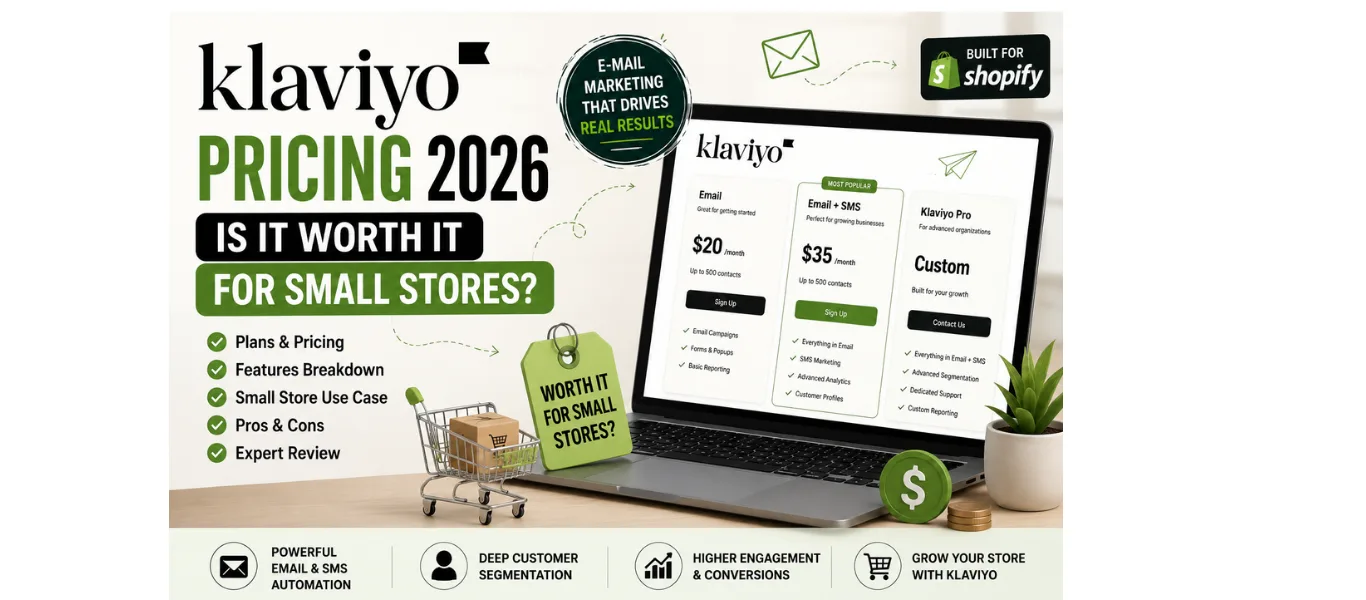
Klaviyo Pricing 2026 — Is It Worth It for Small Ecommerce Stores?
Surprising truth: the most common question I get from small e-commerce store owners isn’t “How do I write better emails?”—it’s “Is Klaviyo worth it for a store my size?”
And it’s a fair question. Klaviyo pricing is not the cheapest option in the market. At 10,000 contacts, you’re looking at around $200 per month — significantly more than Mailchimp at $135 or Omnisend at $115. For a small Shopify store watching every penny of overhead, that gap feels significant.
But here’s what most Klaviyo cost comparisons miss: the question isn’t whether Klaviyo is expensive. The question is whether Klaviyo generates enough additional revenue to justify the premium. And that answer depends entirely on where your store is right now.
In this guide, I’ll break down every Klaviyo pricing plan in detail, explain exactly how much Klaviyo costs at every contact tier, and give you a clear, honest verdict on whether it’s worth it—based on your store’s monthly revenue, not a generic recommendation.
Quick answer: Klaviyo is NOT worth it for stores doing under $1,500/month. It IS worth it—often dramatically—for stores doing $2,000+/month who activate its automation flows properly. Full breakdown below.
How Klaviyo Pricing Actually Works in 2026
Before we can answer whether Klaviyo is worth it for small e-commerce stores, you need to understand exactly how its pricing model works—because it’s different from most email marketing tools.
Klaviyo charges based on active profiles — not total contacts, not email sends. An active profile is any contact in your Klaviyo account who has been emailed or is contactable. This includes:
- Subscribers who have received at least one email in the last 90 days
- Contacts who are opted-in and eligible to receive emails
- SMS contacts who are opted-in for text messages
This distinction matters because it’s different from how tools like Mailchimp count contacts. In Klaviyo, if a subscriber goes 90+ days without receiving an email, they may become inactive and stop counting toward your billing tier — potentially reducing your Klaviyo monthly cost automatically.
The practical implication: your actual Klaviyo cost is often lower than the sticker price if you maintain good list hygiene and regularly suppress unengaged contacts.
Klaviyo Free Plan — What You Get and What You Don’t
The Klaviyo free plan is one of the most generous in the email marketing tools for the e-commerce market—and it’s the best starting point for small stores testing the platform before committing to a paid tier.
What the Klaviyo Free Plan Includes
- 250 active profiles: Enough to build your initial list and test the platform properly
- 500 email sends per month: Sufficient for a small welcome series and occasional campaigns
- Full automation flows: Unlike Mailchimp’s free plan, Klaviyo unlocks all automation features, including abandoned cart flows, welcome series, and browse abandonment—on the free tier
- Full segmentation: Advanced segmentation based on purchase history, engagement, and behavioural data is available at no cost
- Revenue attribution: See exactly how much money each email and flow generates—even on the free plan
- 150 free SMS/MMS credits: Test SMS marketing alongside email at no additional cost
Klaviyo Free Plan Limitations
- 250 contact ceiling: Once you exceed 250 active profiles, you’ll need to upgrade to a paid plan
- 500 send limit: Low send volume limits how frequently you can run campaigns to your full list
- Klaviyo branding on emails: Free plan emails include Klaviyo footer branding
- Limited customer support: Email support only on the free tier — no live chat
Free plan verdict: The Klaviyo free plan is better than Mailchimp’s free plan for e-commerce specifically because it includes automation flows and segmentation that Mailchimp locks behind paid tiers. If you’re asking, “Is the Klaviyo free plan enough for a small store?” — yes, until you hit 250 contacts.
Klaviyo Pricing at Every Contact Tier — 2026
Here is the full Klaviyo pricing breakdown for 2026, compared against Mailchimp and Omnisend at the same contact tiers:
| Contacts | Klaviyo/Month | Mailchimp/Month | Omnisend/Month |
| 250 (Free) | $0 | $0 | $0 |
| 500 | ~$20 | ~$13 | ~$16 |
| 1,000 | ~$30 | ~$20 | ~$20 |
| 1,500 | ~$45 | ~$25 | ~$25 |
| 2,500 | ~$60 | ~$37 | ~$35 |
| 5,000 | ~$100 | ~$69 | ~$65 |
| 10,000 | ~$200 | ~$135 | ~$115 |
| 25,000 | ~$400 | ~$270 | ~$210 |
| 50,000 | ~$700 | ~$350 | ~$360 |
All prices are approximate 2026 monthly rates on standard plans. Annual billing typically reduces cost by 15–20%. Always verify current pricing on each platform’s website.
Looking at this table, the Klaviyo pricing premium is clear — it’s consistently 30–100% more expensive than competitors at every tier. But as we’ll cover below, that premium is contextual: it’s a bad deal at low revenue and a genuinely excellent deal at higher revenue stages.
What Are Active Profiles and Why Does It Matter for Your Klaviyo Bill?
One of the most common sources of confusion around Klaviyo pricing is the active profiles model—specifically how it differs from the contact-counting methods used by competitors.
Active profiles in Klaviyo include everyone you can email or SMS—opted-in subscribers, recent purchasers, and contactable profiles even if they haven’t opened your last few emails.
Active profiles do NOT include hard bounces, unsubscribes, profiles suppressed by you, and contacts who have been inactive beyond Klaviyo’s engagement window.
The practical implication for Klaviyo cost for small e-commerce stores: if you maintain strong list hygiene—regularly suppressing unengaged contacts, removing hard bounces promptly, and cleaning your list quarterly—your active profile count and, therefore, your Klaviyo monthly cost will be lower than your total contact count suggests.
Klaviyo Hidden Costs Small Stores Miss
- SMS pricing is separate: SMS messages cost additional credits on top of your email plan. Budget approximately $0.01–$0.02 per SMS credit depending on your plan
- Active profile threshold jumps: Klaviyo pricing tiers jump at specific thresholds—crossing 1,001 contacts moves you to the next tier immediately rather than on your next billing cycle
- Annual vs monthly pricing: Annual billing reduces your Klaviyo pricing by approximately 15–20%—a meaningful saving at higher tiers that most small stores overlook
Is Klaviyo Worth It for Stores Under $1,500/Month?
This is the most important question for small e-commerce store owners—and the most honest answer is probably not yet.
Here’s the logic: Klaviyo’s pricing premium over Mailchimp at the 500-contact tier is $7/month ($20 vs $13). At the 1,000-contact tier, it’s $10/month. Those differences are small in absolute terms, but the question is what additional value Klaviyo delivers at that store size.
For a store doing under $1,500/month, the advanced features that justify Klaviyo’s cost—browse abandonment flows, predictive CLV segmentation, and revenue-per-email attribution—often generate less incremental revenue than the tool promises because
- The subscriber list is too small for segmentation to add significant value
- Browse abandonment requires meaningful traffic volumes to generate revenue
- The learning curve costs time that small stores can’t spare
- The revenue uplift from Klaviyo over Omnisend at this stage is minimal
❌ VERDICT: Not Worth It Yet — For stores under $1,500/month — start with Mailchimp or Omnisend’s free plan. Learn email marketing fundamentals without paying the Klaviyo premium. Revisit when your store hits $1,500–$2,000/month consistently.
Is Klaviyo Worth It for Stores Doing $2,000–$10,000/Month?
This is where the Klaviyo ROI question gets genuinely interesting—and where most honest reviewers give a nuanced answer.
At this revenue stage, Klaviyo’s advanced features start delivering measurable incremental revenue. Let’s do the actual math for a store doing $5,000/month:
The Klaviyo ROI Calculation at $5,000/Month Revenue
- Browse abandonment flow: A well-optimized browse abandonment sequence typically converts 2–4% of triggered visitors. For a store with 500 daily visitors, that’s potentially $100–$400/month in additional revenue from one flow alone
- Abandoned cart recovery: Industry average cart recovery rate of 5–8% from email. For a store with a 70% cart abandonment rate on $5,000 GMV, that’s potentially $175–$280/month recovered
- Predictive replenishment: For consumable products, Klaviyo’s AI-predicted replenishment emails drive significant repeat purchase revenue that standard email tools can’t replicate
Combined, these three automations can conservatively generate $300–$700/month in additional revenue for a store at this stage. Against a Klaviyo cost of $60–$100/month at this list size, the ROI is clear.
The counterargument: Omnisend delivers most of these same automations — including browse abandonment — at $35–$65/month at this tier. The Klaviyo vs Omnisend pricing gap is real, and for stores at the lower end of this revenue range, Omnisend may be the smarter choice.
✅ VERDICT: Worth It — With Conditions — For stores doing $2,000–$10,000/month — Klaviyo is worth it IF you activate and optimize its automation flows within the first 30 days. If you’re just sending campaigns without using flows, Omnisend at 40% lower cost delivers comparable value. Read our full Klaviyo vs Mailchimp comparison at blogwithjawed.com/klaviyo-vs-mailchimp-ecommerce
Is Klaviyo Worth It for Stores Doing $10,000+/Month?
At this revenue stage, the Klaviyo pricing question has a clear answer: yes, without hesitation.
For ecommerce stores generating $10,000+ per month, Klaviyo’s cost at the relevant list size ($200–$400/month for most stores at this revenue level) represents 2–4% of monthly revenue. The platform’s automation flows, when properly configured, typically generate 20–35% of total store revenue for brands at this scale.
The features that make Klaviyo worth it at this stage include:
- Predictive Customer Lifetime Value: Identify your highest-value future customers and target them with specific retention campaigns before they consider churning
- RFM segmentation: Recency, Frequency, Monetary segmentation that automatically identifies your Champions, Loyal Customers, At-Risk, and Lost Customers—enabling precise win-back and VIP campaigns
- Revenue attribution at scale: Know exactly which flows, campaigns, and sequences are driving revenue—essential for optimising a $10,000+/month email program
- Advanced A/B testing: Test subject lines, content, send times, and CTA copy across large enough sample sizes for statistically significant results
✅ VERDICT: Absolutely Worth It — For stores doing $10,000+/month, Klaviyo is the clear choice. Its revenue attribution, predictive analytics, and automation depth justify the cost many times over. Switching from a cheaper platform to Klaviyo at this stage typically pays back within the first month.
Klaviyo vs Mailchimp Pricing — Head to Head
The Klaviyo vs Mailchimp pricing comparison is the one most small store owners care about—because these are the two platforms they’re most likely choosing between.
At 1,000 contacts, Klaviyo costs ~$30/month, and Mailchimp costs ~$20/month. That’s a $10/month difference — $120/year.
The key question isn’t whether $120/year is meaningful (it often is for small stores). The key question is, what does that $120 buy you?
- Klaviyo at $30: Browse abandonment automation, full revenue attribution, predictive analytics, deep Shopify integration with real-time behavioural data
- Mailchimp at $20: Basic Shopify sync, no browse abandonment, limited behavioural segmentation, no revenue-per-email tracking
For a full breakdown of every feature difference, read our dedicated comparison: Klaviyo vs Mailchimp for Ecommerce in 2026
Klaviyo vs Omnisend Pricing — Which Is Better Value?
The Klaviyo vs Omnisend pricing comparison is increasingly relevant in 2026 as Omnisend has closed the feature gap with Klaviyo while maintaining a significant price advantage.
At 5,000 contacts: Klaviyo is ~$100/month vs Omnisend ~$65/month—a $35/month, $420/year difference. At 10,000 contacts: Klaviyo is ~$200/month vs Omnisend ~$115/month—an $85/month, $1,020/year difference.
What Omnisend has that makes this comparison compelling:
- Browse abandonment flows — previously a Klaviyo exclusive, now available in Omnisend
- SMS + email + push notifications in one workflow
- Solid Shopify integration with behavioural data syncing
- Product recommendation blocks in emails
What Klaviyo still does better:
- Deeper predictive analytics and CLV modelling
- More granular RFM segmentation
- More sophisticated revenue attribution
- Larger ecosystem of integrations and pre-built flows
For stores doing $2,000–$10,000/month, where the annual price difference is $500–$1,000, Omnisend is worth serious consideration as the best Klaviyo alternative cheaper option. For stores doing $10,000+/month, Klaviyo’s additional sophistication typically justifies the premium.
When Should You Switch to Klaviyo?
The most common question I hear from store owners using Mailchimp or Omnisend is, “Should I switch to Klaviyo from Mailchimp—and when?”
Here’s the framework I use with every e-commerce client:
Switch to Klaviyo When:
- Your store consistently generates $2,000+/month: At this stage, Klaviyo’s automation revenue uplift typically covers the cost premium within 30 days
- You’re losing significant revenue to cart abandonment: If your store has a high cart abandonment rate and you’re not recovering it with automated sequences, Klaviyo’s flow builder is the most powerful tool available
- You need to segment beyond basic demographics: When purchase history, predicted CLV, and RFM scoring matter to your strategy, Klaviyo’s segmentation is unmatched
- You want SMS + email in one platform: Klaviyo’s combined email and SMS workflow editor is the most sophisticated on the market
- You’re ready to invest time in setup: Klaviyo requires 4–6 hours of initial setup to get full value. If you’re ready to invest that time, the payoff is significant
Stay on Your Current Platform When:
- Your store does under $1,500/month consistently
- You haven’t yet set up basic email automations on your current platform
- Your list has under 500 contacts, and traffic is still building
- The budget is genuinely tight and every $30/month matters right now
Read next: Best Email Marketing Software for Shopify Stores in 2026 — blogwithjawed.com/best-email-marketing-software-shopify — covers all major platforms at every price point with honest recommendations for every store stage.
Frequently Asked Questions
How much does Klaviyo cost per month in 2026?
Klaviyo pricing in 2026 starts at $0 for up to 250 contacts and 500 email sends/month. Paid plans start at approximately $20/month for 500 contacts, $45/month for 1,500 contacts, $100/month for 5,000 contacts, and $200/month for 10,000 contacts. SMS credits are charged separately. Annual billing reduces these rates by approximately 15–20%.
Is Klaviyo pricing worth it for a small Shopify store?
It depends on your store’s revenue stage. For stores doing under $1,500/month, Klaviyo’s pricing is not justified—start with Mailchimp or Omnisend’s free plan. For stores doing $2,000+/month who activate Klaviyo’s automation flows — particularly abandoned cart, browse abandonment, and welcome series — the platform typically generates 20–35% of email revenue and justifies its cost significantly.
What are Klaviyo active profiles, and how do they affect pricing?
Klaviyo bills based on active profiles — contactable subscribers in your account — rather than total contacts. Profiles that haven’t been emailed in 90+ days or have been suppressed don’t count toward your billing tier. Good list hygiene — regularly suppressing unengaged contacts — can meaningfully reduce your Klaviyo monthly cost.
Is there a cheaper alternative to Klaviyo for e-commerce?
Yes—Omnisend is the strongest Klaviyo alternative, cheaper for e-commerce stores. It delivers comparable automation features, including browse abandonment, SMS + email, and solid Shopify integration, at pricing 30–40% lower than Klaviyo at equivalent contact tiers. For stores doing $2,000–$10,000/month where the annual price difference is $500–$1,000, Omnisend is worth serious consideration. Read our full comparison: Best Email Marketing Tools for Ecommerce 2026 at blogwithjawed.com/best-email-marketing-tools-ecommerce.
Does Klaviyo pricing increase as my list grows?
Yes, Klaviyo pricing scales with your active profile count. As your list grows, your monthly cost increases in tiers. The positive side: a growing list means a growing customer base, and properly configured Klaviyo flows should generate revenue that scales proportionally with list size. Most stores find that revenue growth outpaces the cost increase as their email program matures.
Is Klaviyo pricing too expensive for startups?
For early-stage e-commerce startups with under 250 contacts, Klaviyo’s free plan is actually a strong choice—it includes automation flows that paid Mailchimp plans don’t. For startups beyond 250 contacts but under $1,500/month in revenue, Klaviyo pricing at paid tiers is harder to justify. Omnisend or Mailchimp at this stage delivers the fundamentals at lower cost while you build the revenue base that makes Klaviyo’s premium worthwhile.
Final Verdict — Is Klaviyo Worth It for Small Ecommerce Stores?
The honest answer to “Is Klaviyo worth it?” is it depends on your revenue stage—and nobody should give you a blanket yes or no without knowing where your store actually is.
Under $1,500/month: No. Start with Mailchimp or Omnisend. Build your list and learn email fundamentals without the Klaviyo premium.
$2,000–$10,000/month: Yes — if you activate the automations. Klaviyo’s flows generate enough incremental revenue to cover the cost premium within 30–45 days for most stores at this stage. Omnisend is a strong alternative at the lower end of this range.
$10,000+/month: Absolutely yes. Klaviyo’s revenue attribution, predictive analytics, and automation sophistication are unmatched at this scale. The cost is a rounding error against the revenue it generates.
Whatever stage you’re at, the platform is only as powerful as the email copy running inside it. High-converting welcome sequences, abandoned cart emails, and win-back campaigns require copy that connects emotionally and drives action — not just a powerful tool sending average sequences.
If you need help writing the email copy that makes Klaviyo or any other platform perform at its highest level, visit blogwithjawed.com.
Related reading:
Klaviyo vs Mailchimp for Ecommerce in 2026
Best Email Marketing Software for Shopify
Best Email Marketing Tools for Ecommerce — blogwithjawed.com/best-email-marketing-tools-ecommerce
Published on blogwithjawed.com | Written by Jawed Iqbal, Email Copywriter for Ecommerce Brands