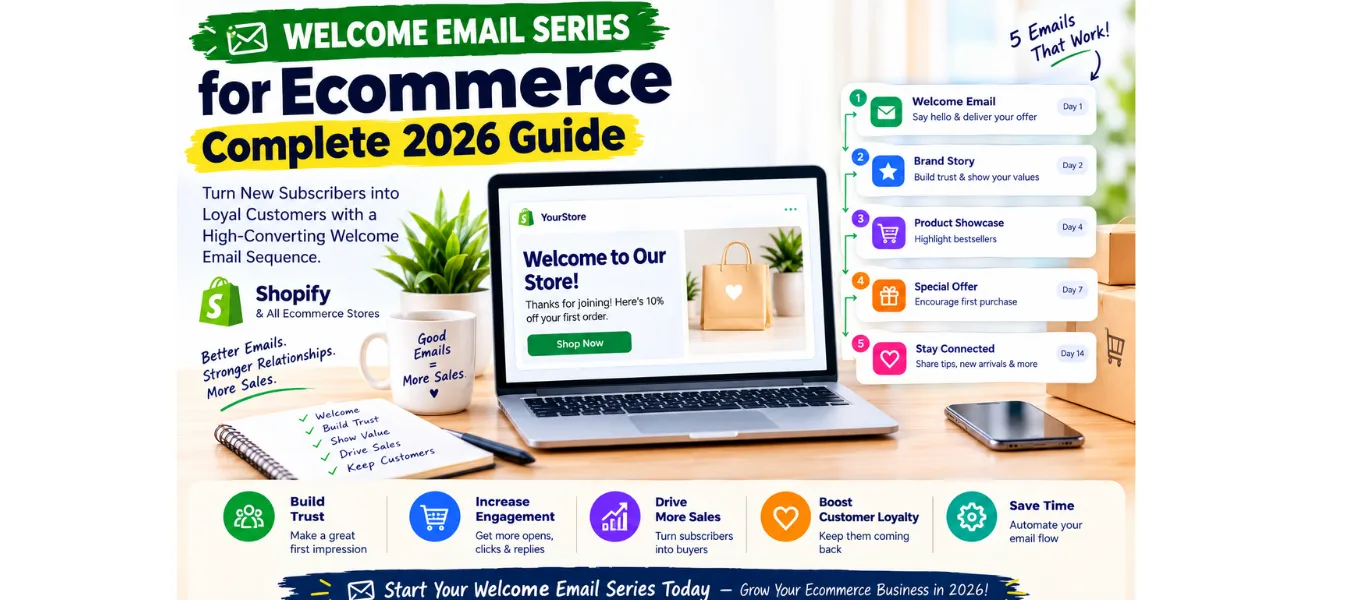
How to Write a Welcome Email Series for Ecommerce — Complete 2026 Guide
Your welcome email is the most-opened email you will ever send. New subscribers open welcome emails at 60–70%—three times higher than standard promotional campaigns and nearly double the open rate of abandoned cart emails.
Most e-commerce stores waste this opportunity. They send a single “Thanks for subscribing” email, deliver the discount code the subscriber signed up for, and consider the job done. Then they wonder why their list is not converting into buyers.
A properly written welcome email series for e-commerce does not just deliver a discount. It builds the relationship, establishes trust, introduces your best products, removes objections through social proof, and creates urgency to make a first purchase — all within the first 7 days of a subscriber joining your list.
This complete guide shows you how to write a welcome email series that converts new subscribers into buyers—including every email, the subject line formula, the copy angle, the timing, and how to set the whole thing up in Klaviyo and Mailchimp.
What you will have after this guide: A complete 5-email welcome series with subject lines, copy frameworks, timing, CTA strategy, and platform setup instructions — ready to activate today. The average e-commerce welcome series converts 15–25% of new subscribers into first-time buyers within 7 days.
Why Your Welcome Email Series Is Your Most Important Automation
Before we get into how to write a welcome email series, here is why this automation deserves to be your absolute first priority — above abandoned cart flows, post-purchase sequences, and broadcast campaigns:
- Highest open rate of any email type: Welcome emails average 60–70% open rates — the highest of any ecommerce email. Your subscriber is at peak curiosity and peak trust the moment they join your list
- First impression is permanent: The welcome series defines how your subscriber thinks about your brand. A warm, valuable, relationship-building welcome series creates a loyal buyer. A generic discount-and-pitch welcome creates a deal-hunter
- Revenue impact is immediate: A 5-email welcome series converts 15–25% of new subscribers into first-time buyers within 7 days. That conversion rate is higher than most ecommerce stores achieve from any paid traffic source
- It runs forever without ongoing work: Set it up once and every new subscriber — whether you have 10 or 10,000 joining per month — receives the same perfectly crafted sequence automatically
- It builds your most engaged segment: Subscribers who engage with your welcome series are your most valuable long-term email audience. They open at higher rates, click at higher rates, and buy at higher rates than any other segment in your list
KEY STAT: Welcome emails generate 320% more revenue per email than standard promotional campaigns. If you have not set up a multi-email welcome series yet, this is the single highest-ROI action you can take for your ecommerce email program today.
How Many Emails Should Be in Your Welcome Series?
The most common question about welcome email series structure is: how many emails should you send? The answer is five — and here is exactly why that number works:
- One email is not enough: A single welcome email delivers your incentive and makes one impression. It does not build a relationship, tell your story, or create enough touchpoints to move a subscriber from curious to confident enough to buy
- Three emails is a minimum viable sequence: Three emails can deliver the incentive, tell the brand story, and showcase products. But it misses social proof and urgency — the two most powerful conversion drivers at the end of a welcome sequence
- Five emails is the proven sweet spot: Five emails across 7 days allows you to address every psychological stage of the buyer journey — curiosity, trust, desire, confidence, and urgency — without overwhelming subscribers or stretching the sequence too long
- More than seven emails is too long: Welcome sequences longer than 7 emails see diminishing open rates and increasing unsubscribe rates. By Day 8, subscribers expect regular campaigns — not more onboarding content
| Send Time | Avg Open Rate | Avg CTR | Primary Goal | |
|---|---|---|---|---|
| Email 1 — Welcome | Immediately | 60–70% | 10–14% | Deliver incentive + first impression |
| Email 2 — Brand story | Day 2 | 45–55% | 6–9% | Build trust and emotional connection |
| Email 3 — Best sellers | Day 3 | 40–50% | 8–12% | Drive first purchase — product showcase |
| Email 4 — Social proof | Day 5 | 35–45% | 6–9% | Remove objections with real reviews |
| Email 5 — Last chance | Day 7 | 40–50% | 9–13% | Convert with urgency and deadline |
Related: For full open rate and CTR benchmarks for every email type, see our Ecommerce Email Marketing Benchmarks
Welcome Email Series Timing — The Exact Schedule
Timing is one of the most important elements of a high-converting welcome email sequence for ecommerce. Send too slowly and you lose momentum. Send too quickly and you overwhelm your subscriber before trust is built.
The proven timing schedule for a 5-email ecommerce welcome series:
- Email 1: Immediately after signup — within 5 minutes of the subscriber confirming their email address. The subscribe action is at peak curiosity right now. Every hour of delay reduces Email 1 open rates by an average of 8%
- Email 2: 24 hours after Email 1 — the subscriber has had time to receive and open Email 1. They know your brand name. Day 2 is the perfect moment to deepen the relationship with your story
- Email 3: 48 hours after Email 1 — Day 3. Your subscriber is still in the active consideration window. This is the right moment to show your best products while interest is high
- Email 4: 96 hours after Email 1 — Day 5. Two days of space since the product showcase — enough time for the subscriber to have thought about it without the series feeling relentless
- Email 5: 144 hours after Email 1 — Day 7. The final email of the series. The discount or offer incentive from Email 1 has now been available for a week. Day 7 is the natural deadline — “your welcome offer expires tonight”
IMPORTANT: Add a conditional exit to your welcome flow — if the subscriber makes a purchase at any point during the sequence, they should exit the welcome flow immediately and enter your post-purchase sequence instead. Sending “buy now” urgency emails to someone who already bought is one of the most trust-damaging mistakes in ecommerce email marketing.
EMAIL 1 The Instant Welcome | Send immediately after signup — within 5 minutes
Your first welcome email has one primary job: deliver on the promise you made at signup. If you promised a 10% discount code, deliver it instantly. If you promised a free guide, deliver the download link immediately. Do not make your subscriber wait or hunt for the thing that made them sign up.
Email 1 — Copy Framework
- Subject line: “Welcome to [BRAND] — your gift is inside” or “Here is your [X]% off, [Name]” — lead with the promised incentive directly
- Opening line: Address the subscriber by first name. Thank them for joining with a sentence that feels warm and genuine — not corporate
- Deliver the incentive: The discount code or download link should appear in the first half of the email — never buried at the bottom
- One sentence of brand introduction: Tell them what your brand does and who it is for in one clear, benefit-led sentence — not a paragraph
- Set expectations: Tell them what they can expect from your emails — how often you send and what value they will receive
- CTA: “Shop Now and Use Your Code” or “Claim My [X]% Off” — link directly to your best-selling collection or homepage
- Keep it short: Email 1 should be under 150 words. You are delivering a gift, not selling. The sale comes in Email 3 and Email 5
EMAIL EXAMPLE — EMAIL 1Subject: Welcome to [BRAND]—your 10% off is insidePreview: Plus: what to expect from us and where to start…Hey [Name],Welcome to [BRAND] — we are so glad you are here.Here is your exclusive welcome discount: [CODE] — use it at checkout for 10% off your first order.We help [target customer description] [core benefit in one sentence]. Over the next few days, we will share our best products, real customer stories, and the [BRAND] difference.Questions? Just reply to this email — we read every one.→ CTA: Shop Now and Use Your Code →
EMAIL 2 The Brand Story | Day 2 — 24 hours after Email 1
Email 2 is the most underestimated email in the welcome series. Most ecommerce brands skip it entirely or fill it with more products. That is a missed opportunity. The brand story email is what separates brands that subscribers buy from once from brands that subscribers buy from repeatedly.
Email 2 — Copy Framework
- Subject line: “Why we started [BRAND] (the honest version)” or “The story behind [BRAND] — and why it matters to you” — personal, curiosity-driven, no selling
- No products in Email 2: This email is 100% about building trust and emotional connection. The moment you pitch a product in your brand story email, you undercut the authenticity
- Tell the founding story honestly: Why did you start this brand? What problem were you trying to solve? What did you believe that others did not? Be specific and be real
- Connect the story to the subscriber: After telling your story, bridge it to the subscriber — “That is why we created [PRODUCT] for people like you”
- End with a soft CTA: “Reply and tell us what brought you to [BRAND]” or “Visit us to learn more about our mission” — relationship-building, not transactional
- Length: 200–300 words. Long enough to feel genuine. Short enough to be read completely
EMAIL EXAMPLE — EMAIL 2Subject: Why we started [BRAND] (the honest version)Preview: This is the story most brands are afraid to tell…Hey [Name],We almost did not start [BRAND].[Honest founding story in 2–3 sentences — the real problem you faced, the moment you decided to do something about it, and what you believed that nobody else was acting on].That is why we built [BRAND] for [target customer]. Not to be just another [product category], but to be [your point of difference].We think you deserve [core brand promise]. And every product we make is built around that belief.We would love to know what brought you to [BRAND]. Just reply to this email.→ CTA: Read Our Full Story →
EMAIL 3 The Best Sellers Showcase | Day 3 — 48 hours after Email 1
Email 3 is where your welcome email series makes its first direct move toward a sale. Your subscriber now knows your brand and trusts your story. Day 3 is the right moment to show them what to buy — not all of your products, but your curated best sellers presented with benefit-led descriptions that speak to the outcome rather than the specification.
Email 3 — Copy Framework
- Subject line: “Our 3 most-loved products right now (and why)” or “Customers can not stop buying these” — lead with social validation
- Feature 3 products maximum: Decision paralysis is real. More than 3 product options reduces click-through rates. Pick your three highest-converting or most representative products
- Write benefit-led descriptions: Not “Merino wool — 200 thread count”. Instead “Stays cool in summer, warm in winter — the only [PRODUCT] you will ever need”
- Include social proof per product: One short review or star rating next to each product makes the showcase feel validated rather than promotional
- Remind them of their discount: Mention the welcome discount code once — not as the CTA, but as a reminder that it is still available
- CTA: “Shop [PRODUCT NAME]” with a separate link for each of the three products — individual product links outperform “Shop All” links consistently
EMAIL EXAMPLE — EMAIL 3Subject: Our 3 most-loved products right now (and why)Preview: Start here — these are the ones customers come back for.Hey [Name],With so many options, it can be hard to know where to start. So we narrowed it down for you.These are the 3 products our customers love most — and the reasons why they keep coming back.[PRODUCT 1 NAME] — [Benefit-led description in 1 sentence] “[Short review quote]” → Shop Now[PRODUCT 2 NAME] — [Benefit-led description in 1 sentence] “[Short review quote]” → Shop Now[PRODUCT 3 NAME] — [Benefit-led description in 1 sentence] “[Short review quote]” → Shop NowRemember: your 10% welcome discount [CODE] is still valid. Use it at checkout.→ CTA: Shop Our Best Sellers →
EMAIL 4 The Social Proof Email | Day 5 — 96 hours after Email
Email 4 targets the subscribers who have seen your best sellers but have not yet purchased. The most common reason a motivated, engaged subscriber does not buy after seeing your products is not price — it is doubt. “Will this actually work for me?” Social proof answers that question in a way your brand voice alone cannot.
Email 4 — Copy Framework
- Subject line: “5,000 customers love this — here is why” or “Real reviews. Real results.” or “What customers say after their first order” — credibility-led
- Lead with a powerful specific testimonial: Use the most specific, benefit-specific review you have — not a generic “Great product!” but a detailed story of transformation or result
- Include 2–3 total reviews: Use reviews that address the most common pre-purchase objections for your product category. If customers worry about fit, use a fit-specific review. If they worry about quality, use a quality-specific review
- Add context to reviews: Include the customer name and any identifying detail that builds credibility — “Sarah M. — verified buyer” or “Tom, 42, from Manchester”
- Address the top objection directly: After the reviews, write one paragraph that proactively answers the most common reason people hesitate to buy your product
- CTA: “See Why They Love It” linking to your most-reviewed product — or “Read More Reviews” linking to your reviews page
EMAIL EXAMPLE — EMAIL 4Subject: 5,000 customers love this — here is whyPreview: Real reviews from real customers. No filters.Hey [Name],We could tell you why [BRAND] is worth trying. But we think our customers do it better.”[Specific, detailed review that tells a story of transformation or result]” — [Name, verified buyer]”[Review addressing the most common objection — quality, fit, value, effectiveness]” — [Name, verified buyer]”[Review that shows the product in a relatable use case]” — [Name, verified buyer]Still have questions? Reply to this email — our team responds within 2 hours. And your 10% welcome discount [CODE] is waiting whenever you are ready.→ CTA: See Our Reviews →
Related: For more on using social proof effectively in ecommerce emails, read our guide on Email Copywriting Psychology That Drives Sales
EMAIL 5 The Last Chance Close | Day 7 — 144 hours after Email 1
Email 5 is your conversion email. After four days of delivering value, building trust, showcasing products, and providing social proof, you now have earned the right to create urgency. Your subscriber has had their welcome discount for a full week. Today is the day it expires.
Email 5 — Copy Framework
- Subject line: “Your welcome offer expires tonight” or “[Name], this is your final reminder” or “Your [X]% off disappears at midnight” — urgency is the lead
- State the deadline in the first line: Do not bury the urgency. The deadline should be the first piece of information in the email body
- Remind them what they get: Restate the offer clearly — the discount percentage and the code — and link directly to your best-selling product or collection
- Use genuine urgency only: If the discount expires at midnight tonight, it must expire at midnight tonight. If you extend it after the “final” deadline, you train subscribers to ignore urgency in all your future emails
- Keep it short and direct: Email 5 should be your shortest email in the sequence — under 120 words. The message is simple: the offer expires tonight, here is your code
- CTA: “Claim My [X]% Off” or “Use My Code Before Midnight” — first-person ownership language drives higher click-through rates on urgency emails
EMAIL EXAMPLE — EMAIL 5Subject: Last call — your welcome offer expires tonightPreview: Your 10% off disappears at midnight. Here is the code.Hey [Name],This is your final reminder.Your welcome discount — [CODE] for 10% off your first order — expires at midnight tonight. After that, your cart will clear and the offer disappears.If you have been thinking about [PRODUCT NAME], now is the time.[Short, direct product benefit in one sentence].Questions before buying? Reply to this email — we answer within 2 hours.→ CTA: Claim My 10% Off →
CRITICAL: Never extend the Email 5 deadline after sending it. If you tell subscribers their discount expires at midnight and then offer the same code the following week, you permanently destroy the credibility of your urgency emails. Urgency only works when subscribers believe the deadline is real.
Welcome Email Subject Lines That Get Opened
Your welcome email subject lines determine whether your highest-potential email series gets read or ignored. Here are the proven formulas for each email in the sequence:
| Subject Line Formula | Top Performer | Avg Open Rate | |
|---|---|---|---|
| Email 1 | [Incentive] + [Name] | “[Name], your 10% off is inside” | 60–70% |
| Email 2 | Curiosity + honesty | “Why we started [BRAND] (the honest version)” | 45–55% |
| Email 3 | Social validation + benefit | “Our 3 most-loved products right now” | 40–50% |
| Email 4 | Number + social proof | “5,000 customers love this — here is why” | 35–45% |
Welcome Email Subject Line Rules
- Always personalise with first name: Subject lines with the subscriber’s first name open 26% higher on average — use merge tags to automate this in every platform
- Keep Email 1 subject line under 50 characters: Shorter subject lines display fully on mobile — where 60%+ of ecommerce emails are opened
- Test two variants on every email: A/B test subject lines on Emails 1 and 5 — the highest-stakes emails in your sequence. Most platforms do this automatically
- Do not use clickbait: Welcome email subscribers are at peak trust. A misleading subject line that does not match the email content destroys that trust immediately and permanently
Related: Our complete guide to Email Subject Line Secrets That Increase Open Rates
How to Set Up Your Welcome Series in Klaviyo
Klaviyo is the most powerful platform for setting up an ecommerce welcome email flow — its Shopify integration, dynamic merge tags, and conditional split builder make it the industry standard. Here is the step-by-step setup:
- Go to Flows in your Klaviyo dashboard and click Create Flow
- Select Welcome Series from the pre-built flow template library
- Set the trigger: “Joined List” — fires when a new subscriber joins your main email list
- Email 1: Set delay to 0 minutes — sends immediately after the trigger fires. Customise using your Email 1 framework above
- Add a time delay of 1 day then Email 2: Use the drag-and-drop editor to configure your brand story email
- Add a time delay of 1 day then Email 3: Use dynamic product blocks to showcase your best sellers with real product images and prices pulled from Shopify automatically
- Add a time delay of 2 days then Email 4: Configure your social proof email with review content
- Add a time delay of 2 days then Email 5: Configure your last chance urgency email with the discount code and midnight deadline
- Add a conditional split before Email 3: Condition: “Has placed order — at least once — since flow start”. If YES → exit flow. If NO → continue to Email 3. Repeat this split before Emails 4 and 5
- Turn the flow to Live and send a test to yourself: Verify that the product blocks display correctly, the discount code is accurate, and the timing is set correctly
Setup guide: For full platform installation instructions, read our How to Set Up Email Marketing on Shopifyncentive in Email 1 — no exceptions: If you promised a discount code or free resource at signup, the subscriber must receive it in the first email. Any delay reduces trust immediately
- Never pitch in Email 2: The brand story email is a trust-builder — not a sales email. The moment you add product links or promotional content to Email 2, you undercut the authenticity of the story
- Use dynamic personalisation throughout: First name in every subject line and opening. Dynamic product recommendations based on the category the subscriber browsed before signing up. Klaviyo supports both natively
- Add a postscript to every email: The P.S. line is the second most-read element of any email after the subject line. Use it to surface a key benefit, a review, or a reminder of the discount in every email of the sequence
- Include plain text versions: Some email clients do not render HTML. Klaviyo and Omnisend generate plain text versions automatically — make sure yours are configured and coherent
- Suppress purchasers at every stage: Use conditional splits before every email from Email 3 onwards — any subscriber who purchases should exit the welcome flow immediately and enter your post-purchase sequence
- Review your welcome series every 90 days: Check open rates, CTR, and conversion rate for each email. Low-performing subject lines should be A/B tested. Low-performing email bodies should be rewritten
- Do not extend the Email 5 deadline: If you say the offer expires at midnight, it expires at midnight. Urgency only works when subscribers believe you mean it
PRO TIP: The welcome series is your most important email sequence — but it is not a one-time write. Revisit it every quarter with fresh eyes. What felt authentic when you wrote it six months ago may no longer reflect your current brand voice, your current best sellers, or your current understanding of what your customers actually need to hear before they buy.
Frequently Asked Questions
How many emails should be in an ecommerce welcome series?
Five emails over 7 days is the proven sweet spot for a welcome email series for ecommerce. One email is insufficient to build the trust and relationship needed to convert a cold subscriber into a buyer. More than seven emails stretches the sequence beyond the natural welcome period and begins to feel like nurture content rather than onboarding. Five emails — welcome, brand story, best sellers, social proof, and last chance — cover every stage of the buyer psychology journey within the critical first week.
When should I send each email in my welcome series?
The proven welcome email series timing is: Email 1 immediately (within 5 minutes of signup), Email 2 on Day 2, Email 3 on Day 3, Email 4 on Day 5, and Email 5 on Day 7. The gap between Emails 3 and 4 (Day 3 to Day 5) gives subscribers time to consider the products without the series feeling relentless. The gap between Emails 4 and 5 (Day 5 to Day 7) allows final consideration before the offer deadline.
What should I write in my first welcome email?
Your first welcome email should: deliver the promised incentive (discount code or free resource) in the first half of the email, address the subscriber by first name, introduce your brand in one clear benefit-led sentence, set expectations for what they will receive from your emails, and include a single CTA linking to your best-selling product or collection. Email 1 should be under 150 words — you are delivering a gift, not selling.
What open rate should I expect from my welcome email series?
A healthy welcome email open rate for Email 1 is 60–70%. Email 2 should achieve 45–55%, Email 3 40–50%, Email 4 35–45%, and Email 5 40–50% (the urgency of the last chance email typically recovers open rate from the Email 4 dip). If your Email 1 open rate is below 45%, your subject line or send delay needs attention. For full benchmark data by email type, visit blogwithjawed.com/ecommerce-email-marketing-benchmarks
Should I offer a discount in my welcome email series?
Yes — but only in the first email and the last. Deliver the promised discount code immediately in Email 1 (this is why the subscriber signed up). Do not mention it in Emails 2 or 3 — those emails are for trust-building and product showcase, not incentive-driven conversion. Remind subscribers of the discount in Email 4 as a low-pressure nudge, and create genuine urgency around the discount expiry in Email 5. Never offer a new or extended discount after Email 5 — this undermines the credibility of your urgency in all future emails.
How do I set up a welcome email series in Klaviyo?
To set up a Klaviyo welcome flow: go to Flows → Create Flow → select Welcome Series from the template library. Set the trigger to “Joined List.” Configure five emails with delays of 0 minutes (Email 1), 1 day (Email 2), 1 day (Email 3), 2 days (Email 4), and 2 days (Email 5). Add conditional splits before Emails 3, 4, and 5 to exit any subscriber who purchases. Use dynamic product blocks in Email 3 to automatically pull product images and prices from your Shopify store. Turn the flow to Live and test with your own email address before going live.
Write Your Welcome Email Series Today
Your welcome email series is the most powerful automation you can build for your ecommerce store. It captures subscribers at peak trust, delivers value in the first email, builds a real brand relationship over 7 days, and converts 15–25% of new subscribers into first-time buyers — automatically, forever, without any ongoing effort after setup.
Here is the complete welcome email series framework from this guide:
- Email 1 — Instant: Deliver incentive + warm welcome. Under 150 words. CTA to your best-selling collection
- Email 2 — Day 2: Honest brand story. No products. Build trust and emotional connection
- Email 3 — Day 3: Three best sellers with benefit-led descriptions and social proof. Remind of discount code
- Email 4 — Day 5: Two to three real customer reviews addressing the most common pre-purchase objections
- Email 5 — Day 7: Final urgency. Discount expires tonight. Under 120 words. First-person CTA
The sequence is the structure. The copy inside it determines whether subscribers feel genuinely compelled to buy from you — or just read and click away. If you need help writing a welcome email series that converts new subscribers into loyal buyers, visit blogwithjawed.com to learn how I work with ecommerce brands.
Published on blogwithjawed.com | Written by Jawed Iqbal | Email Copywriter for Ecommerce Brands