Internal Links: blogwithjawed.com/email-subject-line-secrets-increase-open-rates | blogwithjawed.com/ecommerce-welcome-email-sequence | blogwithjawed.com/abandoned-cart-emails-recover-lost-sales | blogwithjawed.com/klaviyo-vs-mailchimp-ecommerce | blogwithjawed.com/best-email-marketing-tools-ecommerce | blogwithjawed.com/scarcity-urgency-ecommerce-emails
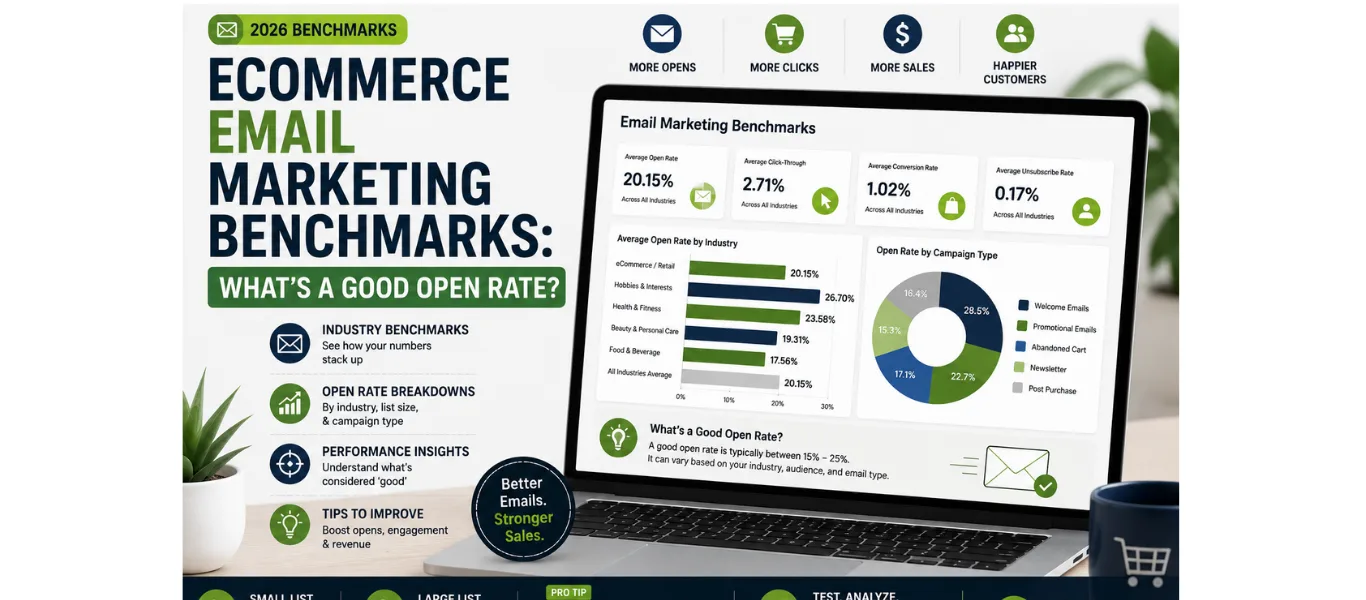
Ecommerce Email Marketing Benchmarks 2026 — What’s a Good Open Rate?
Surprising fact: Most e-commerce store owners are making critical decisions about their email strategy based on completely the wrong benchmarks. They’re comparing their Shopify store’s email performance against averages that include B2B newsletters, non-profit organizations, and financial services—industries where email behavior is fundamentally different from e-commerce.
The result? Store owners panic about a 22% open rate that is actually excellent for a promotional campaign. Or they feel satisfied with a 35% open rate on their welcome sequence that is actually below the e-commerce benchmark for that email type.
This guide gives you the e-commerce email marketing benchmarks you actually need—specific to e-commerce, broken down by email type, measured against 2026 data. You’ll know exactly where your email open rates, click-through rates, conversion rates, and revenue per email stand—and what to do when they fall short.
Key takeaway upfront: A good email open rate for e-commerce depends entirely on the type of email. Welcome emails should hit 50–60%. Abandoned cart emails should hit 40–50%. Standard promotional campaigns should hit 20–35%. If you’re measuring everything against one benchmark, you’re comparing apples to oranges.
Why Email Benchmarks Matter for Ecommerce Stores
Without email marketing benchmarks, you have no frame of reference for whether your performance is strong, average, or costing you revenue. You’re optimizing in the dark.
Here is what accurate e-commerce email marketing benchmarks enable you to do:
- Identify underperforming flows: If your abandoned cart open rate is 28% when the benchmark is 40–50%, you know your subject lines need work—not your product
- Set realistic improvement targets: Knowing that a good email open rate for e-commerce promotional campaigns is 25–35% gives you a specific target to optimise toward
- Justify platform investment: Benchmarks help you understand whether a platform switch—from Mailchimp to Klaviyo, for example—is generating the improvement you paid the premium for
- Diagnose deliverability issues: If your open rates are significantly below benchmark across all email types simultaneously, the problem is likely deliverability — not content
- Benchmark against yourself: Your most important comparison is month-over-month improvement against your own historical data—external benchmarks give you context, not verdicts
With that context clear, here are the e-commerce email benchmarks that matter in 2026.
What Is a Good Email Open Rate for Ecommerce in 2026?
The most common question store owners ask is, “What is a good email open rate for e-commerce?” The honest answer is that it depends on which type of email you’re sending. Here are the 2026 benchmarks:
| Email Type | Average Open Rate | Good Rate | Excellent Rate |
| Welcome email | 50–60% | 55%+ | 65%+ |
| Abandoned cart | 40–50% | 45%+ | 55%+ |
| Browse abandonment | 35–45% | 40%+ | 50%+ |
| Post-purchase | 35–45% | 40%+ | 50%+ |
| Promotional campaign | 20–25% | 25%+ | 35%+ |
| Win-back campaign | 15–25% | 20%+ | 30%+ |
| Newsletter | 18–22% | 22%+ | 30%+ |
Note: These benchmarks reflect 2026 data for e-commerce brands. Open rates can be affected by Apple Mail Privacy Protection (MPP), which inflates open rate reporting for Apple device users. Focus on click-through rate and revenue per email as more reliable performance indicators.
The single most important thing to notice in this table: email open rates vary dramatically by email type. A 25% open rate on a welcome email is a serious problem. The same 25% on a promotional campaign is perfectly normal. Context is everything.
PRO TIP: If your overall average open rate looks low, check whether it’s being dragged down by your promotional campaigns. Automation flows (welcome, cart, browse) consistently outperform broadcast campaigns — and they should account for a significant portion of your email revenue.
Open Rate Benchmarks by Email Type — Deep Dive
Welcome Email Open Rate Benchmark
Your welcome email open rate should be your highest. New subscribers are at peak engagement—they just gave you their email address, and they are actively expecting to hear from you. The average open rate for e-commerce welcome emails in 2026 is 50–60%.
If your welcome email is below 40%: your subject line is not delivering on the promise made at signup, your sending delay is too long (send within 5 minutes of signup), or your from name is not recognizable to the subscriber.
Read more: Our full guide to e-commerce welcome email sequences that convert at blogwithjawed.com/ecommerce-welcome-email-sequence covers subject line formulas, timing, and the complete 5-email welcome sequence framework.
Abandoned Cart Email Open Rate Benchmark
The abandoned cart email open rate benchmark for e-commerce is 40–50% for the first email in the sequence—making it the second-highest opening email type after welcome emails. This makes sense: the subscriber has demonstrated active purchase intent by adding to cart, so the email feels relevant and timely.
If your cart emails are opening at 20–25%, the most common causes are sending the first email too late (send 1 hour of abandonment), using a generic subject line (‘Your cart is waiting’) instead of a personalized one, or low sender reputation affecting inbox placement.
Read more: Our complete Abandoned Cart Email Guide at blogwithjawed.com/abandoned-cart-emails-recover-lost-sales covers the full 3-email sequence with subject lines, timing, and copy angles for each send.
Promotional Campaign Open Rate Benchmark
Standard promotional campaigns — flash sales, product launches, seasonal promotions — have the lowest email open rates of any email type. The average email open rate for e-commerce promotional campaigns in 2026 is 20–25%.
This is normal and expected. Subscribers who opted in for a discount or free resource are not always primed to receive a promotional email on any given day. The key to improving promotional open rates is subject line quality, send time optimization, and list segmentation—sending to your most engaged subscribers first.
Win-Back Campaign Open Rate Benchmark
Win-back campaigns targeting lapsed customers have the lowest email open rates of any flow — 15–25% on average. This is expected: you are trying to re-engage someone who has stopped opening your emails. The benchmark still matters though—if your win-back campaigns are below 10%, your deliverability to that segment may be compromised.
What Is a Good Click-Through Rate for Ecommerce Emails?
Click-through rate (CTR)—the percentage of email openers who click your CTA—is a more reliable performance indicator than open rate because it is not affected by Apple MPP inflation. Here are the email click-through rate benchmarks for e-commerce in 2026:
| Email Type | Average CTR | Good CTR | Excellent CTR |
| Welcome email | 5–8% | 8%+ | 12%+ |
| Abandoned cart | 8–12% | 12%+ | 18%+ |
| Browse abandonment | 6–10% | 10%+ | 15%+ |
| Post-purchase | 3–6% | 6%+ | 10%+ |
| Promotional campaign | 2–4% | 4%+ | 8%+ |
| Win-back campaign | 2–4% | 4%+ | 8%+ |
A good click-through rate for e-commerce emails across all types combined is 3–5%. Top-performing e-commerce brands on Klaviyo consistently achieve 5–8% CTR across their full email program—driven primarily by strong automation flow performance pulling up the overall average.
The most common causes of below-benchmark CTR:
- Weak CTA copy: ‘Click here’ and ‘Shop now’ consistently underperform benefit-led CTAs like ‘Claim my 20% off’ and ‘Get my free shipping’
- Multiple competing CTAs: More than one CTA button splits attention and reduces the probability of any click occurring
- Poor mobile rendering: 60%+ of e-commerce emails are opened on mobile—a CTA button that is too small or poorly positioned on mobile dramatically reduces CTR
- Mismatched promise: If your subject line promises something the email body does not immediately deliver, subscribers leave before reaching the CTA
Email Conversion Rate Benchmarks for Ecommerce
Conversion rate — the percentage of email clicks that result in a completed purchase — is where email marketing performance ultimately gets measured. Here are the email conversion rate benchmarks for e-commerce:
- Average e-commerce email conversion rate: 1–3% of email clicks convert to purchases
- Good conversion rate: 3–5% — indicates strong product-market fit and effective email copy
- Excellent conversion rate: 5%+ — typically seen in highly personalised flows with strong segmentation
- Abandoned cart conversion rate: 5–10% of cart recovery emails result in a completed purchase—significantly higher than standard campaign conversions
The most important thing to understand about email conversion rates for e-commerce: conversion rate is a function of copy quality, product relevance, and landing page experience. A subscriber who clicked your email but didn’t purchase was either not convinced by the copy, didn’t see the product as right for them at that moment, or encountered friction on your website.
Unsubscribe and Bounce Rate Benchmarks
These benchmarks protect your sender reputation—the invisible score email providers use to decide whether your emails go to the inbox or the spam folder.
| Metric | Healthy Rate | Warning Level | Action Required |
| Unsubscribe rate | Under 0.3% | 0.3–0.5% | Over 0.5% |
| Hard bounce rate | Under 0.5% | 0.5–1% | Over 1% |
| Soft bounce rate | Under 2% | 2–3% | Over 3% |
| Spam complaint rate | Under 0.08% | 0.08–0.1% | Over 0.1% |
| List growth rate | 5–10%/month | 2–5%/month | Under 2%/month |
An email unsubscribe rate above 0.5% on any send is a warning signal. Above 1% is an emergency. The most common causes: sending too frequently, sending to disengaged subscribers who should have been suppressed, or sending irrelevant content to a poorly segmented list.
A high bounce rate above 1% typically indicates list hygiene issues—old addresses, incorrectly entered emails, or purchased lists (which should never be used). Clean your list by suppressing addresses that have bounced more than once.
Revenue Per Email — The Most Important Metric Nobody Tracks
Here is the email marketing benchmark that matters more than any other—and that most e-commerce stores never look at:
Revenue per email: how much money each individual email sent generates.
Not revenue per campaign. Not revenue per subscriber per month. Revenue per specific email send. This is the metric that tells you whether your email strategy is actually working — whether the combination of your platform, your copy, your segmentation, and your timing is converting subscribers into buyers.
| Email Type | Good Revenue/Email | Excellent Revenue/Email |
| Welcome series (overall) | $0.10–$0.20 | $0.20+ |
| Abandoned cart email | $0.20–$0.50 | $0.50+ |
| Promotional campaign | $0.05–$0.15 | $0.15+ |
| Post-purchase flow | $0.10–$0.25 | $0.25+ |
| Win-back campaign | $0.05–$0.15 | $0.15+ |
Klaviyo tracks revenue per email natively for every send—campaigns and flows. Omnisend also provides clear revenue attribution. If your current email platform doesn’t show you revenue per email, you are flying blind on your most important performance metric.
IMPORTANT: Revenue per email is calculated by dividing total attributed revenue from an email by the number of emails delivered. A welcome email to 1,000 subscribers that generates $150 in attributed revenue has a revenue per email of $0.15 — right at the benchmark.
Why Your Email Open Rate May Be Lower Than Benchmark
If your email open rates are consistently below the e-commerce email benchmarks above, here are the most common causes—in order of likelihood:
1. Subject Line Quality
Your subject line is the single biggest determinant of open rate. A weak subject line on an excellent email will always underperform. Test urgency, curiosity gaps, personalization, and benefit-led subject lines against your current approach.
Resource: Our guide to Email Subject Line Secrets That Increase Open Rates at blogwithjawed.com/email-subject-line-secrets-increase-open-rates covers the five proven formulas that consistently beat benchmark open rates.
2. Sender Name and Recognition
Subscribers open emails from people and brands they recognize and trust. If your from name is ‘noreply@yourstore.com’ or a name that doesn’t match your brand, open rates suffer. Use your first name, your brand name, or a combination — whichever matches how your subscribers know you.
3. Send Time
Send time has a measurable impact on email open rates. For e-commerce, Tuesday through Thursday between 9am and 11am and 7pm and 9pm consistently outperform other time slots. Klaviyo’s Smart Sending feature predicts the optimal send time for each individual subscriber—one of the platform’s most valuable features for improving open rates at scale.
4. List Hygiene and Deliverability
If a significant portion of your list is unengaged—subscribers who haven’t opened in 90+ days—they are actively dragging down your reported open rate. More importantly, sending to a large unengaged segment damages your sender reputation, which can cause inbox placement issues that affect even your engaged subscribers.
Suppress subscribers who haven’t opened in 90–120 days. Your list will be smaller, but your email open rates and deliverability will both improve immediately.
5. Apple Mail Privacy Protection
Since Apple introduced Mail Privacy Protection, open rates for Apple Mail users are automatically recorded as ‘opened’ regardless of whether the email was actually viewed. This inflates reported open rates for brands with a high proportion of iOS users. If your open rates look artificially high, this may be the cause—which is why CTR and revenue per email are more reliable indicators of true performance.
How to Improve Your Email Open Rate — 8 Proven Tactics
- Test two subject lines on every send: A/B test subject lines by sending Version A to 20% of your list, Version B to 20%, and the winner to the remaining 60%. Most platforms do this automatically
- Use the subscriber’s first name: Personalisation in subject lines increases email open rates by an average of 26% — set up merge tags in your email platform to automate this
- Write preview text deliberately: Preview text is the second line subscribers see in their inbox—treat it as an extension of your subject line, not a repeat of it
- Clean your list every 90 days: Suppress unengaged subscribers before they damage your sender reputation and inbox placement rates
- Use urgency and scarcity in subject lines: ‘Ends tonight’ and ‘Only 3 left’ are proven open rate boosters when genuine — never fake
- Optimise your send time: Test Tuesday to Thursday at 9–11am and 7–9pm to identify your audience’s peak engagement window
- Run a re-engagement campaign before suppressing: Send a final ‘Are you still interested?’ email to unengaged subscribers before suppressing—some will re-engage
- Improve your signup promise: Subscribers who signed up for a specific reason open more consistently—a vague ‘join our newsletter’ signup produces a lower-quality, lower-engagement list than a specific discount or free resource offer
Related: How to use Scarcity and Urgency in Ecommerce Emails—proven tactics that boost open rates and conversions at blogwithjawed.com/scarcity-urgency-ecommerce-emails
Email Benchmarks by Platform — Klaviyo vs Mailchimp vs Omnisend
Platform choice affects your ability to hit e-commerce email benchmarks—not because of the platform’s sending infrastructure, but because of what data it makes available for personalization and segmentation.
| Platform | Avg Open Rate (Users) | Revenue Tracking | Benchmark Visibility |
| Klaviyo | 25–32% | Per email—native | Full — real-time |
| Omnisend | 23–30% | Per campaign/flow | Full dashboard |
| Mailchimp | 21–27% | Limited | Basic only |
| Shopify Email | 18–24% | Basic | Limited |
Klaviyo users consistently report higher average open rates—not because Klaviyo sends emails differently, but because its deep Shopify integration enables more precise segmentation and personalization, which naturally drives higher engagement rates.
See also: Our full Klaviyo vs Mailchimp for Ecommerce comparison at blogwithjawed.com/klaviyo-vs-mailchimp-ecommerce covers every benchmark difference between the platforms with honest pricing and feature analysis.
Frequently Asked Questions
What is a good email open rate for e-commerce in 2026?
A good email open rate for e-commerce depends on the email type. For welcome emails, 50–60% is average, and 65%+ is excellent. For abandoned cart emails, 40–50% is average, and 55%+ is excellent. For standard promotional campaigns, 20–25% is average, 30%+ is good, and 35%+ is excellent. Never compare your promotional campaign open rates against your welcome email benchmark — they are fundamentally different email types with different subscriber psychology.
What is a good click-through rate for e-commerce email marketing?
A good click-through rate for e-commerce emails is 2–5% across all email types combined. Abandoned cart emails should achieve 8–12% CTR. Welcome emails should hit 5–8%. Promotional campaigns averaging 2–4% CTR are performing normally. Below 2% CTR across all email types indicates CTA copy, mobile rendering, or content relevance issues.
What is a good email conversion rate for e-commerce?
A good email conversion rate for e-commerce is 1–3% of email clicks resulting in a purchase. Abandoned cart emails typically convert at 5–10% — significantly above standard campaign conversion rates. If your conversion rate is below 1% consistently, the issue is usually landing page experience, product-copy mismatch, or audience segmentation rather than the email itself.
What is revenue per email, and how do I calculate it?
Revenue per email is the total attributed revenue from a specific email divided by the number of emails delivered. If you send 2,000 emails and the campaign generates $300 in attributed revenue, your revenue per email is $0.15. Klaviyo and Omnisend calculate this automatically. For ecommerce, good revenue per email is $0.10+ for campaigns and $0.20+ for abandoned cart emails.
Why are my email open rates below the benchmark?
The five most common causes of below-benchmark email open rates: weak subject lines without curiosity or urgency, unrecognisable sender name, poor send timing, deliverability issues caused by list hygiene problems, and Apple Mail Privacy Protection inflating your perceived benchmark. Start by auditing your subject lines and cleaning subscribers who haven’t opened in 90+ days.
Do email open rates still matter after Apple MPP?
Apple Mail Privacy Protection — introduced in 2021 and now affecting a significant portion of email openers — automatically records all Apple Mail emails as ‘opened’ regardless of whether they were actually viewed. This inflates open rate reporting for brands with high proportions of iOS users. Open rates still provide useful directional data, but click-through rate and revenue per email are now the most reliable email marketing benchmarks for e-commerce in 2026.
Final Thoughts — How to Use These Benchmarks
Understanding e-commerce email marketing benchmarks gives you a framework for evaluating performance—but the most valuable comparison you can make is against your own historical data, not industry averages.
Use these benchmarks to:
- Identify which email types are underperforming against e-commerce standards
- Set specific improvement targets for your open rate, CTR, and revenue per email
- Evaluate whether a platform switch or list hygiene effort is generating measurable improvement
- Have informed conversations with clients or your marketing team about what ‘good’ actually looks like
And remember: benchmarks tell you what is normal. They do not tell you what is possible. The best-performing e-commerce brands on Klaviyo consistently exceed every benchmark in this guide—through obsessive subject line testing, precise segmentation, and email copy that connects with subscribers on a personal level.
If you need help writing the email copy that helps your e-commerce store exceed these benchmarks—welcome sequences, abandoned cart emails, product launches, and win-back campaigns—visit blogwithjawed.com to learn how I work with e-commerce brands.
Related reading:
Published on blogwithjawed.com | Written by Jawed Iqbal, Email Copywriter for Ecommerce Brands