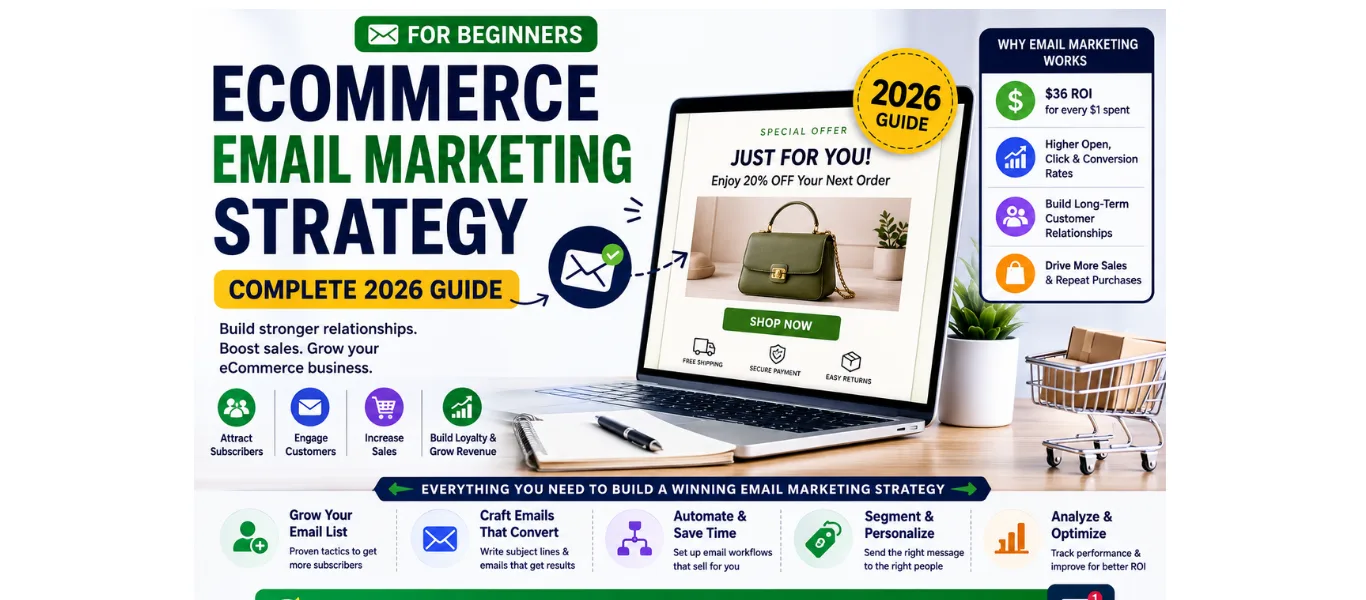
Ecommerce Email Marketing Strategy for Beginners—Complete 2026 Guide
If you have just launched your e-commerce store—or you have had a store for months but email marketing has stayed firmly in the “I should probably do that” category—this guide is for you.
Starting email marketing for e-commerce can feel overwhelming. Which platform should you use? What emails should you send first? What do you write? How do you grow a list from zero? Should you send campaigns or just set up automations?
This complete e-commerce email marketing strategy for beginners answers every one of those questions—in the right order. By the end of this guide, you will know exactly what to set up, what to send, and what to track—and you will be able to implement it starting today, even if you have never sent a single marketing email in your life.
What this guide covers: The 4 types of e-commerce emails, 5 steps to build your complete email marketing strategy from scratch, the 3 automation flows every store needs first, a month-by-month timeline, platform recommendations, and the beginner mistakes that cost e-commerce stores thousands in lost revenue.
Why Every Ecommerce Store Needs an Email Marketing Strategy
Before diving into the e-commerce email marketing strategy itself, a quick reality check on why this is worth prioritizing above almost every other marketing activity:
- Highest ROI of any channel: Email marketing generates $36–42 for every $1 spent—significantly more than paid social ($2–5), Google Ads ($2–8), or influencer marketing ($5–10)
- You own the channel completely: Unlike social media followers or search rankings, your email list cannot be taken away by an algorithm change, a platform update, or a rising ad cost. It is an asset you own permanently
- Direct access to customers: When you send an email, 100% of your subscribers receive it—no algorithm decides who sees it, and no ad budget limits its reach
- Automated revenue 24/7: Once your flows are set up, your email program generates revenue around the clock without any ongoing manual effort from you
- The benchmark that proves it: Ecommerce brands that implement a complete email strategy—flows plus campaigns—consistently generate 25–40% of their total revenue from email alone
With that context clear, here is the email marketing strategy that takes you from zero to revenue in five steps.
The 4 Types of Emails Every Ecommerce Store Should Send
Before building your strategy, you need to understand the four categories of e-commerce email marketing—because each type plays a different role and needs a different approach:
| Email Type | What It Is | Examples | Sent How |
|---|---|---|---|
| Automation flows | Triggered by subscriber behavior | Welcome, cart, post-purchase. | Automatically—set once |
| Broadcast campaigns | Sent to list or segment manually | Flash sale, product launch | Manually—on schedule |
| Transactional emails | Triggered by purchase action | Order confirmation, shipping | Automatically by Shopify |
| Re-engagement emails | Sent to inactive subscribers | Win-back, sunset campaign | Automatically or manually |
As a beginner, your e-commerce email marketing strategy should focus on automation flows first—they generate revenue 24/7 without ongoing effort. Broadcast campaigns come second, once your flows are live. This is the order most beginners get backwards—sending campaigns without flows in place, missing the highest-ROI email types entirely.
KEY PRINCIPLE: Automations first, campaigns second. Your welcome sequence and abandoned cart flow will generate more revenue per month than any campaign you manually send—and they do it without any ongoing work once configured.
STEP 1: Choose Your Platform and Build Your List | Do this first—before anything else.
Every e-commerce email marketing strategy starts with two foundational decisions: which platform to use and how to build your list. Getting these right at the start saves you from expensive migrations and slow list growth later.
Choosing the Right Email Platform
For most e-commerce beginners, the platform decision comes down to three options:
- Klaviyo (recommended for Shopify stores $1,000+/month): The deepest Shopify integration available—syncs product data, customer behavior, and cart activity in real time. The free plan includes 250 contacts with full automation access. The industry standard for serious e-commerce email marketing
- Omnisend (recommended for best value): Ecommerce-native automation at 30–40% lower cost than Klaviyo. Excellent pop-up builder, abandoned cart flows, and campaign tools. The free plan includes 250 contacts and 500 sends per month
- Shopify Email (recommended for absolute beginners): Built directly into your Shopify admin. 10,000 free sends per month. Zero setup required. Limited automation but sufficient for getting started with zero budget
Full comparison: Read our complete guide to the best email marketing software for Shopify which includes honest pricing at every contact tier and a platform recommendation by store size.
Building Your Email List From Zero
Before any flows can run or any campaigns can be sent, you need subscribers. Here are the three fastest ways to grow your email list from zero as a beginner:
- Discount pop-up: Install your email platform and create a pop-up offering 10–15% off the first order. Fires after 5–8 seconds on-site. Converts 3–5% of all visitors. The fastest-volume list builder available to any e-commerce store
- Checkout opt-in: Enable the email opt-in checkbox at Shopify checkout (Admin → Settings → Checkout → enable email marketing opt-in). Captures 25–40% of all buyers—the highest-quality subscribers on your list
- Lead magnet: Create a free resource—buying guide, product quiz, or exclusive content—and promote it via your social media bio link and Pinterest. Converts 20–35% of landing page visitors
Full guide: Read our complete Shopify email list building guide, which covers all five list growth methods with conversion benchmarks and setup instructions for each.
STEP 2: Set Up Your 3 Core Automation Flows | Priority order matters—set these up in sequence
This is the most important step in your e-commerce email marketing strategy. Automation flows generate revenue automatically—once set up, they work 24/7 without any ongoing effort. Here are the three flows every beginner needs, in priority order:
| Flow | Setup Time | Avg Open Rate | Revenue Impact | Priority |
|---|---|---|---|---|
| Welcome sequence | 45 minutes | 50–60% | First purchase within 7 days | 🔴 Set up first |
| Abandoned cart | 30 minutes | 40–50% | 5–8% cart recovery | 🔴 Set up second |
| Post-purchase | 20 minutes | 35–45% | Repeat purchase + reviews | Set up third |
| Browse abandonment. | 25 minutes | 35–45% | 2–4% recovery rate | Set up fourth |
| Win-back campaign | 20 minutes | 15–25% | Re-engage lapsed buyers. | Set up fifth |
Flow 1 — Welcome Email Sequence (Most Important)
Your welcome email sequence is the most important automation in your entire program—and the most opened. New subscribers open welcome emails at 50–60%, three times higher than standard campaigns. Every new subscriber enters this flow the moment they join your list.
The 5-email welcome sequence structure for beginners:
- Email 1 — Instant: Deliver your promised incentive (discount code or lead magnet) + warm welcome. Open rate: 60%+
- Email 2—Day 2: Your honest brand story—why you started, what you believe in. Build trust before asking for a sale
- Email 3 — Day 3: Your top 3 products with benefit-led descriptions. Remove decision paralysis by curating your best
- Email 4—Day 5: Social proof—real customer reviews that answer “Will this work for me?”
- Email 5—Day 7: Last chance—create urgency around their first-order discount expiring tonight
Full guide: Read our complete e-commerce Welcome Email Sequences, which cover every email in the sequence with subject lines, copy angles, and real examples.
Flow 2 — Abandoned Cart Sequence (Highest ROI)
70% of shoppers abandon their cart before completing a purchase. A 3-email abandoned cart sequence recovers 5–8% of those lost sales automatically—the single highest-ROI automation available to any e-commerce store.
- Email 1 at 1 hour: Warm, gentle reminder. Show the exact product. No discount yet. Keep it under 80 words
- Email 2 at 24 hours: Benefit-led follow-up. Social proof. Answer the most common objection
- Email 3 at 72 hours: Final close. Optional 10–15% discount. Real urgency—cart expires tonight
Full guide: Our complete abandoned cart email guide, which covers the full 3-email sequence with copy examples and platform setup for Klaviyo and Mailchimp.
Flow 3 — Post-Purchase Sequence
Your post-purchase sequence transforms one-time buyers into repeat customers and brand advocates. Send to every new buyer immediately after their first purchase:
- Email 1 — Day 1: Thank the buyer genuinely. Set expectations for delivery. Begin building the relationship beyond the transaction
- Email 2 — Day 3: Usage tips or care instructions for the product purchased. Reduces buyer’s remorse and supports fulfillment
- Email 3 — Day 7: Review request. Ask for honest feedback while the product experience is fresh
- Email 4 — Day 14: Cross-sell or upsell. Recommend complementary products based on the original purchase
STEP 3 Plan Your Monthly Email Campaign Calendar | Once flows are live, add campaigns on top
Once your automation flows are live and running, the next step in your e-commerce email marketing strategy is building a consistent campaign calendar. Campaigns are broadcast emails sent to your list or a segment at a specific time—product launches, flash sales, seasonal promotions, and educational content.
How Many Campaigns Should You Send Per Month?
As a beginner, start with 4 campaigns per month—one per week. This is frequent enough to build brand familiarity and generate consistent revenue, but not so frequent that it drives unsubscribe rates above the 0.3% benchmark.
| Week | Campaign Type | Goal | Segment |
|---|---|---|---|
| Week 1 | Educational content | Build trust—no selling. | Full list |
| Week 2 | Product feature or new arrival | Drive product awareness and sales. | Full list of buyers |
| Week 3 | Flash sale or limited offer | Revenue spike — urgency + discount | Engaged subscribers |
| Week 4 | Social proof or story | Relationship building + retention | Full list |
PRO TIP: Never send a promotional campaign without a plan for what comes next. Subscribers who receive only discount emails train themselves to wait for deals. Mix educational, story-driven, and social proof emails between promotions to build a relationship rather than just a discount habit.
STEP 4: Segment Your List for Maximum Relevance | Start simple—add segments as your list grows.
Segmentation is sending the right email to the right person instead of the same email to everyone. As a beginner, you do not need complex segmentation—you need four core segments set up and working before anything else.
The 4 Core Segments for Beginners
- New subscribers (no purchase): People who joined your list but have not yet bought. Your welcome sequence target audience. Should receive nurture and social proof emails focused on encouraging a first purchase
- First-time buyers: Customers who have made exactly one purchase. Receive post-purchase sequences and cross-sell campaigns. Do not send them “first-time buyer” discount offers—they already bought
- Repeat buyers (VIPs): Customers who have purchased twice or more. Your most valuable audience. Reward them with early access, exclusive offers, and VIP treatment. They respond to exclusivity, not discounts
- Lapsed customers: Customers who have not purchased in 90+ days. Target with win-back campaigns before suppressing. These subscribers already know and trust your brand—they need a reason to return
In Klaviyo, create these four segments under Lists and Segments using purchase count and date conditions. Omnisend and Mailchimp both have similar segmentation builders. Once set up, these segments update automatically as subscriber behavior changes.
STEP 5: Track the Metrics That Actually Matter | Weekly review—15 minutes per week
The final step in your e-commerce email marketing strategy is knowing which numbers to watch—and which to ignore. Most beginners track open rate obsessively and miss the metrics that actually tell them whether their email program is generating revenue.
| Metric | Ecommerce Benchmark | What It Tells You | Action if Below Benchmark |
|---|---|---|---|
| Open rate (campaigns) | 20–25% | Subject line quality + list health | Test new subject line formulas. |
| Open rate (welcome) | 50–60% | Welcome sequence performance | Improve subject line and incentive. |
| Click-through rate | 2–5% | Copy and CTA quality | Rewrite CTA and simplify email body. |
| Revenue per email | $0.05–$0.20 | Overall email program ROI | Improve copy and segmentation. |
| Unsubscribe rate | Under 0.3% | List health and send frequency. | Reduce frequency and improve value. |
| Conversion rate | 1–3% | Landing page + offer relevance | Improve product page and email offer match. |
The single most important metric: revenue per email. Not open rate. Not click rate. How much money does each specific email sent generate? Klaviyo tracks this natively for every campaign and flow. If your platform does not show this number, you are optimizing without the most important data point.
Benchmark reference: Our complete Ecommerce Email Marketing Benchmarks guide at blogwithjawed.com/ecommerce-email-marketing-benchmarks covers every metric with benchmarks by email type, platform, and store size.
Best Email Marketing Platforms for Ecommerce Beginners
Choosing the right platform is one of the most important decisions in your e-commerce email marketing strategy. Here is the honest beginner recommendation:
- No budget—just starting out: Shopify Email (free, built-in) or Klaviyo free plan (250 contacts, full automation). Start here and upgrade when your list and revenue justify it
- Small budget ($0–50/month): Omnisend—comparable ecommerce automation to Klaviyo at 30–40% lower cost. Excellent for stores in the $1,500–$10,000/month revenue range
- Growing store ($50–200/month): Klaviyo—deepest Shopify integration, best revenue attribution, and most powerful segmentation and flow builder. The long-term recommendation for stores serious about email marketing
Platform setup guide: Read our step-by-step How to Set Up Email Marketing on Shopify guide at blogwithjawed.com/how-to-set-up-email-marketing-shopify—covers installation, pop-up setup, welcome sequence, and abandoned cart flow configuration in one complete walkthrough.
Ecommerce Email Marketing Strategy Timeline — Month by Month
One of the most common questions beginners ask is, “How long does email marketing take to work?” Here is a realistic month-by-month timeline:
| Month | Focus | Target Milestone |
|---|---|---|
| Month 1 | Platform setup + list building + welcome flow | First 50–100 subscribers · Welcome sequence live |
| Month 2 | Abandoned cart + first campaigns + benchmarking | 100–200 subscribers · Cart recovery running |
| Month 3 | Post-purchase + segmentation + A/B testing | 200–400 subscribers · 4-segment structure live |
| Months 4–6 | Browse abandonment, win-back + optimization. | 500–1,000 subscribers · All 5 flows active |
| Months 6–12 | Advanced segmentation + revenue tracking | 1,000+ subscribers · 25%+ revenue from email |
The stores that see the fastest results are the ones that resist the temptation to do everything at once. Month 1 is about the platform, list, and welcome sequence only. Nothing else. Add the abandoned cart in Month 2. The email marketing strategy compounds over time—and the foundation determines how high the ceiling goes.
Common Beginner Email Marketing Mistakes to Avoid
- Setting up campaigns before flows: Your welcome sequence and abandoned cart flow will outperform any campaign you manually send. Set up automations first—always
- Sending to everyone with no segmentation: New subscribers and repeat VIP buyers need completely different emails. Set up your four core segments before your first campaign
- Writing feature-heavy copy instead of benefit-led: Your customers do not care about product specifications. They care about how the product makes them feel or what problem it solves. Lead every email with the outcome
- No A/B testing on subject lines: Most platforms test two subject line variants automatically. Use this feature on every campaign—the winning subject line can lift open rates by 20–30%
- Ignoring list hygiene: Subscribers who have not opened in 90+ days are damaging your deliverability. Suppress them monthly using your platform’s engagement segment tools
- Measuring open rate instead of revenue per email: A 40% open rate that generates $50 is worse than a 20% open rate that generates $300. Revenue per email is the only metric that tells you what is actually working
Frequently Asked Questions
How do I start email marketing for my e-commerce store from scratch?
Start with three things in this exact order: (1) choose your email platform—Klaviyo or Omnisend if you have a budget, Shopify Email if you are starting free; (2) set up a pop-up and checkout opt-in to begin building your list; (3) configure your welcome email sequence. Do not send any campaigns until your welcome flow is live. Full step-by-step setup guide at blogwithjawed.com/how-to-set-up-email-marketing-shopify
What is the best email marketing strategy for a new e-commerce store?
The best email marketing strategy for a new e-commerce store is flows first, campaigns second. Set up your welcome sequence and abandoned cart flow before sending any campaigns. These two automations will generate more revenue per month than any manual campaign—and they do it without any ongoing effort. Once both flows are live, add one campaign per week using the four-type monthly calendar in this guide.
How many emails should I send per month as a beginner?
Start with 4 campaigns per month — one per week — plus your automated flows. This gives subscribers consistent contact without overwhelming them. As your list grows and you understand your audience better, you can increase to 6–8 campaigns per month. Watch your unsubscribe rate: if it goes above 0.3% on a send, you are either sending too frequently or the content is not relevant enough to that segment.
How long does email marketing take to generate revenue for e-commerce?
Your abandoned cart flow generates revenue from the first week it is live—because it fires for every cart abandoner immediately after setup. Your welcome sequence generates revenue within the first 7 days for new subscribers. Manual campaigns generate revenue within 24–48 hours of sending. The email marketing ROI compounds significantly after Month 3, when you have a healthy list, active flows, and consistent campaign data to optimise from. Most stores see 10–15% of revenue from email by Month 3 and 25–35% by Month 6–12.
Do I need to write all my emails from scratch?
No—and you should not. Every email platform includes template libraries for welcome sequences, abandoned cart flows, and common campaign types. Start with the templates, customize them to match your brand voice and product benefits, and refine over time based on performance data. Our Ecommerce Email Swipe File at blogwithjawed.com includes done-for-you copy frameworks for every major email type—so you are never starting from a blank page.
Your 30-Day Ecommerce Email Marketing Action Plan
Here is exactly what to do in your first 30 days of e-commerce email marketing—in the right order:
- Day 1–3: Choose your email platform and install it on your Shopify store. Set up your discount pop-up and enable the checkout opt-in
- Day 4–7: Write and activate your 5-email welcome sequence. This is your most important automation—prioritize it above everything
- Day 8–10: Set up your 3-email abandoned cart sequence. Configure dynamic product blocks showing cart contents automatically
- Day 11–14: Set up your 4-email post-purchase sequence. Thank new buyers, request reviews, and introduce complementary products
- Day 15–21: Create your four core segments: new subscribers, first-time buyers, VIPs, and lapsed customers
- Day 22–30: Send your first 4 campaigns—one per week—following the educational, product, promotional, and story-driven calendar structure
Follow this order. Do not skip ahead. The stores that generate 25–35% of their revenue from email did not build that overnight—they built it one flow at a time, on a solid foundation, consistently over 6–12 months.
And remember: the platform is the infrastructure. The copy inside your emails is what converts subscribers into buyers. If you need help writing high-converting email sequences for your ecommerce store—welcome flows, abandoned cart emails, product launches, and seasonal campaigns—visit blogwithjawed.com to learn how I work with ecommerce brands.
Published on blogwithjawed.com | Written by Jawed Iqbal | Email Copywriter for Ecommerce Brands
Tags: ecommerce email marketing strategy for beginners, email marketing strategy ecommerce, ecommerce email marketing, email marketing for beginners, email marketing for ecommerce stores, ecommerce email flows for beginners, email automation ecommerce beginners, email marketing plan ecommerce 2026