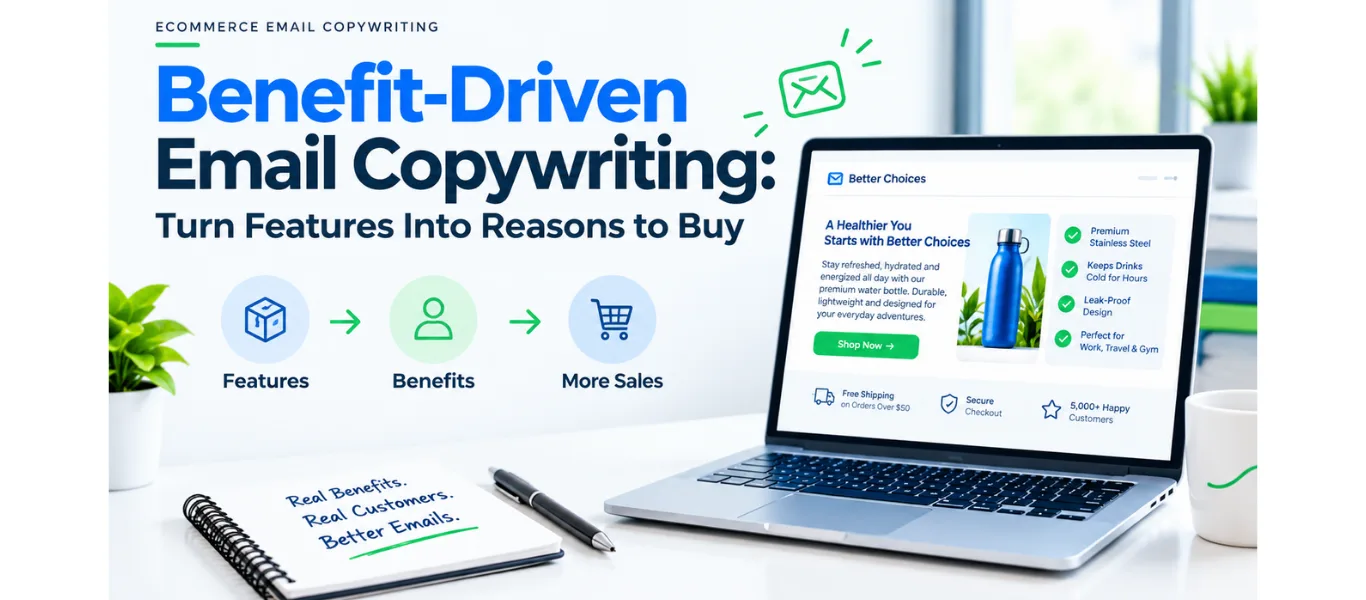
Customers rarely buy a product just because a feature exists. They buy because that feature helps them solve a problem, enjoy an experience, save time, feel more confident, or get something they value. Benefit-driven email copywriting makes that connection clear.
For ecommerce brands, this means moving beyond a list of specifications and showing subscribers why the product matters in their everyday lives. This guide explains a simple feature-to-benefit framework, practical email examples, and a checklist you can use before sending your next campaign.
What Is Benefit-Driven Email Copywriting?
Benefit-driven email copywriting explains what a product feature means for the customer. A feature describes what a product has or does; a benefit explains why that detail is useful to the person considering a purchase.
- Feature: what the product is, includes, or does.
- Benefit: the practical or emotional value the customer gets.
- Proof: the evidence that makes the benefit believable, such as accurate specifications, a verified review, a demonstration, or a clear policy.
For example, “double-wall stainless steel” is a feature. “Keeps your drink hot or cold for longer while you work or travel” expresses a customer benefit—but only use the claim if the product’s tested performance supports it.
Shopify’s guidance on writing engaging product descriptions similarly recommends focusing on the ideal customer, explaining benefits, avoiding vague statements, and making sure product claims are factual.
Why Benefits Make Ecommerce Emails Clearer
Subscribers scan emails quickly. If the message only lists materials, dimensions, or technical specifications, readers must work out for themselves why those details matter. A clear benefit helps them connect the product to a need or desire.
- Relevance: connect product details to a real customer situation.
- Clarity: make the value understandable without requiring technical knowledge.
- Confidence: pair benefits with accurate proof and answer likely purchase questions.
- Stronger calls to action: make the next step feel connected to the outcome the reader wants.
Benefit-led copy is not a licence to exaggerate. Avoid guaranteed outcomes, unsupported superlatives, invented reviews, or claims that the product cannot substantiate. Clear, specific language is more useful than hype.
The Feature → Benefit → Proof Framework
Use this three-step process to turn product information into email copy.
1. Start with a real feature
Collect verified product details: materials, dimensions, ingredients, functions, care instructions, compatibility, delivery terms, or warranty information. Do not invent details to make the copy sound impressive.
2. Ask “So what does that mean for the customer?”
Translate the feature into a practical outcome or experience. Ask what problem it helps solve, when it is useful, or what friction it may remove. The answer should fit the audience and the product.
3. Add proof or a useful detail
Support the benefit with a specification, demonstration, policy, or genuine customer feedback. If proof is unavailable, keep the wording modest rather than turning a possibility into a promise.
Before-and-After Examples for Ecommerce Emails
The following examples are illustrative copy ideas, not claims about real products. Adapt them only when the product details support the benefit.
Example 1: Reusable water bottle
Feature-led: “Double-wall stainless-steel bottle with a 750 ml capacity.”
Benefit-led: “Take enough water for your commute or workout, with an insulated design made to help maintain your drink’s temperature.”
Possible subject line: “A better bottle for busy days”
CTA: “Find Your Everyday Bottle”
Example 2: Cotton shirt
Feature-led: “Made with 100% cotton.”
Benefit-led: “Build an easy everyday outfit around a breathable cotton staple.”
Possible subject line: “The easy-to-style shirt you’ll reach for”
CTA: “Explore the Collection”
Example 3: Storage organiser
Feature-led: “Includes three adjustable compartments.”
Benefit-led: “Give everyday essentials a place of their own, and adjust the compartments to suit what you store.”
Possible subject line: “Make room for a tidier space”
CTA: “See How It Fits”
How to Use Benefit-Driven Copy in Different Email Types
Welcome emails
Introduce one or two reasons your products may be useful to the subscriber, then help them discover the right collection. Avoid cramming every product feature into the first message. For more guidance, read our ecommerce welcome email sequence guide.
Promotional campaigns
Lead with the customer value, explain the offer clearly, and state any conditions. A discount is a feature of the offer; the customer benefit might be a more affordable way to try a product they already want. Never hide exclusions or create false urgency.
Product launches
Choose the most meaningful improvement and explain what it changes for the user. If you are announcing a new version, make the difference from the previous version concrete and verifiable. Our article on storytelling in ecommerce emails can help you connect those improvements to a relatable customer scenario.
Back-in-stock emails
Remind subscribers why the product may suit them, but keep availability information accurate. A short benefit-led line can add context to a simple restock alert. See our back-in-stock email copywriting templates.
Review and follow-up emails
Use genuine customer language to help readers understand how others experience the product. Do not invent testimonials or imply that one person’s result is guaranteed for everyone. Our guide to writing review request emails covers asking for feedback clearly.
A Simple Template You Can Adapt
Use this structure for a focused product email:
- Headline: name the outcome or need that matters to the reader.
- Opening: describe a relevant situation in one or two sentences.
- Benefit: explain how the product helps in that situation.
- Proof: include one or two verified details that support the message.
- CTA: invite the reader to take one clear next step.
Example draft:
Subject: Make your everyday routine a little easier
Headline: Thoughtful details for busy days
From the morning commute to your evening plans, choose an everyday essential designed around practical use. Its [verified feature] helps you [specific, supported benefit], while [second verified detail] makes it easier to [relevant use case].
CTA: Explore the Details
Replace every bracketed phrase with accurate information from the product page or product team before sending.
Common Mistakes to Avoid
- Listing features without explaining their value. Add a “so what?” sentence after the most important detail.
- Making vague promises. Replace “premium quality” or “game-changing” with concrete, verifiable information.
- Overloading one email. Choose one primary benefit and support it with only the details needed to make the decision easier.
- Using the same benefit for everyone. Match the message to the audience, use case, and stage of the customer journey.
- Forgetting the CTA. Tell readers what to do next, and make the action match the message.
- Making unsupported claims. Check performance, health, sustainability, savings, and comparison claims carefully before publication.
How to Test Benefit-Led Email Copy
Choose one clear hypothesis and test one meaningful change at a time where your email platform and audience size allow it. For example, compare a feature-led subject line with a benefit-led subject line, or test a CTA that describes the outcome against a generic “Shop Now.” Keep the audience, offer, and timing as comparable as possible.
Measure the metric that matches the goal: click-through rate for engagement with the message, conversion rate or revenue per recipient for sales outcomes, and unsubscribe or complaint rates for potential negative effects. Do not assume a test winner from a tiny sample or a single send; consider sample size, seasonality, audience mix, and the wider campaign context.
Benefit-Driven Email Copy Checklist
- Is the main benefit relevant to this audience?
- Can a reader understand the value at a glance?
- Does every product claim match verified information?
- Have I included proof or specific detail where needed?
- Does the email focus on one main message?
- Does the CTA tell the reader what happens next?
- Have I checked the mobile layout, links, offer terms, and spelling?
Final Takeaway
Effective benefit-driven email copywriting connects what a product has to what the customer can reasonably expect to gain from it. Start with a verified feature, ask why it matters, support the benefit with evidence, and give the reader one clear next step. Keep the language specific, honest, and focused on the customer.
For more practical guidance, explore our guide to voice-of-customer copywriting for ecommerce emails.
External resources: Shopify’s product description guide and Email Optimize’s ecommerce email copywriting frameworks.