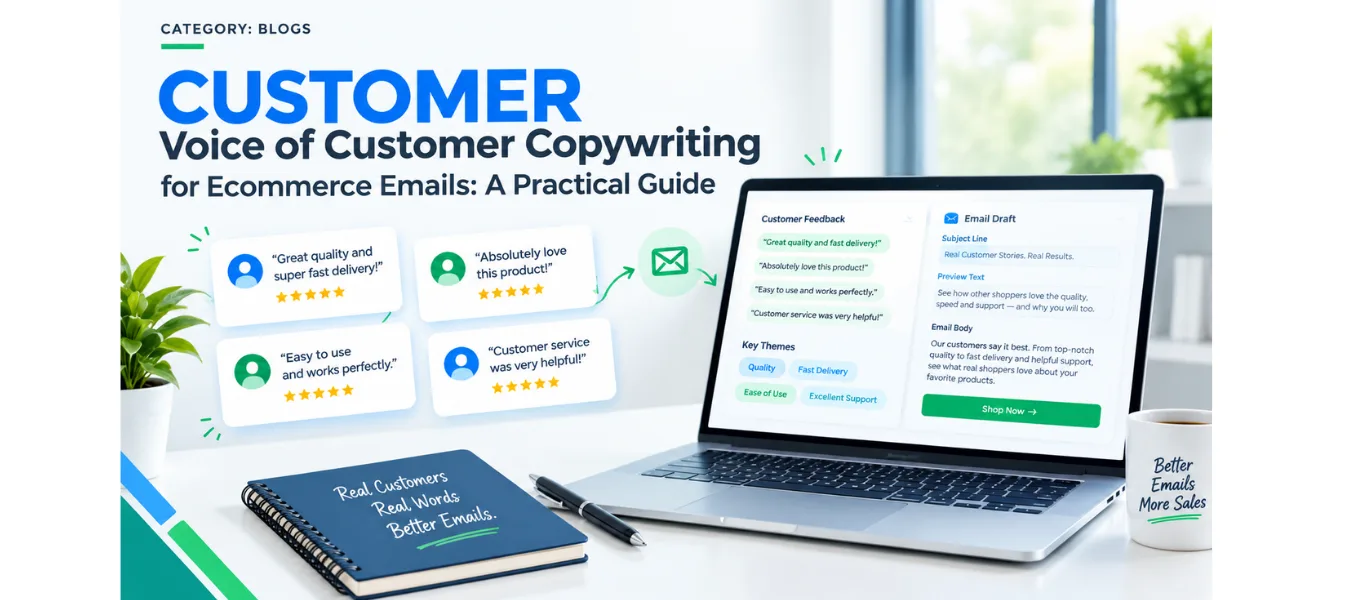
Voice of Customer Copywriting for Ecommerce Emails: A Practical Guide
Customer feedback is one of the most useful raw materials in ecommerce email copywriting. Reviews, support conversations, surveys, returns comments, and product questions reveal how shoppers describe their needs in their own words. Voice of customer (VoC) copywriting turns those real phrases into clearer, more relevant emails—without making up testimonials or exaggerating what a product can do.
The goal is not to paste reviews everywhere. It is to learn which problems customers want solved, which benefits they notice, what doubts hold them back, and which words feel natural to them. Then use those insights to make subject lines, email openings, product explanations, and calls to action more specific.
What is voice of customer copywriting?
Voice of customer copywriting uses the language customers actually use when describing their goals, questions, frustrations, and experiences. Instead of assuming that shoppers want “premium solutions” or “an elevated experience,” you look for the concrete phrases they use to explain what matters.
For example, a store might describe a backpack as “ergonomically designed with multiple storage compartments.” A customer might say, “I can finally fit my laptop, lunch, and charger without digging around.” That second phrase may suggest a more relatable email angle—provided it reflects genuine feedback and the product details support it.
VoC is not permission to publish private messages or invent customer quotes. Treat feedback responsibly, preserve the speaker’s meaning, remove identifying details where appropriate, and get permission when required to use a review, name, photo, or direct quotation.
Where to find useful customer language
1. Product reviews and ratings
Read positive, mixed, and negative reviews. Positive reviews often reveal the benefit customers value most; critical reviews can show uncertainty, unmet expectations, sizing concerns, setup friction, or details that need explaining. Do not cherry-pick a rare comment and present it as everyone’s experience.
2. Customer support conversations
Support tickets, live chat transcripts, and pre-sale questions can uncover the questions that stop a shopper from buying. Look for repeated questions about fit, compatibility, delivery, returns, materials, instructions, or product care. Follow your privacy policy and access controls, and do not move sensitive personal details into marketing copy.
3. Surveys and post-purchase feedback
Ask short, open questions such as “What nearly stopped you from ordering?” or “What were you hoping this product would help with?” Open questions can produce more specific language than a survey that only offers preset answers. Make it easy for customers to skip a question.
4. Returns and cancellation reasons
Return comments can reveal gaps between marketing promises and the actual product experience. If several shoppers misunderstand a size, feature, or compatibility requirement, clarify that detail in product emails rather than trying to persuade every shopper past the same objection.
5. Customer interviews and sales conversations
When possible, speak with a small, varied group of customers. Ask what happened before they searched for the product, what alternatives they considered, what made them hesitate, and what they noticed after using it. Avoid leading questions that suggest the answer you want to hear.
For a practical research framework, see CXL’s email copywriting guide and its advice on organizing customer language into themes. For ecommerce email examples and different campaign formats, explore Shopify’s email marketing examples.
Build a simple voice-of-customer swipe file
You do not need a complicated research platform to begin. Create a spreadsheet with one row per useful observation and these columns:
- Source: Review, survey, support ticket, interview, or another approved source.
- Customer phrase: A short exact quote or faithful paraphrase, clearly marked.
- Theme: A recurring need, concern, desired outcome, or use case.
- Context: Product, customer segment, purchase stage, and date range if relevant.
- Evidence strength: One isolated comment or a repeated pattern across multiple sources.
- Copy opportunity: The email type or message where the insight may help.
- Permission and privacy: Whether the phrase can be quoted publicly or should only inform internal copy.
Keep exact quotations in quotation marks and label paraphrases as paraphrases. Remove names, order numbers, email addresses, and other unnecessary personal details. Do not treat a single review as proof that all customers share the same view.
Turn customer phrases into email copy
Use this five-step workflow to move from raw feedback to a useful message.
- Collect: Gather relevant feedback from approved sources.
- Group: Sort comments into recurring themes such as convenience, confidence, fit, speed, ease of use, or support.
- Prioritize: Choose a theme that matters to the target segment and fits the email’s purpose.
- Translate: Use the customer’s plain language to explain a real product benefit. Do not copy a phrase if it is unclear, misleading, or unrepresentative.
- Verify and test: Check every product claim, protect customer privacy, then test one meaningful copy change against a reasonable alternative.
Three before-and-after examples
The following examples are illustrative, not real customer testimonials. Replace them with verified language and product facts from your own store.
Example 1: Product benefit email
Generic copy: “Discover our innovative, high-quality storage solution.”
Customer-led direction: “Keep the everyday essentials you reach for in one place.”
Why it may be clearer: It describes a use case rather than relying on broad adjectives. Only mention the items or organization features the product genuinely supports.
Example 2: Browse-abandonment email
Generic copy: “Still interested? Shop now!”
Customer-led direction: “Need to check the fit first? Here are the measurements and a quick size guide.”
Why it may help: If research shows that sizing uncertainty is a recurring barrier, useful information may be more appropriate than another sales nudge. Link to accurate sizing details and avoid implying that a shopper asked a question if they did not.
Example 3: Post-purchase email
Generic copy: “Thank you for your order. We hope you love it.”
Customer-led direction: “Ready to get started? Follow these three steps to set up your [product].”
Why it may help: If customers often ask how to set up or care for the item, a short practical guide can address that need. Make the steps accurate for the product and avoid inventing results or reviews.
Use VoC in different ecommerce email types
- Welcome emails: Reflect the main reason subscribers say they are interested in the category, then explain how the store helps them evaluate products. See our ecommerce welcome email sequence guide.
- Abandoned-cart emails: Address common purchase questions—such as delivery, returns, compatibility, or product fit—only when the information is relevant and verified.
- Browse-abandonment emails: Use common research questions to offer a guide, comparison, or helpful product detail instead of repeating a generic “come back” message. See our browse-abandonment email copywriting guide.
- Product launches: Explain the customer problem the product is designed to address, using documented product details and real research rather than unsupported claims.
- Review-request emails: Ask for honest feedback without pressuring customers to leave only positive reviews. For examples, read our review-request email guide.
- Winback emails: Investigate why customers stopped buying before assuming that a discount is the answer. Different reasons may need different messages.
Three adaptable email templates
Template 1: Customer need and product fit
Subject: A simpler way to [customer task]
Preview text: See how [verified product detail] fits into your routine.
Hi [First name],
If you’re trying to [customer goal], it helps to know [useful consideration]. [Product] includes [verified feature], which is designed to help with [specific, supportable use case].
Take a look at the details to see whether it’s right for you.
CTA: Explore [Product]
Template 2: Answer a recurring question
Subject: Wondering about [common product question]?
One question we often hear is [accurately summarized question]. Here’s the short answer: [clear, verified answer]. You can also check [guide, specifications, care instructions, or policy] before deciding.
CTA: Get the details
Template 3: Use a real customer quote responsibly
Subject: What customers mention about [product category]
“[Insert an exact, approved customer quote that is representative and used in context.]”
That feedback describes one customer’s experience, not a guaranteed outcome for everyone. Learn more about [relevant feature or product detail] and decide if it suits your needs.
CTA: See product details
Never publish the bracketed placeholders. Use a real quote only with the required permission, keep its meaning intact, and ensure any accompanying claim is accurate.
Common voice-of-customer copywriting mistakes
- Inventing quotes: Never create fake testimonials, review excerpts, or customer outcomes.
- Overusing customer jargon: A phrase may make sense in a review but confuse new shoppers. Keep the meaning and improve clarity where needed.
- Ignoring negative feedback: Objections can reveal what information customers need. Do not hide material product limitations.
- Assuming every customer is the same: Segment by relevant needs or product context when evidence supports it; avoid stereotypes.
- Using feedback without privacy safeguards: Limit access to customer data and get permission where required before publishing identifiable quotes or images.
- Claiming results without evidence: Customer wording does not automatically substantiate a performance, health, environmental, or comparative claim.
- Changing too many variables at once: If you want to learn whether VoC phrasing helped, keep the offer and other major elements stable where practical.
How to test customer-led copy
Choose one specific hypothesis, such as: “Using the language customers use to describe sizing uncertainty will increase clicks to our size guide.” Compare the customer-led version with a clear control version. Keep the audience, offer, send time, and design as consistent as practical so that the result is easier to interpret.
Choose a metric that matches the purpose. A click rate may suit a guide-focused email; conversion rate or revenue per recipient may be more relevant to a purchase campaign. Monitor unsubscribes and complaints as well. Do not declare a winner from a tiny sample or assume a result will hold for every audience.
Pre-send checklist
- Is the customer insight based on real, relevant feedback?
- Have exact quotes been distinguished from paraphrases?
- Are permissions, privacy, and customer expectations respected?
- Can every product statement be verified?
- Does the email address one clear need or question?
- Does the subject line match the email’s content?
- Are the links, offer terms, and call to action correct?
- Is there a clear plan to measure the email’s result?
Final takeaway
Voice of customer copywriting helps ecommerce brands move from assumptions to more specific, customer-centered messaging. Collect real feedback, identify recurring themes, preserve customers’ meaning, and turn those insights into useful email copy. The best result is not an email that imitates a customer; it is an email that shows the brand understands the customer’s question and can answer it honestly.