How to Write Re-Engagement Emails That Win Back Customers
Your email list is silently bleeding value every single year.
Not because your subscribers unsubscribe. Not because they complain. They simply stop opening. Stop clicking. Stop caring. And while you keep sending campaigns to a list that is growing colder by the week, your deliverability drops, your open rates crater, and your sender reputation takes damage that affects every email you send — including to the subscribers who still want to hear from you.
The data is brutal: your email list loses 22–30% of its value every year through natural decay.
Most ecommerce brands respond to this the same way — by doing absolutely nothing. They keep emailing the dead weight, watch their metrics slide, and assume list decay is just the price of doing business.
It is not.
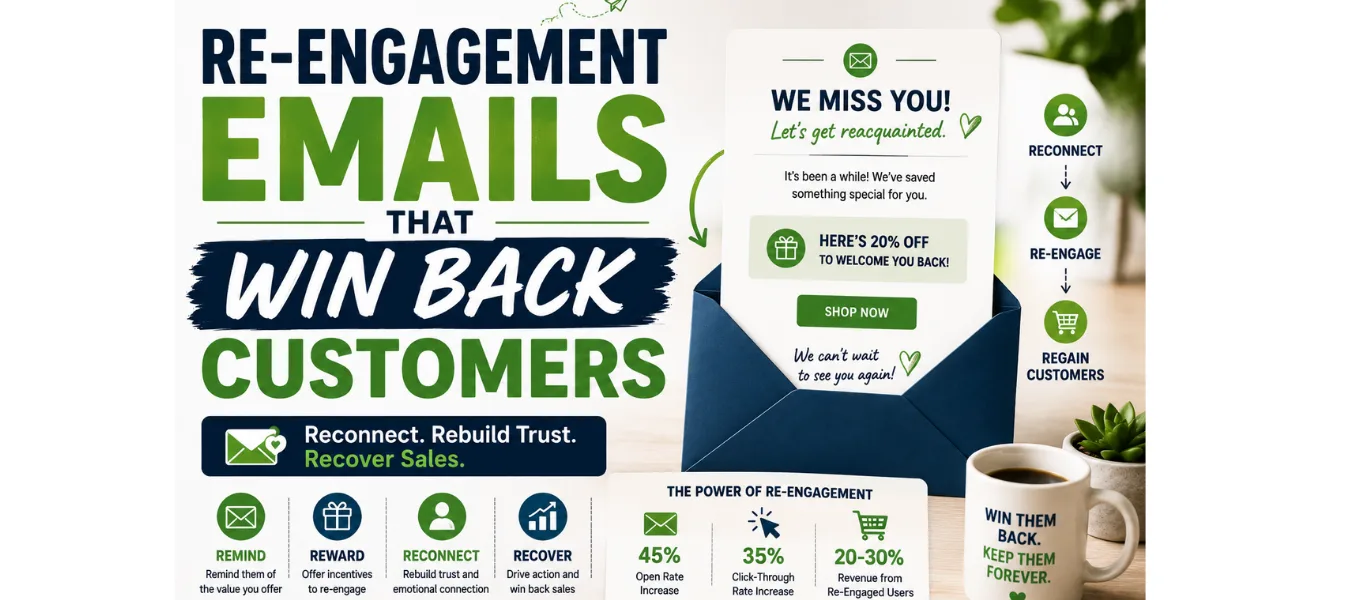
45% of dormant subscribers can still be reactivated with properly targeted messaging. And reactivating an existing subscriber costs five times less than acquiring a new one through paid channels.
In this guide, you will get the complete winback playbook—the proven re-engagement emails for e-commerce that rescue inactive subscribers, recover lost revenue, and protect your sender reputation before the damage becomes permanent. Full copy templates, exact timing, and the psychological triggers that make dormant subscribers open, click, and buy again.
Why Inactive Subscribers Are Your Most Overlooked Revenue Stream
Before we get into the copy, let us reframe the way you see your inactive list.
Most founders look at a segment of subscribers who have not opened in 90 days and see dead weight. A problem to manage. Names to eventually delete.
Here is what they actually are: a warm audience who already trusted you enough to opt in — and simply drifted away.
They did not find a better brand. They did not consciously reject you. Life happened. Your emails blended into the noise. The timing was off. You never sent the right message at the right moment to pull them back.
That is a solvable problem.
And the business case for solving it is irresistible:
- Reactivating one dormant subscriber costs five times less than acquiring a new one
- Win-back campaigns achieve success rates of 14–29% with the right targeting and timing
- Brands with systematic re-engagement programs show 20–30% better overall email performance — because a cleaner, more engaged list improves deliverability across every campaign
- Only 24% of marketers currently use inaction-triggered emails to win back dormant subscribers
That last number is the one that should excite you. 76% of your competitors are leaving this revenue completely untouched. A systematic winback sequence is one of the few genuine competitive advantages left in ecommerce email marketing — because most brands simply never build one.
When to Trigger Your Re-Engagement Campaign (Exact Timing Guide)
Timing is everything in re-engagement emails for e-commerce. Send too early, and you interrupt subscribers who are just in a quiet period. Send too late and you are emailing addresses that have gone completely cold—hurting your deliverability without recovering any revenue.
Here is the proven timing framework:
Define “Inactive” for Your Store First
The definition of inactive depends entirely on your send frequency and your customer’s typical purchase cycle:
| Send Frequency | Define “inactive” as |
|---|---|
| Daily sender | No openings in 30–45 days |
| 2–3x per week | No openings in 60 days |
| Weekly sender | No openings in 90 days |
| Bi-weekly sender | No openings in 120 days |
| Monthly sender | No openings in 180 days |
Chase Dimond’s timing rule—widely used by 7, 8, and 9-figure e-commerce brands—is to start re-engagement at 2x your average purchase or engagement cycle. If your customers typically buy every 30 days, trigger re-engagement at 60 days of inactivity.
The 3-Stage Re-Engagement Trigger System
Stage 1—Early Warning (60–90 days inactive) Subscribers who have gone quiet but are not yet cold. Highest recovery rate. Easiest to win back. This is where most of your revenue recovery will come from.
Stage 2 — At Risk (90–120 days inactive) Subscribers drifting toward permanent disengagement. Requires a stronger hook and a more personalized approach.
Stage 3 — Last Chance (120–180 days inactive) Final attempt before sunsetting. Be direct, be honest, and make the offer impossible to ignore. After this, if they do not engage, remove them.
The Proven 3-Email Winback Sequence (Full Copy Templates)
One email is not a winback campaign. It is a single shot in the dark.
The most effective customer reactivation email campaigns use a 3–4 email sequence — spaced 5–7 days apart — that escalates in urgency and shifts angle with every send.
Here is the complete sequence:
Email 1 — The Gentle Reconnect (Send at Inactivity Trigger)
Goal: Re-establish the connection. Remind them of the value they opted in for. No hard sell. No pressure.
Steal-worthy subject lines:
- “We have missed you, [First Name].”
- “It has been a while — we wanted to check in”
- “[First Name], are you still there?”
- “Something has changed since you last visited”
Preview text options:
- “We have been busy — here is what you missed.”
- “A quick note from us — no pressure, just hello.”
Subject: We have missed you, [First Name]
Preview text: Here is what has been happening since you last stopped by.
Hey [First Name],
We noticed you have not been around lately.
No judgement — inboxes get busy, life gets full, and sometimes great things just slip through the cracks.
But we wanted to reach out personally, because we have been doing a lot since you last visited [Brand Name].
Here is what is new:
→ [New product, collection, or feature launched since they last engaged] → [A result or transformation your recent customers have experienced] → [Something exclusive coming soon that they should know about]
We think you are going to love where things are headed.
If you want to stay in the loop — your place on our list is waiting. If life has moved on and email is not working for you — no hard feelings. Just let us know.
[SEE WHAT’S NEW AT [BRAND NAME] →]
Good to hear from you, [Your Name] [Brand Name]
Email 2 — The Value Reminder + Feedback Ask (Send Day 5–7)
Goal: Apply the PAS formula. Remind them what they are missing. Ask for feedback — re-engagement emails requesting customer feedback achieve 29% open rates and 4.5% response rates, making this your highest-engagement email in the sequence.
Steal-worthy subject lines:
- “Quick question — be honest with us”
- “Did we do something wrong, [First Name]?”
- “We want to know what you actually think”
- “[First Name], your opinion matters — one question”
Subject: Did we do something wrong, [First Name]?
Preview text: We are asking because we genuinely want to know.
[First Name], we will be straight with you.
You joined [Brand Name] because [the promise that made them sign up — their desired outcome].
And somewhere along the way, we lost you.
Maybe our emails got repetitive. Maybe life got busy, and we slipped off your radar. Maybe we stopped delivering the value you signed up for.
Whatever happened — we want to know. Because the subscribers who are still here are telling us [specific positive result, testimonial, or outcome your active customers are experiencing]. And we believe you deserve that too.
We have made some changes recently. New content. New products. A different approach to [relevant area of improvement].
And before we tell you about any of it, we want to ask you one question:
What would make [Brand Name] emails worth opening again?
Just reply to this email. We read every response personally.
Or if you are ready to give us another chance right now:
Honestly, [Your Name]
P.S. If you would rather we stop emailing you, just click here, and we will honour that immediately. No guilt. No follow-up.
Email 3—The Irresistible Offer (Send Day 12–14)
Goal: Make staying on your list feel like the obvious decision. Apply the BAB formula. Use your strongest offer. Create genuine urgency.
Steal-worthy subject lines:
- “[First Name], this is our last email—make it count.”
- “A gift before we say goodbye”
- “Your exclusive winback offer — expires in 48 hours.”
- “Last chance to claim this, [First Name]”
- “We are about to remove you—unless you want this.”
Subject: [First Name], this is your last email from us — unless you want this
Preview text: An exclusive offer — yours for the next 48 hours only.
[First Name], before you were on our list, you were dealing with [the core problem your product solves].
That is why you signed up. Because [Brand Name] promised [the transformation or result you offer].
Right now, [X] of our active customers are experiencing exactly that. They are [specific transformation, result, or positive outcome your product delivers].
We want that for you, too.
So here is what we are going to do.
As a thank you for being on our list — even quietly — we want to give you one last reason to stay.
YOUR EXCLUSIVE WINBACK OFFER: [Your best offer—discount code, free shipping, free product, exclusive access]
CODE: COMEBACK[XX]
This offer expires in 48 hours. After that, we will remove you from our list — which means no more offers, no more updates, and no more chances to claim this.
We hope to keep you.
[CLAIM MY EXCLUSIVE OFFER — EXPIRES IN 48 HOURS →]
With appreciation, [Your Name] [Brand Name]
P.S. This is genuinely the last email we will send you if you do not engage. We respect your inbox too much to keep emailing someone who has moved on.
The Psychology Behind Winback Emails That Actually Convert
Understanding why these emails work makes you dramatically better at writing them. Here are the four psychological triggers powering every high-converting re-engagement email:
1. The Curiosity Gap
“Did we do something wrong?” works because it opens a loop the human brain cannot leave unresolved. Your subscriber does not know the answer — and they have to open to find out. This is the open loop formula applied to winback copy — and it consistently outperforms transactional subject lines in re-engagement campaigns.
2. Loss Aversion
“We are about to remove you” activates the most powerful buying trigger in human psychology. Losing something you have — even passive list membership — feels twice as painful as gaining something equivalent. When you frame the final email around what the subscriber is about to lose, not what they are about to gain, your open rate spikes.
3. Reciprocity
Asking for feedback before making an offer creates a reciprocal dynamic. You gave them something (your genuine interest in their opinion). The social obligation to reciprocate makes them more likely to engage, reply, and ultimately return.
4. Identity Restoration
“You joined [Brand Name] because you wanted [desired outcome]” reminds the subscriber of who they were when they opted in — and who they could be again. This BAB formula creates a gap between their current reality and their desired identity that only your product can close.
The 7 Re-Engagement Email Mistakes That Kill Your Winback Rate
Even with the right sequence, these mistakes silently destroy your results:
Mistake 1 — Sending to your entire inactive list at once. Emailing thousands of cold subscribers simultaneously tanks your deliverability and triggers spam filters. Segment your inactive list by inactivity duration and send in small batches — starting with the most recently inactive.
Mistake 2—Starting with a discount in Email 1. Offering a discount in your first re-engagement email trains subscribers to go inactive on purpose — waiting for the deal. Start with a genuine reconnection. Save the offer for Email 3.
Mistake 3 — No sunset clause If you never remove unresponsive subscribers after your winback sequence, your list quality deteriorates permanently. Every address that does not respond to a 3-email winback sequence should be suppressed — not deleted, suppressed. This protects deliverability and keeps your engagement metrics accurate.
Mistake 4 — Generic “We miss you” emails with no substance. “We miss you — here is 10% off” is the most common and least effective winback email in ecommerce. It says nothing specific. It shows no understanding of why the subscriber left. It offers no reason to return beyond a discount that trains bad behaviour.
Mistake 5 — Sending all three emails in 72 hours. Aggressive sequencing feels like desperation — and desperation kills conversions. Space your emails 5–7 days apart. Give subscribers time to re-engage naturally between sends.
Mistake 6 — No mobile optimization. Re-engagement emails are frequently opened on mobile — often by subscribers who scan their inbox while clearing notifications. If your email is not mobile-optimized, you lose the re-engagement before it even begins.
Mistake 7 — Forgetting to suppress buyers mid-sequence If a subscriber purchases or re-engages during your winback sequence, remove them from the remaining emails immediately. Continuing to send “last chance before we remove you” to someone who just spent $80 is a trust-destroying experience.
How to Build a Re-Engagement System on Autopilot in Klaviyo
Here is the exact setup to run your winback email sequence that ecommerce brands use in Klaviyo — triggered automatically without manual intervention:
Step 1 — Create your inactive segment In Klaviyo: Profiles → Segments → Create Segment Filter: “Has not opened email in the last 90 days” AND “Is on your main list”
Step 2 — Build your winback flow In Klaviyo: Flows → Create Flow → Trigger: Segment membership Trigger: When someone joins your inactive segment
Step 3 — Set your email delays
- Email 1: Send immediately on segment entry
- Email 2: 7-day delay
- Email 3: 7-day delay (14 days after Email 1)
Step 4 — Add a post-sequence split After Email 3:
- If opened or clicked → Move to reactivated segment → Begin standard email cadence
- If no engagement → Add to suppression list → Remove from all future campaigns
Step 5 — Set up quarterly list cleaning Every 90 days, review your suppression list. Any address that has not engaged in 6+ months gets permanently removed. This keeps your sender reputation strong and your deliverability consistently high.
Frequently Asked Questions
How many re-engagement emails should I send before giving up? Three to four emails is the proven sweet spot for winback email sequences in ecommerce. Sending more than five risks spam complaints and permanent deliverability damage. Space them 5–7 days apart and escalate the urgency with each send. If a subscriber does not respond to a properly written 3-email sequence, they are unlikely to re-engage — and suppressing them protects the deliverability of your entire list.
What is the best subject line for a re-engagement email? The highest-performing re-engagement email subject lines use three techniques: the curiosity gap (“Did we do something wrong?”), the identity question (“Are you still there, [First Name]?”), and the loss frame (“This is our last email — unless you want this”). Avoid generic phrases like “We miss you” without any substance — they are overused, predictable, and consistently underperform against pattern-interrupting alternatives.
How do I re-engage inactive email subscribers without hurting my deliverability? Send your winback campaign in small batches — not to your entire inactive segment at once. Start with subscribers inactive for 90 days before moving to 120 and 180-day segments. Always warm up your sending volume gradually, and suppress non-responders immediately after the sequence ends. Brands with systematic re-engagement programs show 20–30% better overall email performance because a cleaned, engaged list dramatically improves sender reputation.
Should I offer a discount in my re-engagement emails? Reserve the discount for your third and final email — not your first. Starting with a discount immediately trains your audience to go inactive intentionally, waiting for the offer. Emails one and two should focus on reconnection and genuine value. The discount in Email 3 serves as the irresistible reason to act now — combined with the urgency of the sunset clause, it creates the most effective possible conversion moment.
How do I know if my re-engagement campaign is working? Track four metrics across your winback sequence: open rate (benchmark: 12% average for re-engagement emails), click rate (benchmark: 2–3%), reactivation rate (benchmark: 5–15% of your inactive segment), and revenue recovered per reactivated subscriber. Compare these against your standard campaign benchmarks. A successful winback campaign should recover 10–15% of your inactive segment and generate measurable revenue — even at a modest average order value, this represents significant recovered income from subscribers who cost nothing to reacquire.
Conclusion
[Promise] Your inactive subscribers are not a lost cause. They are a recoverable revenue stream — one that costs five times less to reactivate than it would cost to replace with paid acquisition.
[Picture] Imagine a fully automated winback sequence running in the background of your Klaviyo account — triggering every time a subscriber goes quiet, sending three perfectly timed emails that reconnect, remind, and reward — recovering 10–15% of your inactive list every single quarter without you touching a single keyboard.
[Proof] 45% of dormant subscribers can be reactivated with targeted messaging. Winback campaigns achieve 14–29% success rates. Only 24% of brands are running them — which means 76% of your competitors are leaving this revenue completely on the table.
[Push] Build your winback sequence this week. Start with 90-day inactives. Use the three email templates in this guide. Set your sunset clause. And watch a segment of subscribers you had written off start generating revenue again.
And if you want your entire winback sequence written by a specialist who builds these for ecommerce brands every day — visit blogwithjawed.com. Let us recover the revenue your inactive list is sitting on.