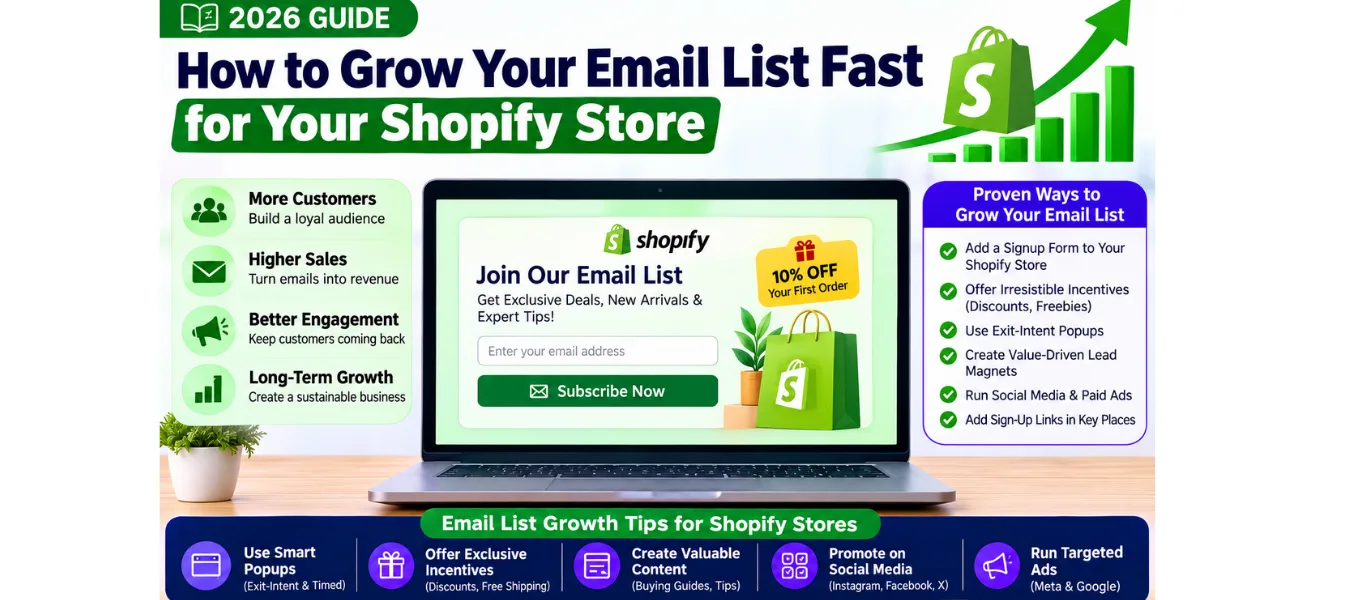
How to Grow Your Email List Fast for Your Shopify Store — 2026 Guide
Your Shopify store is getting visitors. Some of them browse. Some add to cart. Some even reach the checkout page. But the vast majority — over 95% — leave without buying and without giving you any way to reach them again.
Paid ads can bring them back — but only if you keep spending. SEO can attract new visitors — but only if Google decides to rank you. Social media can keep you visible — but only if the algorithm cooperates.
Your email list is the only marketing channel you own completely. No algorithm. No ad spend. No platform dependency. When you send an email to your list, 100% of your subscribers receive it—and a properly built list converts at a higher rate than any other channel available to e-commerce stores in 2026.
This complete guide shows you exactly how to grow your email list fast for your Shopify store—five proven methods, the benchmark data behind each one, the best lead magnet ideas for e-commerce, and the mistakes that slow list growth to a crawl.
What you will have after this guide: A clear, executable Shopify email list-building strategy using pop-ups, lead magnets, checkout opt-ins, content upgrades, and social traffic—plus the benchmark data to measure your progress and the tools to implement everything today.
Why Your Email List Is Your Most Valuable Ecommerce Asset
Before diving into the email list growth strategies themselves, it is worth being specific about why this asset is worth building aggressively:
• You own it permanently: Unlike Instagram followers, Facebook fans, or paid search rankings, your email list cannot be taken away by a platform policy change, an algorithm update, or an account suspension. It is an asset you own and control indefinitely.
• Email ROI dwarfs every other channel: Email marketing generates an average of $36–$42 for every $1 spent—the highest ROI of any digital marketing channel available to e-commerce stores. A list of 5,000 engaged subscribers consistently outperforms a social following of 50,000.
• Direct inbox access: When you send an email, it lands directly in your subscriber’s inbox—no algorithm decides whether to show it, no ad budget determines its reach, and no platform controls its distribution.
• Compound growth: A properly set up Shopify email program grows in value over time. Every new subscriber enters your welcome sequence, is tagged by behavior, and becomes more valuable through ongoing personalization.
• Free traffic forever: Every subscriber you capture today becomes a source of free, high-intent traffic to your store for as long as they remain subscribed—reducing your dependence on paid acquisition.
The stores with the strongest e-commerce email programs did not build their lists overnight. They built them systematically, using the five methods below, consistently applied over 6–12 months. Here is exactly how to do it.
How Fast Should Your Shopify Email List Be Growing?
Before implementing your email list building strategy, you need a benchmark to measure success. Here is what healthy email list growth looks like for Shopify stores at different stages:
Store Stage Monthly Traffic Target New Subscribers List Growth Rate
New store (0–6 months): Under 1,000/month, 30–80 subscribers, 5–10%/month
Growing store (6–18 months):: 1,000–5,000/month, 100–300 subscribers, 5–8%/month
Established store (18+ months): 5,000–20,000/month, 300–1,000 subscribers, 4–6%/month
Scaling store (20,000+/month): 20,000+/month, 1,000+ subscribers, 3–5%/month
The most important benchmark: your email opt-in rate — the percentage of store visitors who join your list. A healthy opt-in rate for a Shopify store with a well-configured pop-up is 3–5% of all visitors. If you are below 1%, your pop-up strategy, incentive, or targeting needs work.
See also: Our complete Ecommerce Email Marketing Benchmarks guide at blogwithjawed.com/ecommerce-email-marketing-benchmarks covers all key metrics, including list growth rate, opt-in rates, and what good looks like at every stage.
METHOD 1: The High-Converting Pop-Up Form | Avg opt-in: 3–5% of visitors
The email pop-up in Shopify is the single highest-volume source of new subscribers for most e-commerce stores. Configured correctly, a pop-up form captures 3–5% of all visitors — meaning every 1,000 visitors to your store adds 30–50 new subscribers to your list automatically.
Pop-Up Design That Converts
• Trigger timing: Show the pop-up after 5–8 seconds on-site or on exit intent — not immediately on page load. Instant pop-ups have the lowest conversion rate and the highest bounce rate.
• Single field only: Email address only — no name, no phone number. Every additional field reduces your email signup form conversion rate by 10–20%
• Strong headline: Not ‘Sign up for our newsletter ‘—instead, ‘Get 10% off your first order’ or ‘Join 5,000 customers getting exclusive deals’. Lead with what the subscriber gets, not what you want.
• Clear CTA button: First-person phrasing converts highest—”Claim My 10% Off’ beats ‘Subscribe’ by a consistent margin in A/B testing.
• Easy dismissal: Always include a visible close button. Trapping visitors in a pop-up creates resentment—the people who sign up under pressure immediately unsubscribe
Best Incentives for Shopify Pop-Ups
Incentive Type Avg Opt-In Rate Best For
Discount code: 10–15% off 3–5% of visitors All product stores
Free shipping offer 2–4% of visitors High AOV stores ($80+)
Free gift with first order: 4–6% of visitors; beauty and wellness stores
Product quiz or finder: 5–8% of visitors; complex product ranges
Exclusive content or guide: 2–4% of visitors; educational or niche brands
PRO TIP: A/B test two pop-up variants simultaneously — one with a discount offer and one with a non-discount incentive like a free gift or quiz. Many stores find non-discount incentives attract higher-quality subscribers who buy at full price more consistently.
Pop-Up Tools for Shopify
• Klaviyo: Built-in pop-up builder with smart timing, A/B testing, and direct list integration — best for stores using Klaviyo for email
• Omnisend: Strong pop-up templates with exit intent and scroll-based triggers — best for stores on Omnisend
• Privy: Dedicated pop-up and email capture tool — good for stores needing advanced targeting by URL, device, or cart value
Related: Read our comparison of the best email marketing software for Shopify at blogwithjawed.com/best-email-marketing-software-shopify to find the platform with the strongest built-in pop-up and email capture tools for your store size.
METHOD 2: The Lead Magnet Landing Page | Avg opt-in: 20–35% of landing page visitors
A lead magnet is a free resource you offer in exchange for an email address. Unlike a discount code — which costs you margin on every conversion — a lead magnet is created once and converts subscribers indefinitely. The lead magnet landing page consistently achieves 20–35% opt-in rates when the offer is specific and genuinely valuable.
Best Lead Magnet Ideas for Shopify Stores in 2026
• PDF buying guide: A downloadable guide that helps your customer make a better purchase decision—’The Complete Guide to Choosing the Right [Product]’. High perceived value, costs nothing to deliver
• Product quiz: An interactive quiz that recommends the right product for the subscriber’s specific needs—’Find Your Perfect [Product] in 60 Seconds’. Average opt-in rate: 30–40% of quiz starters
• Exclusive recipe or how-to guide: For food, beauty, fitness, or lifestyle brands—a free guide closely related to your product category that delivers standalone value
• First access or VIP waitlist: For product launches or limited collections — ‘Join the VIP list for first access and an exclusive pre-launch discount’. Scarcity drives high opt-in rates
• Free sample offer: For consumable products — ‘Get a free sample delivered to your door.’ High conversion rate because the value is tangible and immediate
• Email course or challenge: A free 5-day email course delivered directly to the inbox — builds the subscriber relationship from day one while showcasing your brand expertise
How to Drive Traffic to Your Lead Magnet Page
• Link in bio: Your Instagram, TikTok, and X profile—the highest-traffic link in your social accounts should point to your lead magnet page, not your homepage
• Pinterest pins: Create a dedicated Pinterest pin for your lead magnet with the free resource in the title — Pinterest drives consistent referral traffic to landing pages for months after publishing
• Facebook ads: Run Facebook ads directly to your lead magnet landing page — this is the highest-converting ad destination for email list building, significantly outperforming ads sent to blog posts or product pages
• Blog post CTAs: Include a CTA to your lead magnet at the end of every blog post—visitors who have already read 1,500 words of your content are your warmest leads
METHOD 3: Checkout and Post-Purchase Opt-ins | Avg opt-in: 25–40% of buyers
The checkout page is the highest-intent moment in your entire store — a visitor is actively completing a purchase and their trust in your brand is at its peak. Adding an email opt-in at checkout captures buyer emails at the best possible moment and produces the highest-quality subscribers in your entire list.
Checkout Opt-in Setup on Shopify
1. Go to Shopify Admin → Settings → Checkout
2. Under Customer information, enable ‘Email marketing opt-in’
3. Check the box: ‘Show a sign-up option at checkout’
4. Customise the opt-in label — use ‘Get exclusive deals and early access’ instead of the default ‘Email me with news and offers’
5. Enable pre-selected opt-in if your market’s regulations permit — this significantly increases
The checkout opt-in captures 25–40% of all buyers as email subscribers — far higher than any pop-up. These subscribers have already demonstrated the highest possible purchase intent and consistently generate the highest revenue per email in your entire list.
Post-Purchase Email Opt-in
Your order confirmation page and post-purchase email are two more opportunities to capture subscribers who did not opt in at checkout. Include a clear, benefit-led invitation to join your email list on your order confirmation page — ‘Join our VIP list for exclusive deals and early product access.’ Subscribers captured here are already buyers, making them your most valuable list segment from day one.
QUICK WIN: Enable the Shopify checkout opt-in today — it takes under 5 minutes in your admin settings and immediately begins capturing buyer emails at your highest-intent touchpoint. This is the fastest quality improvement you can make to your list.
METHOD 4: Content Upgrades in Blog Posts | Avg opt-in: 10–25% of blog readers
A content upgrade is a bonus resource closely related to the blog post the visitor is reading — offered in exchange for an email address mid-article or at the end. Unlike generic pop-ups that interrupt any visitor, content upgrades target readers who have demonstrated specific interest in a topic and are primed to find additional value on exactly that subject.
Content Upgrade Ideas for Ecommerce Blog Posts
• Post: How to Write Abandoned Cart Emails → Content upgrade: Free 3-email abandoned cart sequence template PDF
• Post: Email Marketing Benchmarks → Content upgrade: Free benchmark tracking spreadsheet
• Post: How to Set Up Klaviyo on Shopify → Content upgrade: Klaviyo setup checklist PDF
• Post: Holiday Email Copywriting Tips → Content upgrade: Holiday email subject line swipe file
Content upgrades consistently achieve 10–25% opt-in rates from blog readers — significantly higher than sidebar forms or footer signup boxes. The key is making the upgrade a natural extension of the post: something the reader wants immediately after consuming the content.
Resource: Our guide on email personalization tactics for ecommerce at blogwithjawed.com/email-personalization-tactics-ecommerce covers how to tag and segment subscribers captured through content upgrades for maximum relevance from day one.
METHOD 5: Social Media Traffic to Email Capture | Avg opt-in: 10–20% of social clicks
Social media followers are not an asset you own — they are rented attention on platforms you do not control. The strategic goal of your social media presence should not be to maximize followers. It should be to convert social traffic into email subscribers—an asset you own permanently.
Instagram and TikTok to Email List
• Link in bio: Point your Instagram and TikTok bio link directly to your lead magnet landing page — not your homepage or product page. A landing page with a single opt-in converts significantly higher than a homepage with competing navigation options
• Story CTAs: Use Instagram Stories with swipe-up or link sticker CTAs pointing directly to your opt-in page—’Get the free guide’ or ‘Join 5,000 subscribers’ drives consistent list growth from engaged followers
• Content teasers: Share a valuable tip from your lead magnet or email content in your feed—then tell followers the full guide is available for free via the link in bio
Pinterest to Email List
Pinterest is a search engine that drives long-term, compounding referral traffic. Create dedicated pins for your lead magnets — using your existing pin designs with ‘Free Download’ or ‘Free Guide’ in the title—and link them directly to your landing page. A single high-performing Pinterest pin can drive consistent opt-ins for months after publishing.
Mistake: Why It Hurts Fix
Buying email lists: spam complaints · Low deliverability · No intent. Only capture subscribers who opt in organically
No double opt-in Poor list quality · GDPR risk Enable double opt-in for all signup sources
Sending immediately without welcome sequence: Missed first impression · Low LTV: Set up welcome sequence before driving traffic
Not segmenting new subscribers Generic emails · Low engagement Tag by source (popup, checkout, lead magnet)
Ignoring list hygiene Low deliverability · Inbox placement drops. Suppress 90-day unengaged subscribers monthly
Prioritising list size over list quality: Low open rates · Poor conversion. Track revenue per subscriber, not just list size
IMPORTANT: Never purchase email lists. They are ineffective, almost universally low quality, and a violation of email marketing best practices. Every platform—Klaviyo, Mailchimp, Omnisend—will suspend your account for using purchased lists. Build your list organically through the five methods in this guide.
What to Do After You Capture a New Subscriber
Growing your Shopify email list is only half the equation. What happens in the 7 days after a new subscriber joins determines whether they become a buyer — or just a number on your list.
• Welcome sequence fires immediately: Every new subscriber should enter a 5-email welcome sequence automatically—delivering your promised incentive instantly, introducing your brand story, showcasing best sellers, providing social proof, and creating urgency to buy
• Tag by source: Tag each subscriber with how they joined—pop-up, checkout opt-in, lead magnet, or content upgrade. This enables segmentation from day one and lets you track which acquisition source produces the highest-value subscribers
• Suppress non-openers at 90 days: Subscribers who have not opened a single email in 90 days should be suppressed — not deleted, but excluded from sends. This protects your sender reputation and keeps your deliverability strong
• Set up abandoned cart trigger: Every new email subscriber who visits your store and adds to cart without purchasing should automatically enter your abandoned cart sequence—the highest-ROI automation in e-commerce.
Related: Our complete guide to e-commerce welcome email sequences that convert at blogwithjawed.com/ecommerce-welcome-email-sequence covers the full 5-email welcome blueprint—including subject lines, copy angles, and timing for every email in the sequence.
Frequently Asked Questions
How fast can I grow my Shopify email list?
With a well-configured discount pop-up receiving 1,000 monthly visitors, you can expect 30–50 new subscribers per month from pop-ups alone — a 3–5% opt-in rate. Adding a lead magnet landing page with Facebook ad traffic, checkout opt-ins, and content upgrades can accelerate this significantly. Most Shopify stores that implement all five methods in this guide add 100–300 subscribers per month within 60–90 days.
What is the best lead magnet for a Shopify store?
The best lead magnet for a Shopify store depends on your product category. For fashion, beauty, and lifestyle brands: a product quiz or style guide consistently achieves 30–40% opt-in rates. For all other stores: a first-order discount code (10–15% off) is the simplest, highest-volume lead magnet—converting 3–5% of all visitors with minimal setup. For stores with existing content: a content upgrade specific to your top blog posts converts 10–25% of blog readers.
Should I use a pop-up or an embedded form?
Use both; they serve different purposes. Pop-ups capture the widest audience and deliver the highest volume of new subscribers (3–5% of visitors). Embedded forms—in your footer, blog posts, and about page—capture the most intentional subscribers: people who specifically sought out your signup option. The combination of pop-up and embedded form consistently outperforms either method alone.
How do I grow my email list without offering a discount?
The most effective non-discount strategies for Shopify email list building are a lead magnet with genuine standalone value (PDF guide, product quiz, email course), a free sample offer for consumable products, a VIP early access list for upcoming launches, and a content upgrade tied to your best-performing blog posts. Product quizzes are particularly effective — a well-designed quiz achieves 30–40% opt-in rates without requiring any discount incentive.
How many email subscribers do I need to make money from email marketing?
You can generate meaningful revenue from as few as 500 engaged subscribers. Revenue depends on list quality, not just list size. A list of 500 highly engaged subscribers who joined via a specific lead magnet and received a strong welcome sequence consistently outperforms a list of 5,000 disengaged subscribers acquired through generic pop-ups. Focus on subscriber quality from day one — track revenue per subscriber, not just total list size.
How do I set up email capture on Shopify?
The quickest way to set up Shopify email capture: install Klaviyo or Omnisend from the Shopify App Store (both have free plans), use the built-in pop-up builder to create a discount offer form, enable the checkout email opt-in in Shopify Admin → Settings → Checkout, and link your lead magnet to a landing page or the Gumroad product URL. Full step-by-step setup at blogwithjawed.com/how-to-set-up-email-marketing-shopify
Start Building Your Shopify Email List Today
Growing your Shopify email list is the highest-ROI marketing activity available to your store—because every subscriber you add today generates free, high-intent traffic for as long as they remain subscribed.
To recap the five methods from this guide:
• Pop-up form: 3–5% opt-in rate from all visitors — highest volume source of new subscribers
• Lead magnet landing page: 20–35% conversion rate — highest quality subscribers who joined for specific value
• Checkout opt-in: 25–40% of buyers—highest—intent subscribers already proven to purchase
• Content upgrades: 10–25% of blog readers — highly targeted subscribers with specific interests
• Social media to email: Convert rented attention into owned subscribers—permanently
Start with Method 1 and Method 3 today—both can be configured in under 30 minutes and begin capturing subscribers immediately. Add a lead magnet and social traffic strategy over the next 30 days, and your list will be growing consistently across every channel by Month 2.
And remember: a growing email list is only valuable if the emails inside it convert. The copy in your welcome sequence, your campaigns, and your automated flows determines how much revenue your list actually generates. If you need help writing high-converting email copy for your Shopify store—from welcome sequences to abandoned cart flows—visit blogwithjawed.com to learn how I work with e-commerce brands.
Related reading:
How to Set Up Email Marketing on Shopify
Best Email Marketing Software for Shopify
Welcome Email Sequences | Abandoned Cart Emails — blogwithjawed.com/abandoned-cart-emails-recover-lost-sales
Published on blogwithjawed.com | Written by Jawed Iqbal | Email Copywriter for Ecommerce Brands
Tags: how to grow email list Shopify, email list building Shopify, grow email list fast, Shopify email capture, lead magnet ideas ecommerce, email popup Shopify, email list growth strategies, Shopify email list building 2026, how to build email list ecommerce, email opt-in rate ecommerce