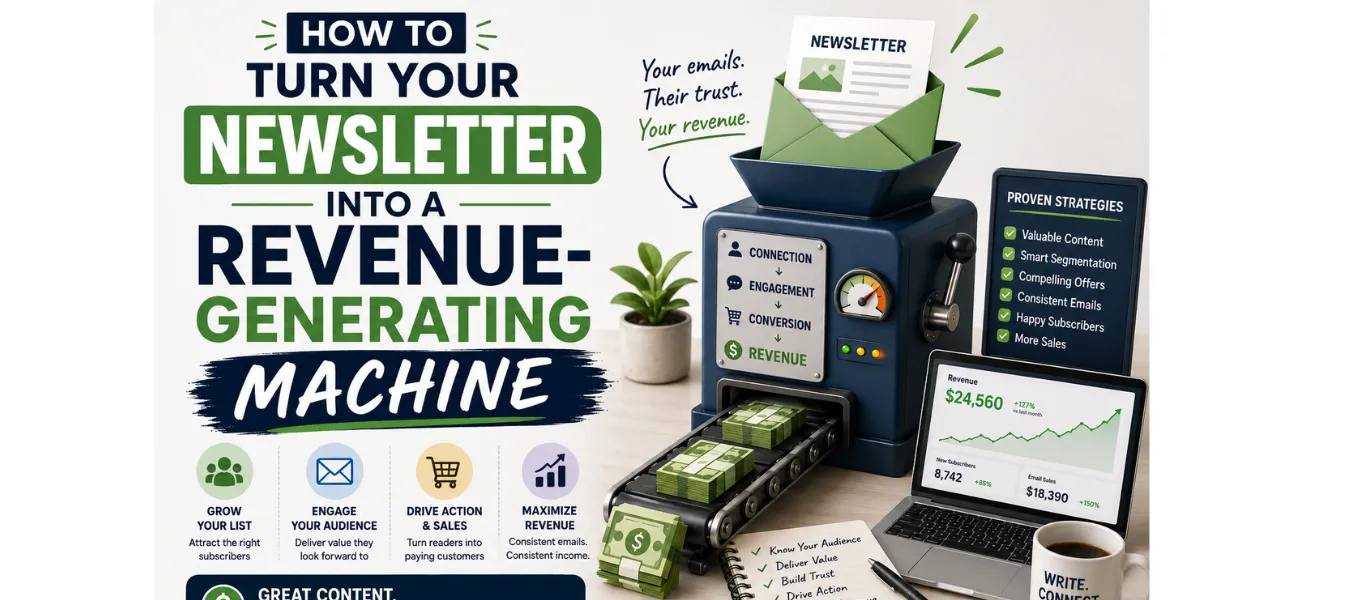
How to Turn Your Newsletter Into a Revenue-Generating Machine
Introduction
Morning Brew built a $36 million revenue machine in six months. The Hustle sold for $27 million. And right now, smaller newsletters — ones with a few thousand engaged subscribers — are generating thousands of dollars every single month.
Here is the part most creators miss: you do not need 100,000 subscribers to start earning. You need the right monetization system.
Most newsletter creators are sitting on a goldmine and treating it like a hobby. They write great content, grow their list steadily, and then wonder why revenue never follows. The problem is not the newsletter. It is the absence of a deliberate, strategic approach to turning that audience into income.
The data backs this up. Email generates $36 for every $1 spent. Paid subscriptions on platforms like Beehiiv jumped 138% year over year in 2025. Newsletter sponsorships can command $3,000 for a single ad slot—even with niche audiences as small as 500 readers.
In this guide, you will get the complete, practical blueprint to turn your newsletter into a revenue-generating machine — with six proven monetization strategies, real copy templates, and the exact systems that work regardless of your list size.
Let us build something that pays you.
Why Your Newsletter Is Already Worth More Than You Think
Before we get into the strategies, let us reframe how you see your list.
Your newsletter is not just an email list. It is a direct line to an audience that voluntarily opted in to hear from you. No algorithm. No pay-to-play. No competing for attention in a crowded feed.
54% of organizations generate 20% or more of their total revenue through email marketing. That number is not dominated by massive corporations. It includes solo creators, small brands, and niche experts who understood one thing: an engaged email list is the most valuable asset in digital marketing.
Here is what makes your newsletter uniquely powerful as a revenue channel:
- You own it. Instagram can change its algorithm tomorrow. Google can deindex your site. Your email list belongs to you — permanently.
- Your subscribers chose you. Every person on your list made an active decision to hear from you. That consent creates a relationship that social media followers never replicate.
- Engagement compounds. The longer someone stays on your list and opens your emails, the more they trust you — and the more likely they are to buy from you, refer others, and become long-term customers.
The creator who sends weekly emails to 3,000 engaged subscribers in a specific niche will consistently outperform the influencer with 50,000 passive social followers when it comes to revenue per audience member.
Now let us unlock that revenue.
The 6 Proven Newsletter Monetization Strategies (And How to Choose the Right One)
Not every monetization model works for every newsletter. The right strategy depends on your audience size, niche, and how much time you want to invest. Here are the six most powerful options — and when to use each one.
Strategy 1 — Newsletter Sponsorships
Best for: Newsletters with 500+ engaged subscribers in a defined niche.
Newsletter sponsorships are one of the fastest ways to generate revenue without creating your own product. A brand pays you to feature their product or service in your newsletter—in a dedicated ad slot, sponsored section, or native recommendation.
The numbers are irresistible: A single sponsored slot can command $3,000 in premium newsletters. Even smaller niche newsletters with 500–1,000 highly targeted subscribers can charge $100–$500 per placement—because advertisers pay for relevance, not just reach.
Here is the game-changing insight: CPM (cost per thousand subscribers) is not the only metric sponsors care about. A health newsletter with 800 fitness founders is worth more to a supplement brand than a general lifestyle newsletter with 50,000 unengaged readers.
How to pitch your first sponsor:
- Build a simple media kit—list your subscriber count, open rate, click rate, and audience demographics
- Identify 5–10 brands whose products you already use and genuinely recommend
- Send a cold pitch email (template below) with your media kit attached
- Start with a discounted “pilot” rate to get your first testimonial
- Raise your rates after delivering results
Plug-and-play sponsor pitch email:
Subject: Partnership opportunity — [Your Newsletter Name] x [Brand Name]
Hi [Name],
I run [Newsletter Name] — a weekly newsletter for [your audience description] with [X] subscribers and a [X%] open rate.
Our readers are [specific audience profile — e.g., “ecommerce founders spending $500+ per month on marketing tools”].
I think [Brand Name] would be a natural fit for our audience, and I would love to feature you in an upcoming edition.
I am offering a discounted pilot placement at $[X] — half my standard rate — so you can see the results before committing to a full campaign.
Would you be open to a quick 15-minute call this week?
[Your Name] [Newsletter Name] | [Subscriber Count] subscribers | [Open Rate]% open rate
Strategy 2 — Paid Newsletter Subscriptions
Best for: Creators with a loyal audience who trust your expertise and want exclusive access.
Paid subscriptions are the strongest-performing revenue channel in newsletters right now. Beehiiv data shows paid subscription revenue jumped from $8 million to $19 million in 2025 — a 138% increase — driven by niche creators delivering specialized expertise.
The model is simple: free subscribers get your regular newsletter. Paid subscribers get additional value — exclusive issues, deeper analysis, templates, community access, or early product releases.
You do not need a massive list. 100 paid subscribers at $10/month = $1,000 monthly recurring revenue. 500 at $15/month = $7,500. The math becomes compelling fast.
What to offer in your paid tier:
- Exclusive weekly deep-dive issues
- Monthly Q&A or office hours
- Access to your resource library — templates, swipe files, checklists
- Behind-the-scenes content and case studies
- Direct access to you—a private community or reply thread
Platform recommendation: Beehiiv and Substack both handle paid subscriptions natively. For e-commerce brands, Klaviyo premium segments can replicate the tiered content experience.
Pricing sweet spot: $7–$15/month for individual subscribers. $49–$99/year for annual plans (offer 20% savings to encourage annual commitments).
Strategy 3 — Selling Your Own Products and Services
Best for: Any newsletter creator — this is your highest-margin revenue strategy.
This is the primary way newsletter creators generate revenue, according to HubSpot’s 2025 State of Newsletters Report. And it makes complete sense — your newsletter is essentially a warm sales channel for whatever you offer.
The subscribers on your list already trust you. Every issue you send builds that trust deeper. When you introduce a product or service, you are not selling to strangers — you are making an offer to an audience that has been waiting for you to tell them how to go further.
What you can sell:
- Digital products—ebooks, swipe files, templates, courses, workshops
- Services — done-for-you copywriting, consulting, coaching, audits
- Physical products—if you run an e-commerce brand, your newsletter is your most powerful sales channel
- Affiliate products — more on this in Strategy 5
The revenue multiplication system: Here is the proven approach — use your newsletter content to pre-sell your products by demonstrating your expertise in every issue. By the time you send a product launch email, your readers already believe you can deliver.
Apply the BAB formula to your product announcement:
[Before]
You are spending hours every week writing emails from scratch — with no system, no templates, and no clear conversion path. Your list is growing but your revenue is not following.
[After]
Imagine having a complete email swipe file — every sequence, every template, every subject line — ready to load into Klaviyo and start generating revenue this week.
[Bridge]
That is exactly what [Product Name] delivers. [X] done-for-you email templates for [specific use case], built on the same frameworks the top ecommerce brands use to generate [result].
Strategy 4 — Affiliate Marketing in Your Newsletter
Best for: Newsletters in any niche — low barrier to entry, immediate revenue potential.
Affiliate marketing is one of the most effortless ways to start generating newsletter revenue without creating anything. You recommend products you already use, include a trackable link, and earn a commission on every sale your recommendation drives.
The critical rule: Only recommend products you genuinely use and believe in. Your subscribers trust your recommendations. The moment you recommend something mediocre for a commission, that trust fractures—and trust is your most valuable newsletter asset.
High-converting affiliate recommendation template:
Subject: The tool I have been using every week (and why it matters for you)
[First Name],
I want to tell you about something I started using three months ago that has completely changed how I [relevant outcome].
[Product Name] is [one-line description]. Here is what it does for me specifically:
→ [Specific result 1] → [Specific result 2] → [Specific result 3]
I was skeptical before I tried it. Now it is a non-negotiable part of my [workflow/stack/routine].
If you are dealing with [a specific problem your readers have], I think you should try it.
[MY AFFILIATE LINK — [PRODUCT NAME] →]
Disclosure: This is an affiliate link. If you purchase, I earn a small commission at no extra cost to you. I only recommend tools I use personally.
[Your Name]
Affiliate programs worth joining for email/marketing newsletters:
- Klaviyo Partner Program
- Beehiiv Affiliate Program
- ConvertKit (Kit) Affiliate Program
- Gumroad (for digital product recommendations)
- Canva Affiliate Program
Strategy 5 — Newsletter Swaps and Co-Promotions
Best for: Newsletters with 500+ subscribers looking to grow revenue without spending.
Newsletter swaps are an underutilized but explosive monetization strategy—especially for smaller newsletters. You feature another newsletter creator’s content to your audience, and they do the same for you. Both newsletters grow. Both audiences benefit.
This directly grows your subscriber count, which increases your sponsorship rates, your paid tier revenue, and your product sales simultaneously.
For revenue generation specifically, co-promotions work when you partner with a complementary brand or creator and offer their product to your audience as an affiliate. You introduce their offer—they pay you a flat fee or revenue share.
Strategy 6 — Selling the Newsletter Itself
Best for: Creators who have built an engaged, monetized newsletter asset.
This is the long game—and it is worth knowing about from day one because it changes how you build.
The Hustle sold for $27 million. Smaller newsletters sell regularly for 24–36 times their monthly revenue. If your newsletter generates $5,000 per month, it could sell for $120,000–$180,000.
You do not need to plan to sell. But building your newsletter like an asset—consistent brand, documented systems, and diversified revenue streams—means you have the option. And that option is worth more than most creators realize.
How to Turn Your Newsletter Into a Revenue-Generating Machine: The 90-Day System
Here is the exact, step-by-step roadmap to go from zero newsletter revenue to your first $1,000 per month — in 90 days:
Month 1 — Foundation (Days 1–30)
Week 1–2: Define your monetization model
- Choose your primary strategy (sponsorships, paid tier, or own products)
- Set your 90-day revenue target
- Audit your current open rate and click rate
Week 3–4: Build the infrastructure
- Create a simple media kit (even a one-page PDF works)
- Set up a paid tier or product landing page
- Write your first sponsored content guidelines document
Your Month 1 goal: Have your monetization infrastructure ready before you need it.
Month 2 — First Revenue (Days 31–60)
Week 5–6: Land your first sponsor or make your first product offer
- Send 10 cold sponsor pitches using the template above
- OR launch a beta version of your paid tier at a discounted rate
- OR promote your first affiliate product with a dedicated email
Week 7–8: Optimise and iterate
- Track which revenue email generated the most clicks
- A/B test your pitch email subject lines
- Follow up with sponsors who did not reply
Your Month 2 goal: Generate your first dollar of newsletter revenue.
Month 3 — Scale (Days 61–90)
Week 9–10: Add a second revenue stream
- Layer in affiliate marketing alongside sponsorships or products
- Create a newsletter swap partnership with a complementary creator
- Launch a paid tier if you started with sponsorships
Week 11–12: Build recurring revenue systems
- Set up a consistent sponsorship calendar—sell slots 4–6 weeks in advance
- Create an automated sequence that introduces new subscribers to your paid tier
- Launch your first digital product (even a $17 template pack)
Your Month 3 goal: $1,000 per month in newsletter revenue from at least two streams.
The AIDA Framework Applied to Newsletter Monetization
Most newsletter creators make the fatal mistake of treating their monetization emails like sales pitches. They are not. They are value deliveries with a revenue opportunity attached.
Here is how to apply the AIDA formula to any newsletter revenue email:
[Attention] — Open with something that makes the reader stop scrolling. A surprising stat, a relatable problem, or an open loop that demands resolution.
“I almost missed the tool that cut my email writing time in half.”
[Interest] — Build relevance. Why should your reader care about what you are about to share?
“If you spend more than 3 hours per week writing your newsletter — this matters to you.”
[Desire] — Make them want it. Use benefits, transformation language, and social proof.
“[Tool Name] has saved me 4 hours per week since I started using it in January. My open rates went up 12%. My stress went down significantly. And my readers say the content has never been better.”
[Action] — One clear, specific CTA. No options. One direction.
“[TRY [TOOL NAME] FREE FOR 14 DAYS →]”
Frequently Asked Questions
How many subscribers do I need before I can monetize my newsletter? You can start monetizing with as few as 500 highly engaged subscribers in a defined niche. Sponsorships are accessible at 500–1,000 subscribers if your open rate is strong and your audience is specific. Affiliate marketing and digital product sales have no subscriber minimum — the key is engagement and trust, not list size. According to beehiiv data, the median time to a first dollar for newsletters launched in 2025 dropped to just 66 days.
What are the most profitable newsletter monetization strategies? Selling your own products and services consistently generates the highest margins because there is no commission split. Paid subscriptions create the most predictable, recurring revenue. Sponsorships generate the fastest cash — especially if you have a niche audience. The most successful newsletters use all three simultaneously, creating diversified revenue that is not dependent on any single stream.
How much can a newsletter with 5,000 subscribers earn? Revenue varies significantly based on niche, engagement, and monetization strategy. A 5,000-subscriber newsletter with a 40%+ open rate in a business or marketing niche can realistically generate $2,000–$8,000 per month through a combination of sponsorships ($500–$1,500 per placement), affiliate commissions ($300–$800/month), and digital product sales ($500–$2,000/month). Paid subscriptions at even a 2% conversion rate (100 paid subscribers at $10/month) add another $1,000 in monthly recurring revenue.
Should I charge for my newsletter or keep it free? Start free and add a paid tier once you have proven your content delivers consistent value. A free list of 1,000 engaged subscribers is more valuable than a paid list of 100 if it means you can build trust, demonstrate expertise, and convert at higher rates for premium offers. The sweet spot for most creators is a free tier that delivers genuine value and a paid tier that goes significantly deeper — not just “more of the same.”
How do I find newsletter sponsors for a small list? Focus on relevance over reach. Brands sponsoring niche newsletters are paying for access to a specific, qualified audience — not just eyeballs. Build a media kit, identify brands whose products you already use and recommend organically, and pitch them directly via email or LinkedIn. Starting with a discounted pilot rate removes the risk for the advertiser and gives you results to build your rate card around. Newsletter swap partnerships with similar-sized newsletters can also introduce you to potential sponsors from adjacent niches.
Conclusion
Your newsletter is not just content. It is a revenue engine — and with the right monetization system, it can pay you every single month on an increasingly predictable schedule.
Imagine opening your dashboard on a Monday morning to see sponsorship income, paid subscriber renewals, affiliate commissions, and product sales — all generated by the newsletter you already send to the audience you already have.
Email generates $36 per dollar spent. Paid subscriptions jumped 138% in 2025. Sponsorships command $3,000 per placement. Morning Brew built $36 million in revenue. The infrastructure is proven. The opportunity is real.
Start with one strategy. Build it properly. Add a second stream in month two. By month three, your newsletter generates income you can rely on.
And if you want help writing the emails behind your newsletter monetization — the product launches, the sponsor placements, the paid tier pitches — that is exactly what I do at blogwithjawed.com. Let us make your newsletter pay.