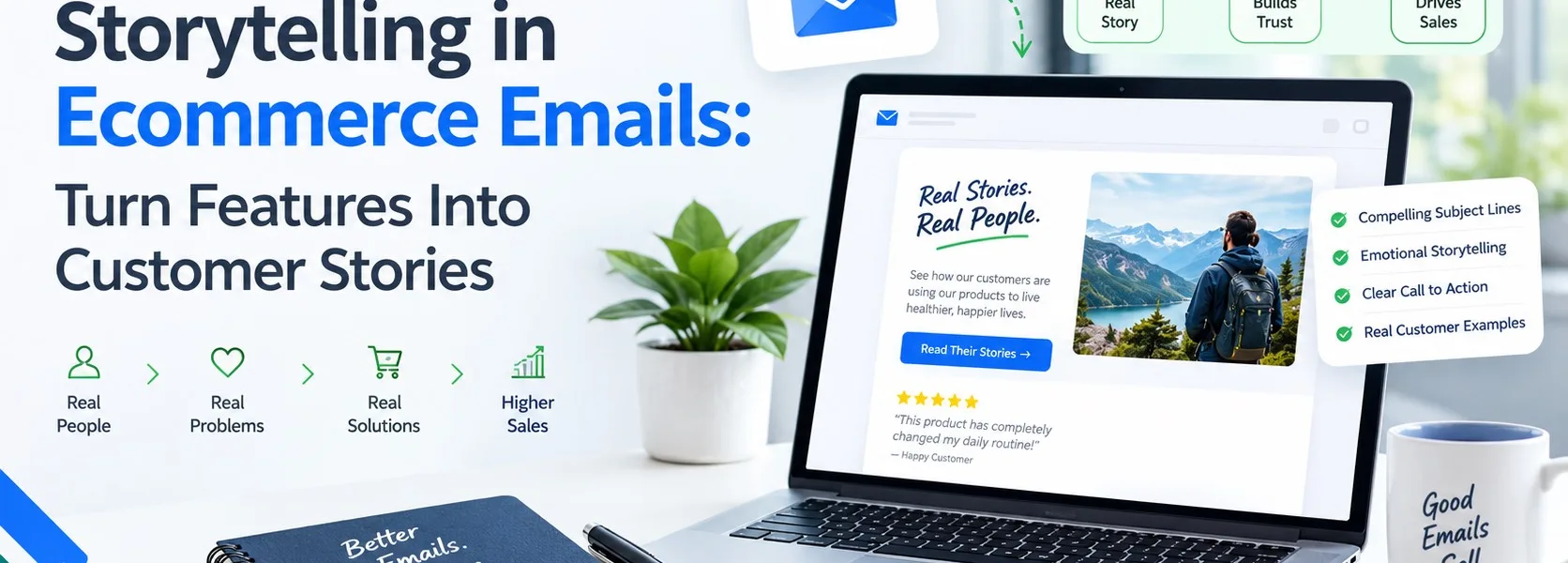
Storytelling in Ecommerce Emails:
A product page can list materials, dimensions, ingredients, or technical specifications. An email has a tougher job: help a subscriber understand why those details matter in their day. That is where storytelling in ecommerce emails helps. Instead of stacking features into a sales pitch, you connect one useful detail to a real customer situation, a clear benefit, and a sensible next step.
Good storytelling does not mean inventing a dramatic tale or hiding product facts. It means choosing a truthful, relevant angle that helps the reader picture how a product fits into their life. This guide gives you a repeatable framework, examples, and templates you can adapt to your store.
What storytelling means in an ecommerce email
Story-led copy puts the product inside a context the customer recognizes. A feature is what the product has; a benefit is what that feature can help the customer do; a story shows the moment when that benefit matters.
- Feature: A travel mug has a locking lid.
- Benefit: It can help reduce spills when carried in a bag.
- Story angle: A rushed commute, a packed tote, and one less thing to worry about.
This is a copywriting illustration, not a claim about a specific product. Before publishing, confirm the feature and any performance statement against product specifications. Storytelling should make facts easier to imagine—not make them bigger than they are.
For the brand-level narrative behind a product, see Shopify’s guide to building a brand story. The same principle applies to email: connect what the brand makes with why it matters to the people it serves.
The feature-to-story framework
Use this five-part sequence to turn a dry specification into customer-focused copy.
- Feature: Name one concrete, verifiable product detail.
- Context: Describe a situation in which the detail becomes relevant.
- Benefit: Explain what it may help the customer do, feel, or decide.
- Proof: Support the story with accurate specifications, a demonstration, a real review used with permission, or a clear product photo.
- Call to action: Offer one logical next step, such as exploring the product or seeing how it works.
For example, “made with a removable, machine-washable cover” is a feature. A useful story might describe a family sofa after a busy weekend, then explain that the removable cover makes routine care more manageable—if the care label confirms machine washing. The CTA could be “See care details.” That is more specific and trustworthy than saying the sofa will “stay perfect forever.”
Five story angles to try
1. The everyday problem
Begin with a familiar friction point, then show how a verified product detail relates to it. A desk organiser might help someone keep charging cables and stationery in one place. A lunch container with separate compartments may help keep ingredients apart until lunchtime. Keep the problem proportionate; do not make ordinary inconveniences sound catastrophic.
2. The product in use
Take readers through a moment of use: packing for a weekend, preparing breakfast, setting up a home office, or choosing an outfit for a busy day. Show the sequence rather than simply calling the product “amazing.” Product-use stories are especially helpful when shoppers need to understand size, setup, compatibility, care, or practical use cases.
3. The reason it was created
A founder or product-development story can explain the problem the team wanted to solve, the trade-off they considered, or why a material or design was chosen. Keep the story specific and documented. If the brand cannot verify a founder anecdote, sourcing statement, or sustainability claim, leave it out.
4. The craft behind the detail
Explain a manufacturing choice, ingredient, design decision, or quality-control step when you can substantiate it. A close-up photo and a short explanation can be more useful than a string of superlatives. Avoid implying that a product is handmade, locally sourced, certified, or environmentally superior unless the claim is accurate and supportable.
5. A real customer’s experience
Customer stories can make a product easier to picture, but use genuine feedback, obtain any permission required for names, photos, or quotations, and preserve the customer’s meaning. Do not turn one person’s experience into a promise that everyone will get the same result. If you lack permission or reliable evidence, use a clearly labelled hypothetical scenario instead of a fake testimonial.
For more on using customer evidence, read social proof in ecommerce emails.
A simple structure for a story-led email
- Subject line: Open a relevant question or moment without promising something the email cannot deliver.
- Opening: Set up the customer situation in one or two sentences.
- Product bridge: Introduce the feature that matters in that situation.
- Evidence: Add a specification, image, demonstration, or verified customer quote.
- CTA: Make the next step clear and match it to the reader’s intent.
For a storage product, a subject line might be “A calmer start to your workday.” The opening can describe the frustration of searching for small desk essentials. The body then shows how the product’s compartments organise those items, using only details the product actually has. “Explore the organiser” is direct without implying that buying it will solve every productivity problem.
For examples of email formats that combine education, product details, and narrative, explore Shopify’s ecommerce email examples and Klaviyo’s collection of brand email examples.
Three adaptable storytelling email templates
Template 1: Product feature spotlight
Subject: A simpler way to [customer task]
Preview text: See how [verified feature] can help with [specific use case].
Hi [First name],
When you’re [recognisable situation], [customer problem] can get in the way. That’s why we designed [Product] with [verified feature]. It helps you [specific, supportable benefit] without [relevant friction, if true].
Take a closer look at [detail or demonstration] to see whether it fits your routine.
CTA: Explore [Product]
Template 2: Behind-the-product story
Subject: Why we chose [material/design detail]
Preview text: A quick look at the thinking behind [Product].
When we developed [Product], we wanted to address [documented customer need]. We considered [verified design choice] because [accurate reason]. The result is [specific product attribute] designed for [relevant use case].
Here’s a closer look at the detail and how to use or care for it.
CTA: See how it’s made
Use this template only when the development story and reasons are documented. If the team did not follow the process described, do not present it as fact.
Template 3: Customer story or use case
Subject: How [customer or audience] uses [Product]
Preview text: One practical way to make [task] easier.
[With permission, introduce the customer and their relevant situation in their own words.] They use [Product] for [specific use case]. The detail that matters most to them is [verified feature or accurately quoted feedback].
Every routine is different, so explore the details and decide whether it suits yours.
CTA: See the product details
If no real customer story is available, use a hypothetical use case and label it internally as such; never publish a made-up customer quote or result.
Where story-led copy fits in your email calendar
- Welcome email: Explain why the brand exists and connect that purpose to one useful product or category.
- Product launch: Show the customer need behind the new product, then introduce the relevant design choices.
- Browse abandonment: Help the shopper evaluate a product they viewed with a practical use case, sizing detail, care note, or compatibility answer.
- Post-purchase: Show how to get started, care for the product, or use it well. Do not turn every helpful message into an immediate upsell.
- Review or loyalty email: Invite authentic customer feedback or show how the community uses the product, with appropriate permission.
Connect a brand-story welcome message to this ecommerce welcome email sequence guide. Each message should add a useful detail rather than repeat the same pitch.
Common storytelling mistakes to avoid
- Turning every feature into a long story: Choose one angle that matters and keep extra details on the product page.
- Using vague emotional language: “Feel incredible” is hard to evaluate. A concrete use case is easier to understand.
- Inventing proof: Do not create fake reviews, customer outcomes, founder stories, or unsupported performance claims.
- Hiding practical details: Price, size, ingredients, delivery terms, compatibility, limitations, and care instructions still matter when relevant.
- Overloading the email: Keep one main message and one primary CTA. Let the product page answer deeper questions.
- Ignoring brand voice: A playful brand can tell a playful story; a premium or technical brand may need a quieter, more precise one.
How to test whether the story helps
Do not assume a story-led email performs better simply because it reads well. Test it against a clear alternative. For example, compare a story-led opening with a straightforward feature-led opening while keeping the offer, audience, send time, and design as consistent as practical.
Choose a metric that matches the goal: click-through rate for product exploration, conversion rate or revenue per recipient for purchases, and replies for feedback. Monitor unsubscribes and complaints too. Use enough data for a useful comparison, and avoid changing several elements at once if you want to understand what influenced the result.
Pre-send checklist
- Does the story focus on a real customer need or use case?
- Is every product feature and factual claim verified?
- Does the reader understand why the detail matters?
- Is any customer quote, photo, or personal detail authentic and properly approved?
- Does the subject line match the email content?
- Is there one clear next step?
- Have links, product details, offer terms, and mobile rendering been checked?
Final takeaway
The best storytelling in ecommerce emails does not add drama to a product. It adds context. Start with one verified feature, place it in a familiar customer situation, explain the practical benefit, support the message with honest evidence, and invite the reader to take a relevant next step. That approach keeps your copy human, specific, and useful—without relying on exaggerated claims.