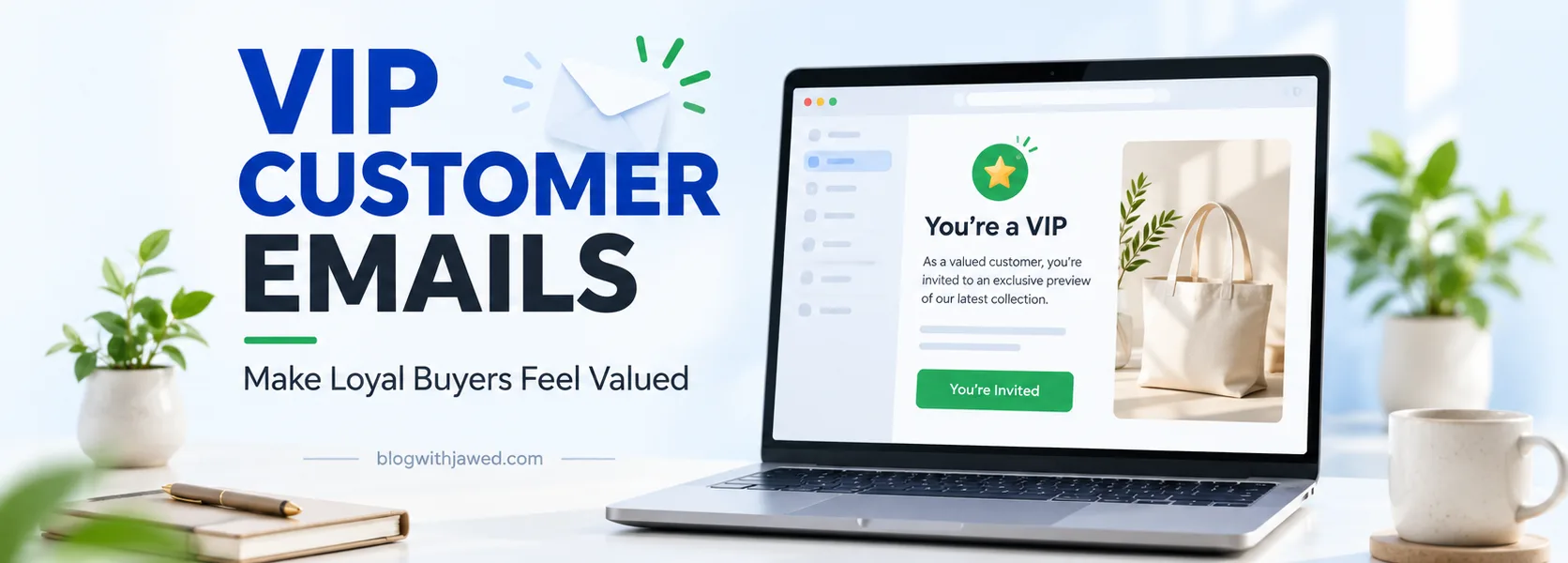
VIP email copywriting for ecommerce starts with a simple question: what can you offer loyal customers that makes their relationship with your brand more useful? Calling someone a VIP is easy. Giving that label meaning takes clear benefits, accurate targeting, and messages that respect their attention.
A repeat buyer may appreciate early access, relevant product advice, or an invitation to influence your next launch. They may not need another discount. This guide explains how to write exclusive customer emails with a practical structure, three illustrative templates, and a checklist for measuring what happens next.
What makes a customer a VIP?
Define the audience before writing the subject line. You might recognize customers by repeat purchases, spending, recent activity, or membership in a loyalty program. The right criteria depend on your products, margins, and buying cycle. A frequent coffee buyer and an occasional furniture buyer should not automatically face the same threshold.
Klaviyo’s VIP segmentation guidance describes ways to combine purchase behaviour and eligibility for marketing messages. Use those ideas as a starting point, then inspect the actual customers in your segment. Check whether they reflect the relationship you intend to reward.
An illustrative rule for a fictional candle store could recognize customers who have ordered several times within the previous year and can receive email marketing. That is a planning example, not a recommended threshold for every shop. Decide what qualifies someone, what they receive, and whether membership expires.
For broader audience planning, read our guide to email segmentation for ecommerce. This article focuses specifically on the copy inside VIP campaigns, rather than building an entire loyalty programme.
Give exclusivity a real benefit
A message feels exclusive when the experience differs meaningfully from an ordinary campaign. Consider early access to a collection, an invitation to a small online event, a useful service, or a chance to share product feedback. Choose an offer you can deliver consistently.
If everyone receives the same promotion, avoid describing it as available only to VIPs. If early access opens today and the public launch follows tomorrow, explain that sequence accurately. A specific privilege is more persuasive than vague promises about special treatment.
Check operational details before drafting: stock availability, access controls, delivery locations, booking capacity, and customer support. An attractive email cannot fix a broken member link or a reward that customers cannot redeem. Ask the fulfilment or support team to review anything they will need to honour.
A five-part VIP email copywriting structure
First, recognize the relationship. A short thank-you is enough. Use a genuine reason, such as returning to your store or joining your programme, rather than exaggerated flattery. Do not reveal sensitive spending details merely to prove personalization.
Second, state the benefit early. Readers should understand what they can access without searching through several paragraphs. Replace “Something amazing is coming” with a clear invitation to preview a collection or book a consultation.
Third, explain why the benefit matters. Translate the offer into a useful experience: more time to compare options, help selecting a size, or a chance to influence a product. Keep claims connected to what the offer actually delivers.
Fourth, explain relevant conditions. Include a genuine deadline, eligibility requirement, booking limit, or access instruction when necessary. Keep important terms visible and readable. Avoid hiding material restrictions behind an enthusiastic headline.
Fifth, give one clear next step. A button such as “Preview the collection” communicates more than “Click here.” Match the destination to the promise, and avoid sending members to a homepage where they must search again.
Template 1: early access without pressure
The following templates are original illustrative examples for fictional brands. They are not real client campaigns, testimonials, or evidence of revenue growth. Replace placeholders and verify every benefit before sending.
Subject: Your first look at our new collection
Preview text: A preview for returning customers, before the public launch.
Hi [First Name],
Thank you for choosing [Brand Name] again. We would like to give you a first look at [Collection Name].
Your preview opens on [Date and Time]. The collection becomes available to everyone on [Public Launch Date and Time]. You can explore the colours, materials, and product details before deciding what fits your routine.
Use your member link below to view the collection. Availability follows our normal stock policy, and early access does not reserve an item.
CTA: Preview the collection.
Why it works: the message explains the privilege and its limits. Use this template only when the preview is genuinely restricted and the launch dates are confirmed.
Template 2: appreciation with a useful service
Subject: A personal thank-you, plus help choosing your next fit
Preview text: Your member styling consultation is ready to book.
Hi [First Name],
We appreciate your continued support of [Brand Name]. As part of your membership, you can book [Service Description] with our team.
Bring your questions about [Relevant Topic]. We will help you compare suitable options and explain the details, so you can decide what works for you.
Appointments are available on [Dates]. Check the booking page for eligible locations, appointment length, and any applicable conditions.
CTA: Choose an appointment
Why it works: the email rewards the relationship with practical help. Remove the invitation if the service is unavailable, and clearly disclose any charge instead of allowing readers to assume it is free.
Template 3: invite customers to contribute
Subject: Help us choose what comes next
Preview text: Share your preferences in our short member survey.
Hi [First Name],
You have spent time with our products, and we would like to hear what matters most to you.
Our member survey asks about [Topic One] and [Topic Two]. Your feedback will help our team understand customer priorities as we plan future products.
The survey takes approximately [Verified Completion Time]. Participation is optional. We will share the main themes we learn, without identifying individual respondents.
CTA: Share your preferences
Why it works: customers receive a clear invitation and understand how their input will be used. Do not promise that every suggestion will become a product. Make sure your feedback process matches the privacy statement.
Personalize for relevance, not surveillance
A first name alone does not make a campaign relevant. Consider product category, purchase stage, location, or preferences the customer deliberately shared. Recommend something useful rather than displaying everything your tracking system knows.
Use fallback text when names or preferences are missing. Exclude unsuitable offers and customers with unresolved service issues when appropriate. Coordinate VIP campaigns with other messages so loyal buyers do not receive multiple overlapping promotions.
For your wider messaging plan, our guide to reducing email unsubscribe rates explains how relevance and expectations shape the subscriber experience.
Measure the relationship and the offer
Review clicks, completed bookings, redemptions, purchases, unsubscribes, and feedback according to the campaign’s purpose. A survey invitation should not be judged only by immediate sales. Compare similar audiences and account for seasonality, product availability, and overlapping promotions.
Platform attribution tells you how activity was credited; it does not prove that every purchase was caused by the campaign. Where practical, compare with a suitable holdout group to assess incremental impact. Avoid declaring success from a handful of responses.
Test one meaningful copy change at a time, such as the subject line or benefit headline. Keep the offer and audience comparable. Record what changed, what happened, and what remains uncertain before applying the result to future campaigns.
Before you send
Confirm eligibility, consent, and exclusions. Test the member link, offer terms, mobile layout, name fallback, and unsubscribe process. Verify that support can answer questions and fulfil the promise. Read the email as a customer: is the benefit obvious, and is the next step easy?
Good VIP customer email copywriting makes recognition tangible. Thank people clearly, offer something relevant, and keep your promises. The strongest starting point is a benefit worth receiving, expressed in language customers can understand.